The Universe is everything that exists. It encompasses all of space, time, matter, and energy. From the smallest subatomic particles to the largest superclusters of galaxies, everything we know, observe, and interact with is contained within the universe. Understanding the cosmos—its vast scale, mysterious composition, and ultimate fate—is humanity’s greatest scientific endeavor.
The Humbling Scale of the Universe
Looking up at the night sky is a humbling experience. It makes you realize that our entire planet is just a tiny speck in an unimaginably vast ocean of stars and galaxies. Every twinkle above us represents mysteries waiting to be solved, and the sheer scale of the universe reminds us how small we are compared to the endless cosmos.
This perspective is powerful because it teaches both wonder and humility. While we may feel insignificant in the grand scheme of things, it also shows that we are part of something extraordinary. The universe is a reminder that life is precious, and our curiosity to explore it connects us to the infinite possibilities beyond our world.
| The Observable Universe | |
|---|---|
| Age | ~13.8 Billion Years |
| Observable Diameter | ~93 Billion Light-Years |
| Estimated Galaxies | Up to 2 Trillion |
| Total Stars | ~200 Billion Trillion (2 × 10²³) |
| Average Temp | ~2.725 Kelvin (-270.4°C) |
| Expansion Rate | ~70 km/s/Mpc (Hubble Constant) |
| Composition | 68% Dark Energy, 27% Dark Matter, 5% Normal Matter |
| Shape | Flat (with a tiny margin of error) |
| Current Era | The Stelliferous Era |
1. The Scale of the Cosmos
The human brain struggles to comprehend the sheer size of the universe. When scientists talk about the universe, they generally refer to the Observable Universe. Because light takes time to travel, and the universe is 13.8 billion years old, we can only see light that has had enough time to reach us since the Big Bang.
Because space has been rapidly expanding that entire time, the edge of our observable bubble is currently about 46.5 billion light-years away in every direction. This makes the observable universe roughly 93 billion light-years across. What lies beyond this boundary? Most cosmologists believe the unobservable universe is simply more of the same, stretching on infinitely.
2. The Ultimate Time Machine
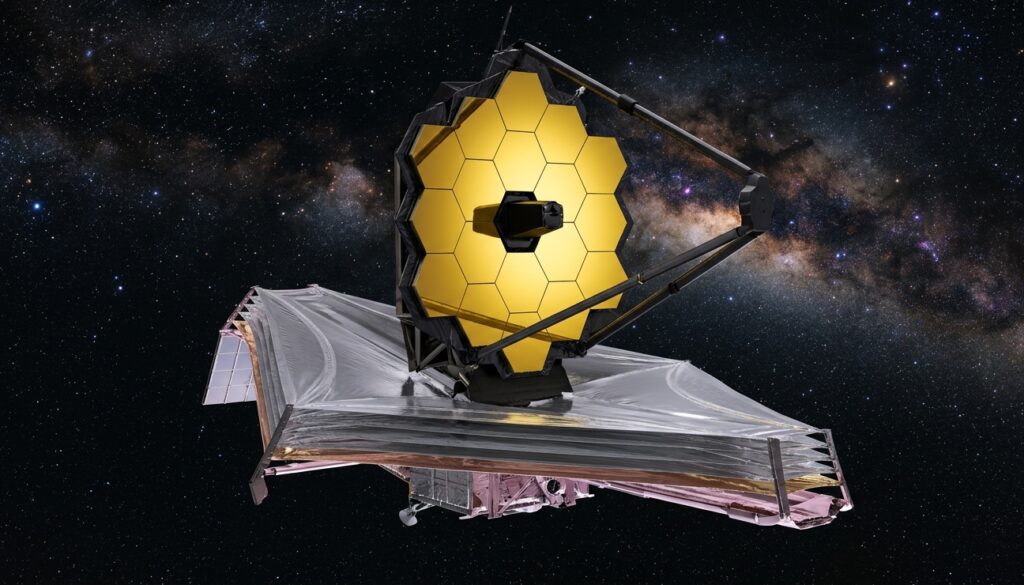
Because the universe is so vast, light takes time to travel across it. When you look at the Sun, you are seeing it as it was 8 minutes ago. Telescopes are literal time machines. When astronomers use advanced tools like the James Webb Space Telescope to look at galaxies billions of light-years away, they are actually seeing the universe exactly as it looked billions of years in the past, near the dawn of creation.
3. How Did It All Begin?
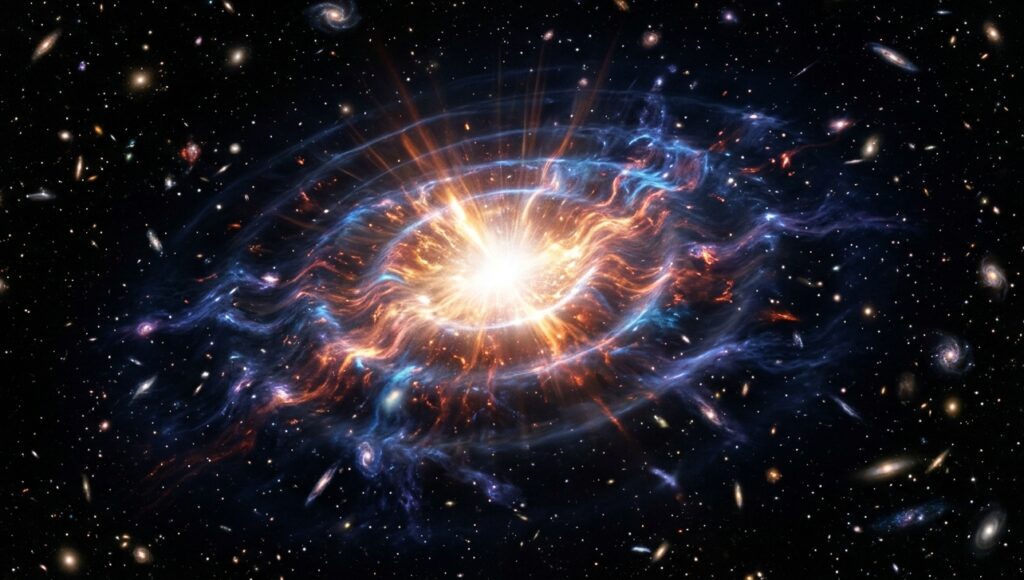
Roughly 13.8 billion years ago, everything in existence—all matter, energy, space, and time—was compressed into an infinitely dense singularity. Through the event known as the Big Bang, space itself began to rapidly expand. As the universe cooled, subatomic particles formed the first atoms. Over billions of years, gravity pulled these cosmic gases together to ignite the very first stars and form the primordial galaxies.
4. What is the Universe Made Of?
Perhaps the most shocking discovery in modern astronomy is that everything we can see, touch, and interact with makes up only a tiny fraction of existence. The universe is divided into three main components:
- Normal Matter (5%): Every star, planet, rock, atom, and human being in existence accounts for roughly 5% of the universe.
- Dark Matter (27%): This is an invisible substance that emits no light or energy. We only know it exists because of its gravitational pull. Dark matter acts as the invisible scaffolding of the universe, holding galaxies together so they don’t spin apart.
- Dark Energy (68%): This is the most mysterious force in physics. Dark energy is a repulsive force embedded in the fabric of space itself, actively pushing galaxies away from each other and causing the universe to expand at an accelerating rate.
5. Structure: The Cosmic Web
The universe is not just a random scattering of stars. It is highly organized into a massive, sponge-like structure known as the Cosmic Web.
Stars are grouped into galaxies. Our home, the Milky Way, contains hundreds of billions of stars. Galaxies are then grouped into clusters, which are further grouped into massive superclusters. The Milky Way belongs to the Laniakea Supercluster (Hawaiian for “immense heaven”), a colossal structure containing roughly 100,000 galaxies spanning 500 million light-years across. Between these bright filaments of galaxies are massive, empty voids of nothingness.
6. The Crisis in Cosmology
Today, astronomers are facing a massive problem known as the Hubble Tension. This is a severe discrepancy in measuring how fast the universe is expanding.
When scientists measure the expansion using the leftover radiation from the Big Bang, they get one speed. But when they measure it using local, modern stars and supernovae, they get a significantly faster speed. Despite rigorous verification, the gap stubbornly refuses to close. This tension suggests our Standard Model of Cosmology is missing a crucial piece of the puzzle—perhaps an undiscovered particle or a completely new law of physics.
7. How Will the Universe End?
Just as the universe had a beginning, it will likely have an end. Based on the overwhelming presence of Dark Energy, scientists predict the universe will experience a Big Freeze (or Heat Death).
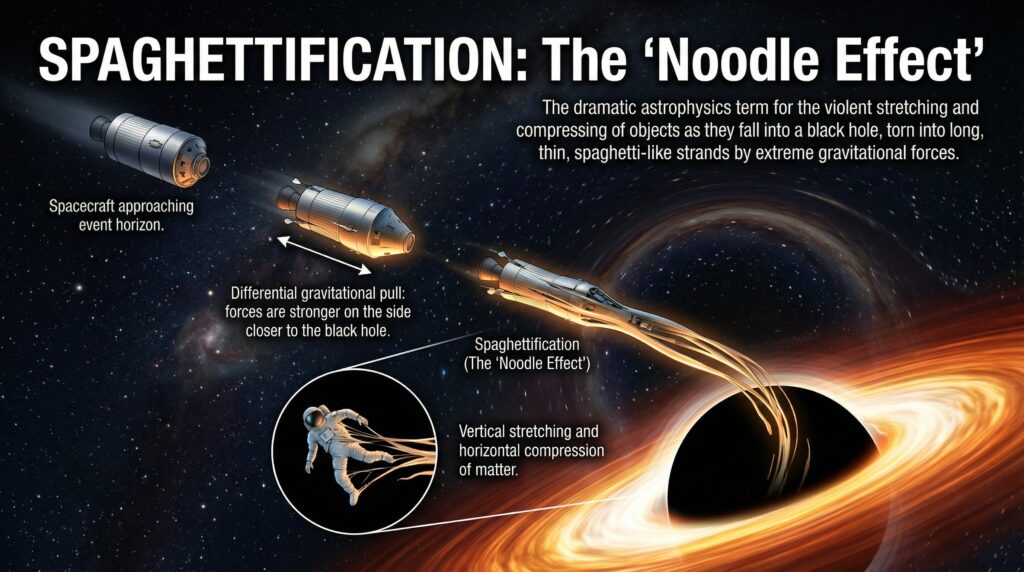
Trillions of years from now, the expansion of space will push galaxies so far apart that they can no longer be seen from one another. The stars will exhaust their nuclear fuel and burn out, leaving behind only black holes and cold, dead rock. Eventually, even the black holes will evaporate into radiation, leaving the universe completely dark, freezing, and uniform.