
Albert Einstein was a German-born theoretical physicist who is widely held to be one of the greatest and most influential scientists of all time. Best known for developing the theory of relativity, Einstein also made foundational contributions to quantum mechanics. His mass–energy equivalence formula, E=mc², which arises from relativity theory, has been called “the world’s most famous equation”. He received the 1921 Nobel Prize in Physics “for his services to theoretical physics, and especially for his discovery of the law of the photoelectric effect.” Beyond his groundbreaking scientific achievements, his life was marked by complex family dynamics, profound philosophical inquiries, and dedicated political activism against fascism and systemic racism.
The Man Behind the Myth
Einstein’s life was nothing short of extraordinary. It’s wild to think that the man who unlocked the secrets of the universe also wrestled with messy family relationships, fled from the Nazis, and stood up against racism in America. His journey wasn’t just about equations and theories—it was about courage, compassion, and conviction. He proved that brilliance doesn’t exist in isolation; it’s shaped by struggle, empathy, and the world around it.
What makes his story so fascinating is how deeply human it is. Einstein wasn’t just a genius in the lab—he was a thinker who cared about justice and humanity. His life reminds us that true genius often comes with complexity, vulnerability, and a relentless drive to make the world better. It’s a powerful reminder that even the brightest minds carry the weight of being human.
| Albert Einstein: Comprehensive Profile | |
|---|---|
| Born | March 14, 1879 (Ulm, German Empire) |
| Died | April 18, 1955 (Princeton, New Jersey, USA) |
| Citizenships | German, Stateless, Swiss (1901), American (1940) |
| Spouses | Mileva Marić (1903–1919) Elsa Löwenthal (1919–1936) |
| Children | Lieserl, Hans Albert, Eduard (“Tete”) |
| Nobel Prize | Physics (1921) specifically for the Photoelectric Effect |
| Complete Scientific Discoveries | Special & General Relativity, Mass-Energy Equivalence (E=mc²), Photoelectric Effect (Photons), Brownian Motion (Atoms), Bose-Einstein Condensates, Gravitational Waves, Stimulated Emission (Lasers) |
| Practical Inventions | The Einstein-Szilard Refrigerator (1930) |
| Theories Proven Wrong | Hidden Variables (Quantum Mechanics), Skepticism of Black Holes |
| Unresolved Theories | Unified Field Theory, Wormholes |
| Periodic Table Element | Einsteinium (Es) – Atomic Number 99 |
| Political Activism | Pacifism, Civil Rights (NAACP), Socialism, Refugee Relief (IRC) |
| Religious Views | Spinoza’s God (Pantheism); strongly rejected a personal deity |
| Notable Hobbies | Playing the violin (“Lina”) and sailing (“Tinef”) |
| Posthumous Legacy | Brain secretly preserved by Dr. Thomas Harvey for neuroscience |
| Official Archives | Albert Einstein Archives (Hebrew University) |
1. Early Life, Education, and Intellectual Awakening
Albert Einstein was born to secular, middle-class Jewish parents who rejected orthodox rituals in favor of an assimilated lifestyle. His intellectual awakening began with two profound childhood epiphanies: at age five, a magnetic compass mystified him with the realization that invisible forces directed the needle across empty space; at age twelve, he voraciously consumed a textbook on Euclidean geometry, which he reverently called his “sacred little geometry book.”
Despite his driving curiosity, Einstein clashed heavily with the rigid, authoritarian, Prussian-style educational system of his youth, believing rote memorization actively stifled original thought. At age twelve, influenced by a medical student named Max Talmud who introduced him to popular science, Einstein abruptly abandoned a brief phase of fervent religious devotion. Concluding that a punishing deity was a “dishonest trick,” he developed a permanent distrust of absolute authority. In 1896, with his father’s permission, he formally renounced his German citizenship to avoid mandatory military service, remaining stateless until acquiring Swiss citizenship. He eventually graduated from the Swiss Federal Polytechnic School in Zurich in 1900.
2. Personal Turmoil: Marriages, Children, and Hidden Tragedies
While his professional life sought universal harmony, Einstein’s personal life was decidedly chaotic. At the Zurich Polytechnic, he began an intense romantic and intellectual partnership with Mileva Marić, the only woman in his physics program. Defying his mother’s intense opposition, Marić became pregnant out of wedlock, giving birth to a daughter named Lieserl in 1902. Lieserl’s existence was entirely hidden from the public; historians hypothesize she either died of scarlet fever around age two or was secretly given up for adoption to protect Einstein’s conservative career at the Swiss Patent Office.
Einstein and Marić married in 1903 and had two sons, Hans Albert and Eduard. The marriage eventually deteriorated into profound bitterness. By 1914, Einstein drafted a shockingly cruel, rigid contract demanding Marić act essentially as a silent servant—requiring her to serve him meals in his room, expect no intimacy, and stop talking immediately upon his request. The psychologically untenable arrangement led to their permanent separation and a 1919 divorce (with Einstein transferring his entire 1921 Nobel Prize monetary award to her as a settlement). The family fracture took a massive emotional toll, particularly regarding Eduard, who suffered from severe schizophrenia and was permanently institutionalized. Einstein later married his first cousin, Elsa Löwenthal, in a union of convenience where she managed his daily affairs while tolerating his serial, open infidelities.
3. The Patent Office and the Annus Mirabilis of 1905
Unable to secure a university teaching position, Einstein worked as a technical assistant examiner at the Swiss Patent Office in Bern. In this intellectual isolation, working in his spare time, the 26-year-old physicist produced his Annus Mirabilis (Year of Wonders). In 1905, he published four seminal articles in the journal Annalen der Physik that fundamentally rewrote the laws of the universe.
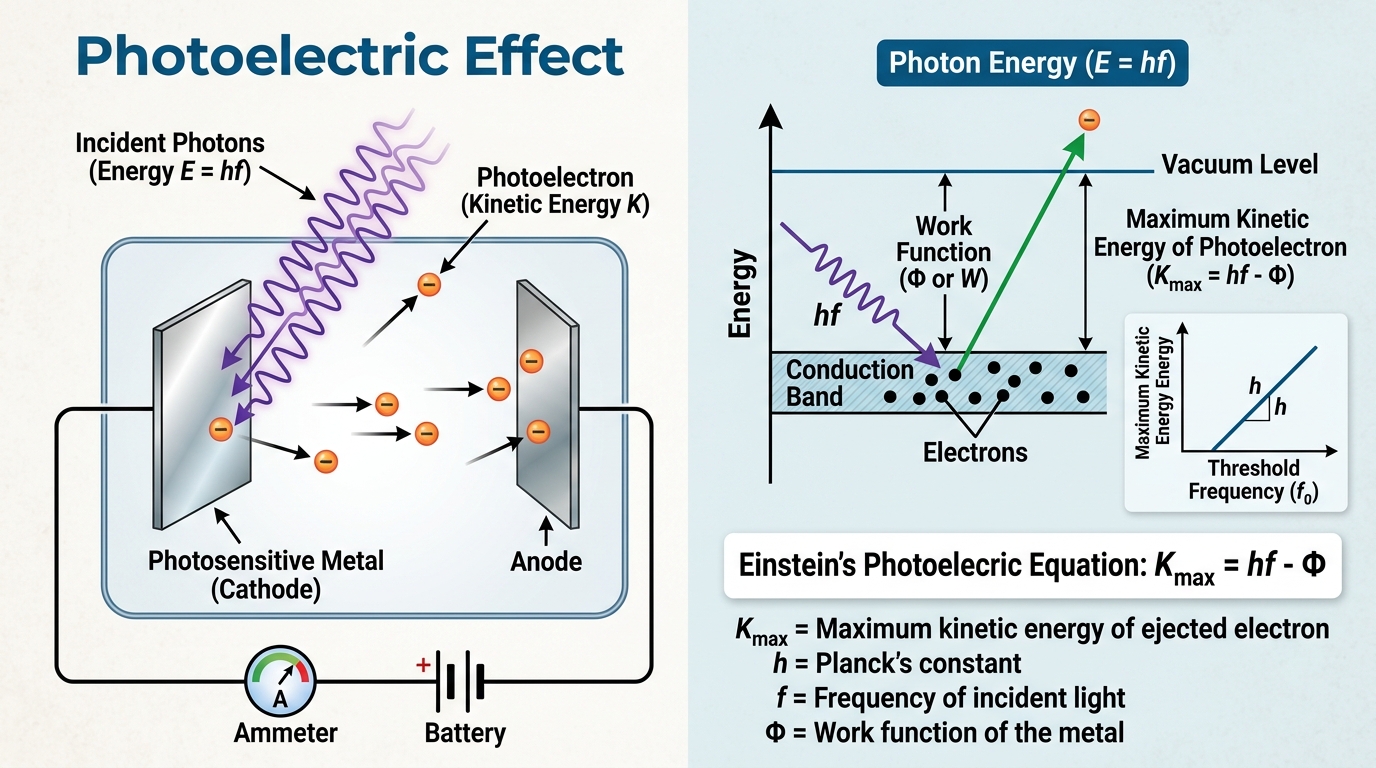
| Paper Topic | Core Discovery & Mechanism | Scientific Impact & Significance |
|---|---|---|
| 1. The Photoelectric Effect | Proposed that light consists of discrete, quantized packets of energy (photons) rather than continuous waves. | Pushed forward the embryonic quantum theory. This was the specific achievement cited for his 1921 Nobel Prize in Physics. |
| 2. Brownian Motion | Modeled the seemingly erratic movement of microscopic pollen in fluid as the direct result of random collisions with liquid molecules. | Provided definitive mathematical and empirical proof for the physical existence of atoms, ending decades of scientific debate. |
| 3. Special Relativity | Established a new absolute: the speed of light is constant in all inertial reference frames, regardless of the observer’s motion. | Abolished Newtonian absolute time and space. Proved time dilates and lengths contract as an object approaches the speed of light. |
| 4. Mass-Energy Equivalence | Demonstrated that the mass of a body is a measure of its energy content. | Formulated the world’s most famous equation, E=mc². Laid the theoretical groundwork for both nuclear power and atomic weaponry. |
4. General Relativity and the Cosmological Constant
In 1916, Einstein published his masterwork, the General Theory of Relativity. It proposed a radical reconceptualization of gravity: it was no longer an instantaneous, invisible pull across empty space, but rather the geometric warping of the four-dimensional fabric of space-time by massive objects.
However, Einstein’s equations dictated a dynamic universe that must be expanding or contracting. Adhering to the era’s consensus of a static universe, he introduced an arbitrary mathematical fix: the Cosmological Constant (Λ). When Edwin Hubble proved in 1929 that the universe was expanding, Einstein discarded the constant, allegedly calling it his “biggest blunder.” Ironically, modern astrophysicists have resurrected this exact constant to represent “dark energy”—the mysterious vacuum energy driving the accelerated expansion of the universe today.
5. The 1919 Solar Eclipse and Global Superstardom
Before 1919, Einstein was highly respected within academic circles, but he was not a global celebrity. To prove the bizarre claims of General Relativity—specifically that gravity could bend light—British astronomer Arthur Eddington led an expedition to the island of Príncipe off the coast of Africa during a total solar eclipse.
Eddington photographed the stars positioned directly behind the eclipsed sun. When the photographic plates were analyzed, they proved that the sun’s immense gravity had indeed bent the starlight precisely as Einstein’s math predicted. In the aftermath of World War I, the story of a British scientist proving a German scientist’s theory was a symbol of powerful international unity. The discovery made front-page news worldwide, instantly transforming Einstein from a quiet academic into the world’s first global science superstar.
6. The 1921 Nobel Prize Controversy and “Deutsche Physik”
Despite the monumental triumph of relativity, Einstein did not win the Nobel Prize for it. At the time, relativity was still considered too radical by the conservative Nobel committee. More sinisterly, a strong anti-Semitic movement within German academia—championed by Nobel laureate Philipp Lenard under the nationalist banner of “Deutsche Physik” (German Physics)—actively and aggressively campaigned against Einstein and his “Jewish science.”
The committee was so paralyzed by the political division that they actually awarded no physics prize in 1921. The following year, they retroactively awarded the 1921 prize to Einstein, but strictly stipulated it was for his 1905 work on the photoelectric effect, explicitly avoiding any official endorsement of Relativity.
7. The Quantum Schism and the Solvay Debates
Einstein’s relationship with quantum mechanics was deeply paradoxical. In the 1920s, building on the work of Indian physicist Satyendra Nath Bose, he predicted the Bose-Einstein Condensate (BEC)—a new state of matter where particles collapse into a single “super-atom” quantum system at near absolute zero. (This was physically created in a lab decades later, on June 5, 1995, at 10:54 a.m., winning the 2001 Nobel Prize).
Despite birthing quantum theory, Einstein vehemently rejected the “Copenhagen interpretation” championed by Niels Bohr, which argued the universe is inherently probabilistic. Finding this abhorrent, Einstein famously declared, “God does not play dice.” This climaxed at the 1927 Solvay Conference and the 1935 publication of the EPR paradox, where Einstein argued that quantum entanglement (“spooky action at a distance”) proved quantum mechanics was incomplete due to “hidden variables.” Decades of subsequent tests (Bell’s inequalities) have ultimately vindicated Bohr, demonstrating that Einstein’s localized determinism does not hold at the quantum level.
8. Fleeing Europe and the Princeton Years
By 1933, facing severe threats to his life from Adolf Hitler’s fascist regime, Einstein renounced his German citizenship for a second time, fled his homeland, and heavily financed visas for Jewish refugees. He helped found the International Relief Association, which would become the International Rescue Committee (IRC), before emigrating to the United States to join the Institute for Advanced Study (IAS) in Princeton.
For the last two decades of his life, Einstein became isolated from mainstream physics, pursuing a solitary quest for a Unified Field Theory. During this time, he formed a deep bond with the brilliant, highly eccentric Austrian logician Kurt Gödel. Their walks bridged vast conceptual divides, culminating in Gödel formulating a mathematical solution to general relativity in 1949 that permitted closed time-like curves—effectively proving the theoretical possibility of time travel.
9. Political Economy, Civil Rights, and the FBI
In 1939, alerted by Hungarian émigré physicists, Einstein signed a fateful letter to President Roosevelt warning of Nazi nuclear ambitions, which served as the catalyst for the Manhattan Project. Denied security clearance due to his left-wing politics, he deeply regretted the letter after Hiroshima, stating he would have done nothing had he known the Germans would fail.
Post-war, Einstein became a fierce advocate for civil liberties. Shocked by segregation, he allied with the NAACP, visited Lincoln University in 1946 to forcefully condemn racism as a “disease of white people,” and maintained close friendships with Black intellectuals like W.E.B. Du Bois and Paul Robeson. In his 1949 essay “Why Socialism?”, he issued a scathing critique of capitalist “economic anarchy” and advocated for a planned economy guarded by robust democratic mechanisms. Consequently, J. Edgar Hoover’s FBI amassed a sprawling, 1,400+ page file on Einstein, constantly monitoring the physicist in an effort to neutralize his political influence.
10. Religion, Zionism, and the “God Letter”
Einstein did not believe in a personal, intervening deity; he repeatedly aligned with the God of Baruch Spinoza—a pantheistic framework where “God” is entirely synonymous with the lawful harmony of the natural universe. In a 1954 handwritten missive known as the “God Letter” (which auctioned for nearly $3 million in 2018), he explicitly rejected traditional faith, calling the Bible a collection of “primitive legends” and “childish superstitions.”
While he maintained deep cultural solidarity with the Jewish people and helped establish the Hebrew University of Jerusalem, his relationship with political Zionism was critical. He publicly likened right-wing Jewish paramilitary groups to fascist parties. When offered the presidency of Israel in 1952 following the death of Chaim Weizmann, Einstein firmly but respectfully declined, stating he lacked the natural ability and experience to deal with human beings in an official capacity.
11. The “Einstein Fridge” and Practical Inventions
While celebrated for abstract theoretical physics, Einstein was also a highly capable practical inventor. In 1926, he read a tragic news story about a family in Berlin who were killed while sleeping by toxic sulfur dioxide gases leaking from a broken refrigerator seal.
Disturbed by the danger of early mechanical refrigeration, Einstein teamed up with his former student Leo Szilard. Together, they invented the Einstein-Szilard Refrigerator. Their brilliant design utilized an absorption process requiring absolutely no moving parts, thereby eliminating the risk of seal failure and toxic leaks entirely. The pair successfully patented the safe refrigerator in 1930, though the subsequent invention of non-toxic Freon gas soon rendered the design commercially obsolete.
12. Cultural Iconography and the Violin
Einstein transcended physics to become the supreme archetypal “genius.” He found profound solace in music, naming his violins “Lina,” and utilizing the instrument for cognitive problem-solving. (In 2025, an Anton Zunterer violin believed to be his first sold at auction for $1.1 million). He also loved sailing his clunky boat on Long Island Sound, self-deprecatingly named “Tinef” (Yiddish for “worthless”), despite notoriously poor nautical skills and frequently capsizing.
His most indelible image was captured on his 72nd birthday in 1951. Exhausted by a barrage of reporters, Einstein stuck his tongue out at photographer Arthur Sasse in a sudden moment of anti-authoritarian defiance, creating a photograph that perfectly encapsulated his duality: a towering intellectual who retained an irreverent, childlike streak.
13. Death, Last Words, and the Stolen Brain
In April 1955, suffering from a ruptured abdominal aortic aneurysm, the 76-year-old Einstein flatly refused life-saving surgery, stating it was “tasteless to prolong life artificially.” He mumbled a final, quiet sentence in German before expiring on April 18. Because the night nurse only spoke English, the final thoughts of the century’s greatest mind were permanently lost to history.
Following his death, an extraordinary and macabre saga unfolded. Despite his strict instructions to be cremated immediately, the pathologist on call, Dr. Thomas Harvey, covertly stole Einstein’s brain without permission. He photographed it, sectioned it into hundreds of blocks, and distributed samples to neuroscientists for decades. (Today, pieces of his brain can be seen on display at the Mütter Museum in Philadelphia).
| Lead Researcher & Institution | Key Neurological Findings | Scientific Implications & Hypotheses |
|---|---|---|
| Marian Diamond (UC Berkeley, 1985) | Found a significantly higher ratio of glial cells to neurons in the left inferior parietal lobe compared to control brains. | Glial cells nourish neurons. The higher ratio suggests Einstein’s neurons possessed an increased metabolic need, indicating unusually intense neural activity. |
| Sandra Witelson (McMaster Univ., 1999) | Reported the absence of the parietal operculum, allowing the inferior parietal lobe to be 15% wider than average. | This region is heavily linked to mathematical, spatial, and visual reasoning, suggesting a physiological basis for his spatial conceptualization abilities. |
| Frederic Lepore (Recent) | Identified an unusual, additional fold in the frontal lobe of the brain. | The frontal lobe governs planning and higher-order thought, potentially aiding his ability to conduct elaborate theoretical thought experiments. |
14. The Final Scientific Ledger: Right, Wrong, and Unresolved
Einstein’s scientific legacy is a fascinating mix of unprecedented triumphs, a few notable missteps, and theories that physicists are still actively testing today.
- Theories Proven Right: Beyond atoms, photons, and relativity, his wildest predictions continue to be validated. In 2015, the LIGO observatory successfully detected gravitational waves—invisible ripples in spacetime caused by colliding black holes—exactly a century after he predicted them. Furthermore, his prediction of Bose-Einstein Condensates was physically proven in 1995 when scientists created the “super-atom” state in a lab.
- Theories Proven Wrong: Einstein’s immense intellect did not make him immune to stubborn errors. Despite writing a paper trying to prove black holes couldn’t exist in reality, we have now directly photographed their shadows. Ironically, he also co-authored a 1936 paper trying to prove gravitational waves didn’t exist due to a math coordinate error, which he angrily withdrew after a peer reviewer caught the flaw. Most significantly, decades of Bell’s Inequality tests have proven his “hidden variables” theory wrong; the universe at the quantum level truly is entangled and probabilistic.
- Nuanced and Still Being Tested: Einstein’s quest for a Unified Field Theory failed, and it remains one of physics’ greatest unsolved mysteries (though String Theory attempts to solve it). Einstein-Rosen Bridges (Wormholes), proposed in 1935, remain mathematically possible but lack any observational evidence. General relativity itself is still undergoing extreme testing; the current ACES (Atomic Clock Ensemble in Space) experiment on the International Space Station uses highly precise atomic clocks to test gravitational time dilation in orbit.
- The Cosmological Constant (Λ): Perhaps his most complicated legacy. Initially his “biggest blunder,” physicists reintroduced it to explain dark energy. Remarkably, this is still actively evolving; recent 2025 data from the DESI (Dark Energy Spectroscopic Instrument) project suggests dark energy might actually be evolving over time, rather than remaining a strict “constant” as Einstein originally wrote it.