
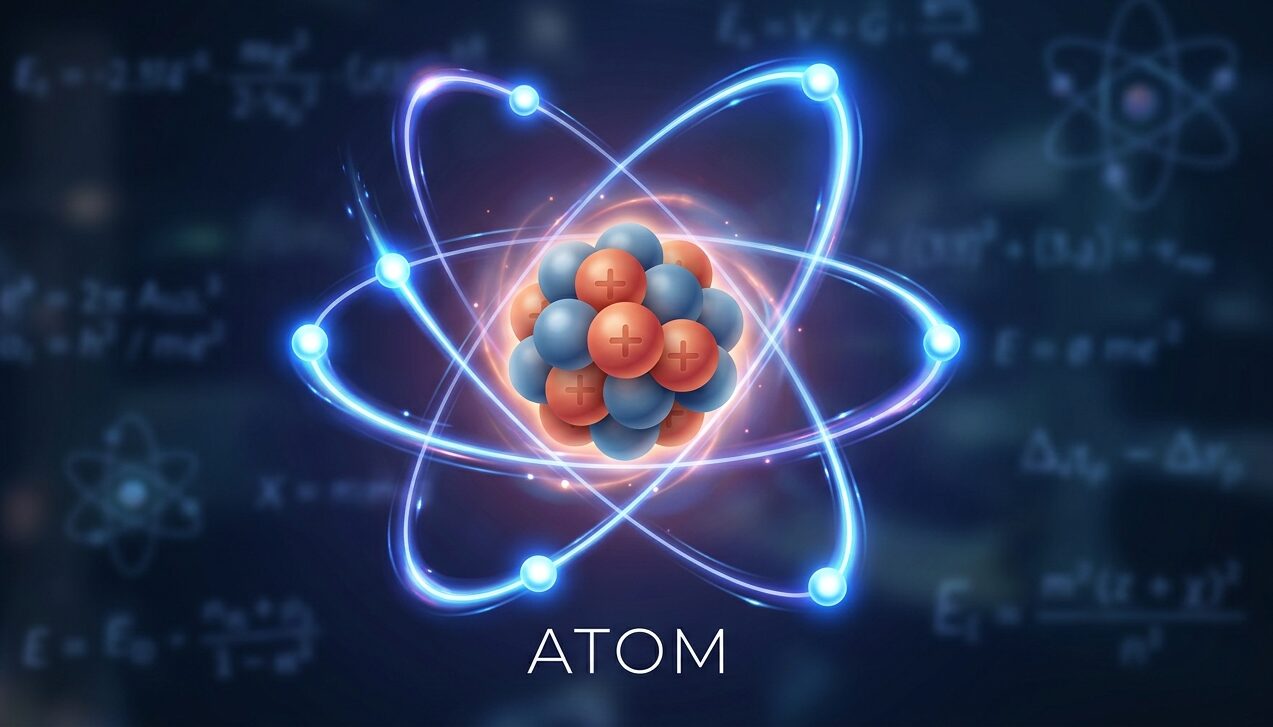
An atom is the basic building block of all ordinary matter in the universe. Every solid, liquid, gas, and plasma is composed of neutral or ionized atoms. They are incredibly small, typically around 100 picometers (a ten-billionth of a meter) across. Despite their microscopic size, the intricate structure and behavior of atoms dictate the fundamental laws of chemistry, physics, and biology, making them the most critical subject of study in the physical sciences.
The Building Blocks of Everything
It is fascinating to realize that everything around us from the stars shining in the sky to the human body itself is made of the same tiny invisible building blocks. These atoms are so small that we cannot see them, yet they combine in countless ways to create the entire universe. The idea that the same particles form both galaxies and people shows how deeply connected all of existence really is.
This truth makes science feel both simple and magical. By studying these building blocks, we learn not only how matter works but also how life itself is possible. It reminds us that diversity in the world comes from the endless combinations of the same basic elements, proving that unity lies at the heart of creation.
| The Atom | |
|---|---|
| Definition | The smallest unit of ordinary matter |
| Subatomic Particles | Protons, Neutrons, Electrons |
| Central Core | Nucleus (contains >99.9% of the mass) |
| Electric Charge | Neutral (if protons = electrons) |
| Size Range | ~0.1 to 0.5 nanometers |
| Smallest Atom | Hydrogen (1 proton, 1 electron) |
| Key Scientists | Kanad, Dalton, Thomson, Rutherford, Bohr |
1. What Exactly is an Atom?
The word “atom” comes from the ancient Greek word atomos, meaning “indivisible.” For centuries, scientists believed it was the smallest possible piece of matter. Today, we know that an atom is actually a complex system composed of even smaller pieces called subatomic particles. When atoms bond together, they form molecules, which in turn make up everything we can see, touch, and breathe.
2. The Three Main Subatomic Particles
While an atom is tiny, its internal structure is highly organized into three primary subatomic particles:
- Protons: Positively charged particles located at the very center of the atom (the nucleus). The number of protons determines what element the atom is (e.g., 1 proton = Hydrogen, 6 protons = Carbon).
- Neutrons: Particles with no electrical charge (neutral), also located in the nucleus. They act as the “glue” that holds the positively charged protons together.
- Electrons: Negatively charged, incredibly tiny particles that orbit the nucleus at near light-speed in a region known as the “electron cloud.” They are primarily responsible for chemical reactions and electricity.
3. A Brief History of Atomic Models
Our understanding of the atom has evolved dramatically over thousands of years:
- Maharishi Kanad (approx. 6th Century BCE): Centuries before modern science, this ancient Indian philosopher conceptualized that all matter is composed of indestructible, invisible particles he called Parmanu (the Sanskrit root for atom).
- John Dalton (1803): Proposed the first modern atomic theory, stating that all matter consists of solid, indivisible spheres.
- J.J. Thomson (1897): Discovered the electron and proposed the “Plum Pudding Model,” visualizing the atom as a positive soup with negative electrons floating inside.
- Ernest Rutherford (1911): Conducted the famous Gold Foil Experiment, discovering that atoms are mostly empty space with a dense, positive center (the nucleus).
- Niels Bohr (1913): Suggested that electrons orbit the nucleus in distinct, fixed circular paths or “shells.”
- Modern Quantum Model: Today, scientists understand that electrons do not orbit in perfect circles, but rather exist in complex probability clouds or “orbitals” around the nucleus.
4. Atomic Number, Mass, and Isotopes
To identify and categorize atoms on the Periodic Table, scientists use two vital metrics:
The Atomic Number is the number of protons in an atom’s nucleus. This is the atom’s ultimate identity card. Changing the number of protons literally changes the element into a completely different substance.
The Mass Number is the total sum of protons and neutrons in the nucleus. Sometimes, atoms of the exact same element can have different numbers of neutrons. These variations are called Isotopes. For example, Carbon-12 and Carbon-14 are both carbon atoms (both have 6 protons), but Carbon-14 has two extra neutrons, making it radioactive and useful for archaeological dating.
5. The “Empty Space” Phenomenon
One of the most mind-boggling facts in physics is that atoms are almost entirely empty space. If you were to enlarge an atom so that its nucleus was the size of a marble sitting in the middle of a massive football stadium, the nearest electrons would be buzzing around the highest seats in the stands. Everything in between is a void. Consequently, everything in the universe—including human beings—is composed of 99.9999999% empty space.
6. Where Do Atoms Come From? (The Origin Story)
The story of atoms is the story of the universe itself. Immediately following the Big Bang, the universe was too hot for matter to exist. As it cooled, the very first and lightest atoms were formed: Hydrogen and Helium.
But where did the heavier elements come from? They were forged inside the crushing, high-pressure cores of ancient stars. Elements like carbon, oxygen, and iron were created through nuclear fusion. When those massive stars eventually died and exploded in violent supernovas, they scattered these heavier atoms across the galaxy. As astrophysicist Carl Sagan famously said, “We are made of star-stuff.”
7. Atoms in Modern Technology
In modern times, humanity has moved far beyond just studying atoms; we now actively manipulate them to power the future:
- Everyday Tech: The movement of electrons between atoms is what generates light in LED bulbs, powers the batteries in your smartphone, and captures energy in solar panels.
- Atomic Clocks: By measuring the highly precise vibrations of cesium atoms, scientists have created clocks that won’t lose a second in millions of years. This atomic precision is what makes global GPS navigation and internet synchronization possible.
- Quantum Computing: The global tech race is highly focused on manipulating single atoms (qubits) to build quantum computers. These machines promise to solve problems in seconds that would take traditional supercomputers thousands of years, revolutionizing medicine, AI, and nanotechnology.