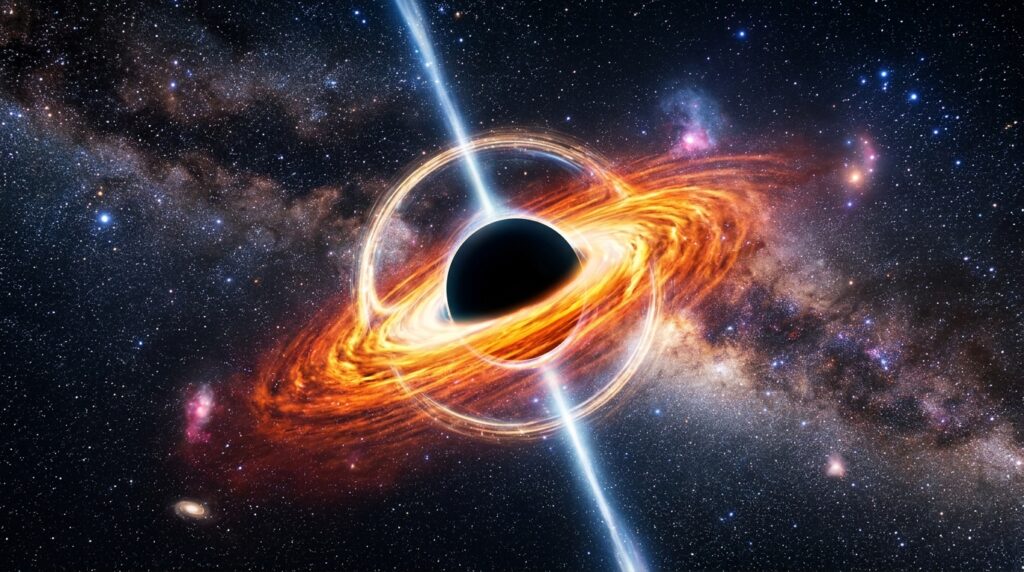
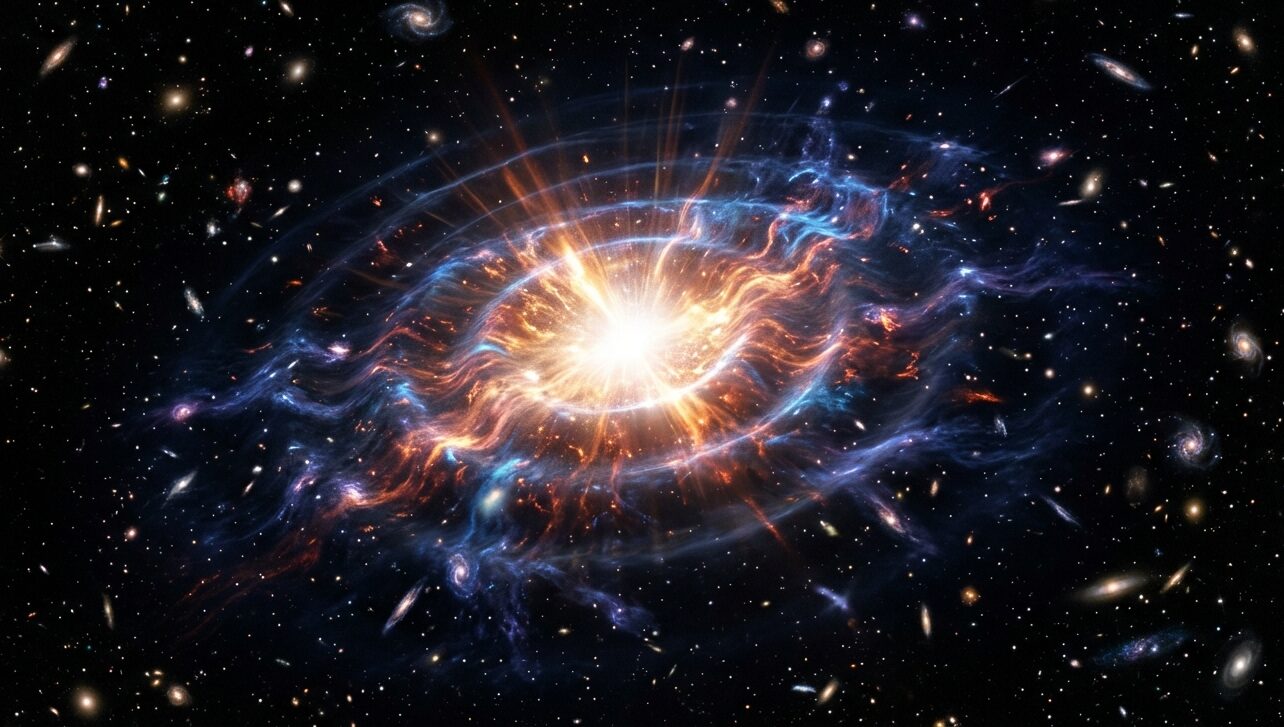
The Big Bang Theory is the leading scientific explanation for the origin and evolution of our observable universe. It suggests that everything we currently see all the matter, energy, and even space and time itself was once compressed into an infinitely dense, incredibly hot, and infinitesimally small point called a singularity. From this single point, the universe expanded rapidly outward, eventually cooling enough to form the atoms, stars, and galaxies we see today.
The Greatest Story Ever Told
It is mind‑blowing to think about the birth of the entire universe. Billions of years ago, everything we see today every star, planet, and even every person came from a single, unimaginably powerful moment. From that explosion of energy and matter, the cosmos began to expand, eventually forming galaxies, solar systems, and the world we live in now.
This idea reminds us how deeply connected everything truly is. The same event that created distant stars also set the stage for life on Earth. Thinking about the universe’s beginning not only sparks wonder but also shows how small we are compared to the vastness of creation, while still being part of something extraordinary.
| The Big Bang Theory | |
|---|---|
| Scientific Field | Cosmology / Astrophysics |
| Estimated Age | 13.8 Billion Years |
| Initial State | Infinitely dense singularity |
| Key Pioneer | Georges Lemaître (1927) |
| Primary Evidence | Redshift, CMB, Element Abundance |
| Current State | Expanding and accelerating |
1. The Origin and The Biggest Misconception
Scientists have calculated that the Big Bang occurred approximately 13.8 billion years ago. To put that massive timeline in perspective, our Earth and Solar System are only about 4.5 billion years old. We are relative latecomers to the cosmic party.
When people hear “Big Bang,” they usually picture a giant explosion resembling a bomb going off in the dark emptiness of space. This is false. The Big Bang was not an explosion in space; it was an explosion of space. Before the Big Bang, there was no space and no time. The expanding universe isn’t expanding into anything; space itself is stretching out, carrying galaxies along with it.
2. The Timeline of Creation
Cosmologists have mapped out the birth of the universe into distinct, mind-bending phases:
- The Planck Epoch (Zero to 10-43 seconds): The very first instant of time. The universe was unimaginably hot and millions of times smaller than a single atom.
- Cosmic Inflation: A fraction of a second later, the universe expanded at a speed faster than light, ballooning from the size of a subatomic particle to the size of a golf ball almost instantly.
- The First Atoms (380,000 years later): For hundreds of thousands of years, the universe was a super-hot, glowing fog of plasma. As it expanded, it cooled down enough for energy to convert into matter, creating the very first atoms.
- Let There Be Light: When those first atoms formed, the dense plasma cleared, and light was able to travel freely through space for the first time. This first flash of light is still echoing through the universe today.
3. Who Discovered It and How?
The Big Bang Theory wasn’t discovered in a single “eureka” moment; it was pieced together by brilliant minds over decades.
- Georges Lemaître (The Concept – 1927): A Belgian Catholic priest and physicist who first proposed that the universe was expanding. He traced this expansion backward in time, suggesting that the universe must have originated from a single “primeval atom.”
- Edwin Hubble (The Proof – 1929): American astronomer Edwin Hubble provided the observational evidence. Just as a police siren’s pitch changes as it drives away from you (the Doppler effect), light from objects moving away from us stretches out and appears “redder.” Hubble observed this redshift through his telescope, proving that almost all galaxies are moving rapidly away from us.
4. The Three Pillars of Evidence
In science, a theory is only as good as the evidence supporting it. The Big Bang is the dominant model because it accurately predicts things we can observe today based on three main pillars:
1. The Expansion of the Universe: Hubble’s discovery of galaxies accelerating away from one another perfectly aligns with an expanding universe.
2. Cosmic Microwave Background (CMB) Radiation: In 1964, Arno Penzias and Robert Wilson accidentally discovered a faint background “noise” of microwave radiation coming evenly from all directions in space. This is the ultimate “smoking gun” the cooled-down residual heat left over from the fiery birth of the universe.
3. The Abundance of Light Elements: The Big Bang Theory predicts that the early universe was practically a giant nuclear fusion reactor. It perfectly calculates the exact ratio of the lightest elements we see in the universe today: roughly 75% Hydrogen and 25% Helium.
5. Modern Technology & Discoveries
The Big Bang isn’t just a historical event; it is an ongoing process. In 1998, scientists discovered something shocking: the universe’s expansion isn’t slowing down due to gravity as expected; it is actually accelerating.
We attribute this mysterious, repulsive force to Dark Energy, which makes up a staggering 68% of the universe. Along with Dark Matter (which holds galaxies together), modern technology is racing to understand these invisible forces. Today, cutting-edge tools like the James Webb Space Telescope (JWST) are looking back in time, capturing the light of the very first galaxies that formed right after the Big Bang.
6. Are There Alternative Theories?
While the Big Bang is the scientific consensus, other fascinating models have been proposed over the years:
- The Steady State Theory: Popular in the mid-20th century, this argued that the universe has no beginning and no end. It is constantly expanding, but new matter is continuously created to keep the density the same. The discovery of the CMB radiation effectively disproved this theory.
- The Oscillating Universe (Big Bounce): This suggests our universe is just one in a continuous cycle of expansions and contractions. The universe expands (Big Bang), eventually stops, collapses back in on itself (Big Crunch), and then “bounces” back out into a new Big Bang.
- The Multiverse Theory: This modern concept suggests our universe is just one of an infinite number of universes bubbling up in a larger, eternal cosmic foam. Our Big Bang was simply the birth of our specific bubble.
7. How Will It End?
If the Big Bang is how it started, how does the story conclude? Based on current observations of cosmic expansion, physicists have a few grim, yet fascinating, predictions:
- The Big Freeze (Heat Death): The most likely scenario. The universe keeps expanding forever. Stars burn out, galaxies drift unimaginably far apart, and the universe becomes dark, incredibly cold, and completely lifeless.
- The Big Rip: Dark energy becomes so strong that it eventually tears everything apart first galaxies, then solar systems, planets, and eventually atoms themselves.
- The Big Crunch: If gravity somehow overpowers Dark Energy, the expansion will reverse. Everything will crash back together into a super-hot, super-dense singularity, exactly how it started.