
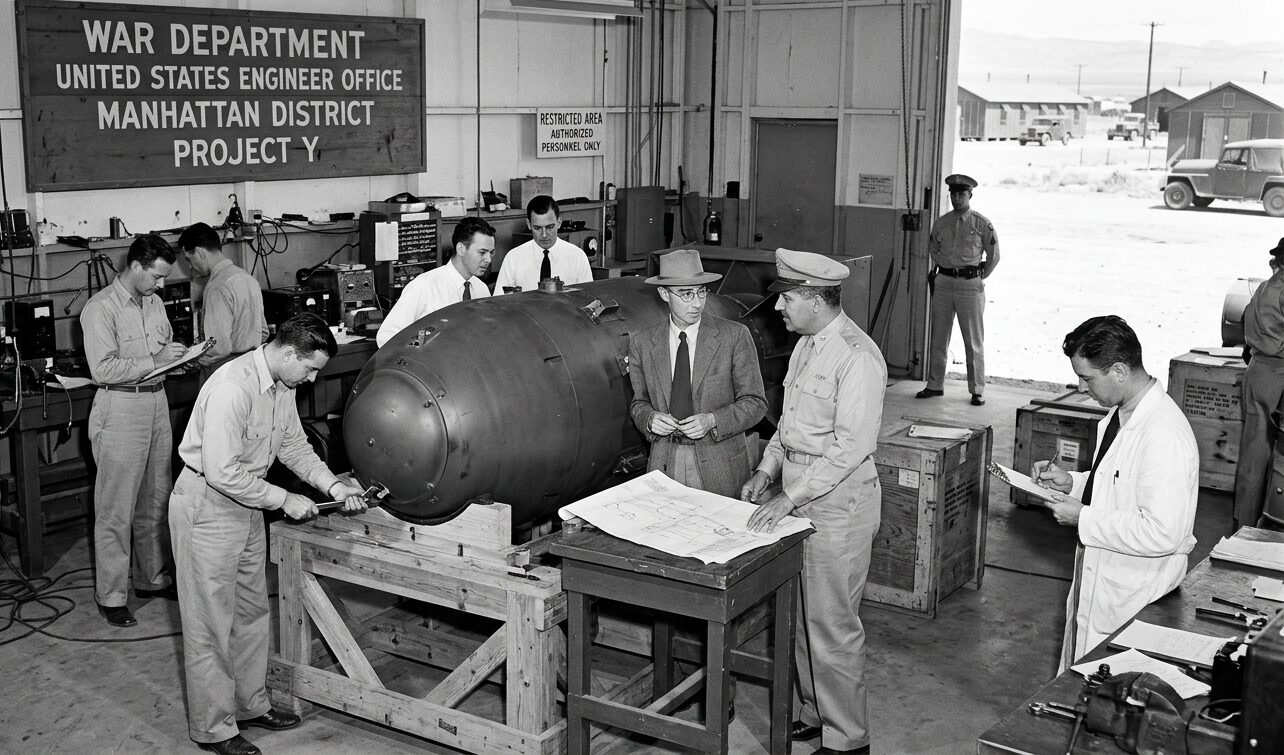
The creation of the atomic bomb is widely considered the most consequential scientific and engineering achievement of the 20th century. Born out of desperation during the darkest days of World War II, this weapon harnessed the fundamental forces of the universe—the energy binding the nucleus of an atom. The devastating power of the atomic bomb not only ended a global conflict but also forever altered the course of human history, plunging the world into the Atomic Age and the subsequent Cold War.
Science: A Tool for Creation and Destruction
Science is one of the most powerful forces shaping our world, and it can be used for both creation and destruction. The discovery of atomic energy is a clear example—on one side, it led to the atomic bomb, a weapon of immense destruction, while on the other, it gave us modern nuclear power plants that provide clean energy to millions of people. This shows how the same knowledge can be used in very different ways depending on human choices.
What makes science fascinating is its potential to improve lives while also reminding us of our responsibility. Every discovery carries both risks and opportunities, and it is up to us to decide how we use it. When guided by wisdom and care, science can build a safer, healthier, and more sustainable future.
| The Manhattan Project & The Atom Bomb | |
|---|---|
| Scientific Director | J. Robert Oppenheimer |
| Military Director | Gen. Leslie R. Groves |
| Core Scientific Process | Nuclear Fission |
| Primary Materials | Uranium-235 & Plutonium-239 |
| First Test (Trinity) | July 16, 1945 |
| Historical Use | Hiroshima & Nagasaki (Aug 1945) |
| Key Global Treaty | Non-Proliferation Treaty (NPT) |
1. The Einstein-Szilard Letter: A Warning to the President
The story of the atomic bomb began not with a military general, but with a warning from scientists. In 1938, German chemists Otto Hahn and Fritz Strassmann discovered nuclear fission—the splitting of the uranium atom. Recognizing that Nazi Germany could potentially use this discovery to build a weapon of unprecedented destructive power, physicist Leo Szilard drafted a letter to U.S. President Franklin D. Roosevelt in 1939. He persuaded the world’s most famous scientist, Albert Einstein, to sign it. This letter successfully urged the U.S. government to begin its own urgent atomic research program.
2. The Manhattan Project and Los Alamos
Following the United States’ entry into World War II in 1941, the atomic research program was officially centralized under the codename The Manhattan Project. It became the largest secret project in human history, eventually employing over 130,000 people across secret cities like Oak Ridge (Tennessee) and Hanford (Washington). The scientific heart of the project was located in a remote desert mesa at Los Alamos, New Mexico. Here, brilliant theoretical physicist J. Robert Oppenheimer assembled the greatest minds of the generation—including Enrico Fermi, Richard Feynman, and Niels Bohr—to figure out the terrifying physics of the bomb.
3. The Physics: How Does an Atom Bomb Work?
Unlike regular explosives that rely on chemical reactions, an atomic bomb relies on Nuclear Fission. The core principle involves taking a heavy, unstable radioactive element—specifically Uranium-235 or Plutonium-239—and bombarding its nucleus with a free neutron.
When the heavy nucleus absorbs the extra neutron, it becomes so unstable that it violently splits into two smaller atoms. This split releases an enormous amount of kinetic energy, gamma radiation, and two or three additional free neutrons. These new neutrons then crash into neighboring uranium atoms, causing them to split as well. This creates a rapid, uncontrollable Chain Reaction that occurs in a fraction of a microsecond.
The devastating energy released is calculated by Albert Einstein’s famous mass-energy equivalence formula (E = mc2). In the fission process, a tiny fraction of the atom’s mass physically disappears, converting entirely into pure, catastrophic energy multiplied by the speed of light squared.
4. The Engineering Challenge: Reaching Critical Mass
To make the bomb explode, the scientists had to assemble enough fissile material to sustain the chain reaction—a specific amount known as Critical Mass. The engineers at Los Alamos developed two distinct designs to achieve this in mid-air:
- The Gun-Type Bomb (Little Boy): This design used a conventional explosive to fire a hollow cylinder of Uranium-235 down a barrel into a solid spike of Uranium-235. When the two pieces collided, they formed a critical mass and initiated the explosion.
- The Implosion-Type Bomb (Fat Man): Plutonium was too reactive for the gun method. Instead, scientists surrounded a core of Plutonium-239 with a sphere of conventional high explosives. When detonated simultaneously, the shockwaves compressed the plutonium core inward, squeezing it until it reached critical mass.
5. The Trinity Test: “Destroyer of Worlds”
Before using the implosion design in war, it had to be tested. On July 16, 1945, in the Jornada del Muerto desert of New Mexico, the first atomic bomb (a plutonium device simply called “The Gadget”) was detonated. The code name for the test was Trinity. The explosion vaporized the steel tower it rested on and sent a massive mushroom cloud 40,000 feet into the sky. Witnessing the terrifying blinding flash, Oppenheimer famously recalled a line from the Hindu scripture, the Bhagavad Gita: “Now I am become Death, the destroyer of worlds.”
6. Historical Deployment and the Cold War Legacy
In August 1945, under the orders of President Harry S. Truman, the United States dropped atomic bombs on the Japanese cities of Hiroshima (August 6) and Nagasaki (August 9). The immediate devastation and subsequent radiation sickness resulted in the deaths of over 200,000 people. Shortly after the bombings, Imperial Japan surrendered, bringing World War II to a close.
While the Manhattan Project ended the deadliest war in history, it birthed a terrifying new era. The monopoly on atomic weapons was short-lived; the Soviet Union successfully tested its own bomb in 1949. This ignited the Cold War arms race, shaping global geopolitics around the terrifying concept of Mutually Assured Destruction.
7. Treaties, Violations, and the Prevention of Nuclear War
To prevent the world from destroying itself, the international community established treaties like the Non-Proliferation Treaty (NPT) to stop the spread of nuclear weapons, and the Comprehensive Nuclear-Test-Ban Treaty (CTBT) to ban all nuclear explosions. However, these treaties have limitations. In international law, a treaty only binds the countries that sign and ratify it. Countries like India and Pakistan never signed the NPT and conducted their own tests. In the 21st century, North Korea withdrew from the NPT and continues to test nuclear weapons, which is a direct violation of United Nations Security Council resolutions, resulting in severe global sanctions.
So, what actually prevents a country from launching a nuclear attack today? There is no single “magic treaty.” Unprovoked attacks are illegal under the UN Charter, but the ultimate shield is Mutually Assured Destruction (MAD). Any country that launches a nuclear missile knows they will be instantly destroyed by a counter-attack. Furthermore, responsible nuclear nations (like India and China) strictly adhere to a “No First Use” (NFU) policy, pledging to never be the first to use nuclear weapons in a conflict.