
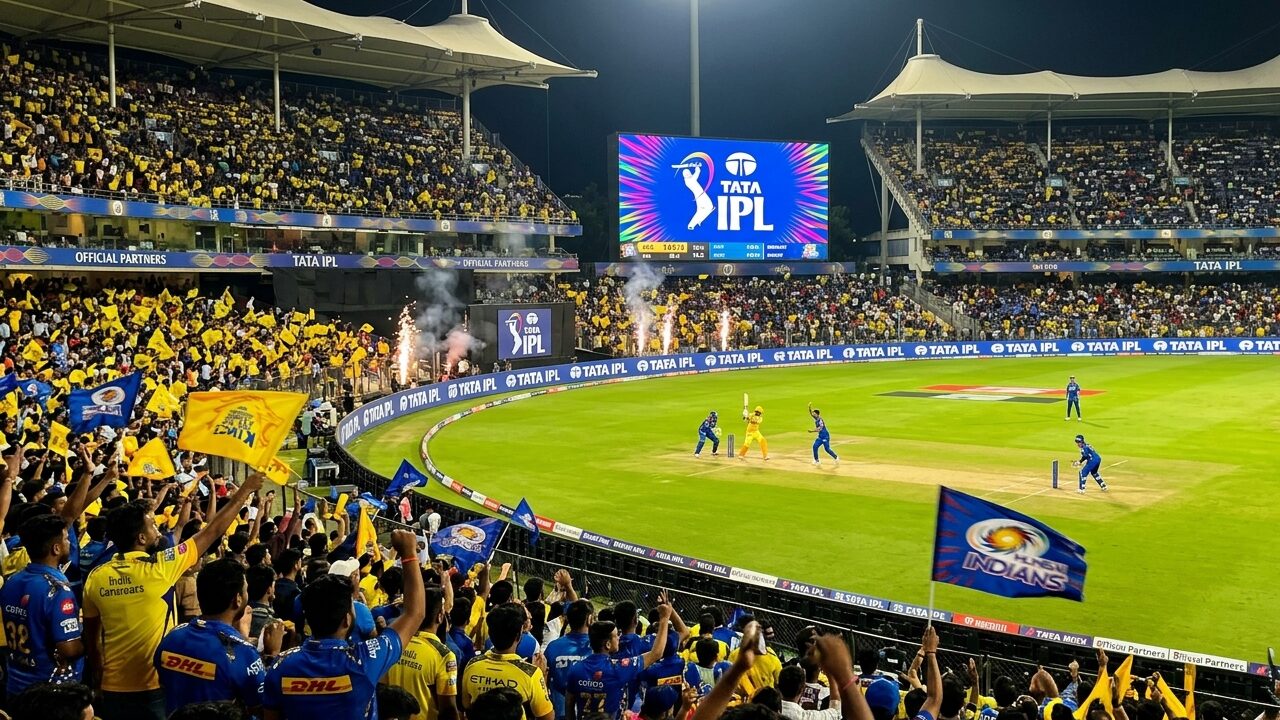
The Indian Premier League (IPL) is a professional men’s Twenty20 (T20) cricket league, contested annually in India. Founded by the Board of Control for Cricket in India (BCCI) in 2007, it has evolved into the most-attended cricket league in the world and one of the most valuable sporting properties globally. By fusing high-octane sporting action with immense commercial enterprise, the IPL completely revolutionized the global cricketing calendar and transformed the economic landscape of modern sports.
The Excitement of the IPL
The IPL is one of the most exciting sporting events because it brings people together in a unique way. Families sit down to watch matches, cheering for their favorite teams, and fans from different cities unite in the spirit of cricket. The atmosphere is full of energy, and every game feels like a festival that connects millions of people.
Beyond entertainment, the IPL has changed the way cricket is played and celebrated around the world. It has introduced new formats, global players, and fresh strategies that make the sport faster and more thrilling. The league shows how cricket can evolve while still keeping its tradition alive, making it a true celebration of unity and passion.
| Indian Premier League (IPL) | |
|---|---|
| Administrator | Board of Control for Cricket in India (BCCI) |
| Format | Twenty20 (T20) |
| Annual Window | March to May |
| Number of Teams | 10 Franchises |
| First-ever IPL Win | Rajasthan Royals(defeating the Chennai Super Kings) |
| Most Successful Teams | Chennai Super Kings (CSK) & Mumbai Indians (MI) |
| Tournament Format | Double Round-Robin and Playoffs |
| Player Acquisition | Mega & Mini Auctions |
1. The Birth of a Cricketing Giant
The genesis of the IPL traces back to 2007. Following the Indian national team’s historic victory in the inaugural ICC T20 World Cup, cricket fever was at an all-time high. To capitalize on this, the BCCI announced the creation of a franchise-based T20 league that would take place annually between March and May. Inspired by the club-model of European football and American sports leagues like the NBA, the IPL auctioned off city-based franchises to Bollywood celebrities, corporate billionaires, and industrial giants.
The first season kicked off in 2008 with a breathtaking 158-run knock by Brendon McCullum, instantly cementing the league’s reputation for explosive entertainment. Since then, it has grown from an eight-team experiment into a ten-team global sporting juggernaut.
2. Media Rights and The Business Model of IPL
What truly sets the IPL apart from most global sports leagues is its unmatched, centralized economic model. At its core is a massive revenue pool generated from broadcasting rights and title sponsorships (like the multi-year deal with the Tata Group), which the BCCI shares directly with the franchises. This guarantees financial stability for every team.
- Record-Breaking Media Rights: The 2023–2027 media rights cycle was sold for a staggering $6.2 billion (₹48,390 crore) to Disney Star (TV) and Viacom18/JioStar (Digital).
- Global Valuation: This deal makes the IPL the second-most valuable sports property in the world on a per-match basis, generating roughly $13.2 million per match, behind only the American NFL.
- Billion-Dollar Teams: This enormous capital inflow has skyrocketed franchise valuations. Several teams are now valued at over $1 billion, attracting major foreign investors, US private equity firms, and global conglomerates.
This self-sustaining flywheel—where guaranteed central revenue and explosive media growth lead to richer franchises and bigger star players—has turned the IPL into a genuine wealth creator for the entire cricket ecosystem.
3. Ownership: Billionaires and Bollywood
A common misconception among casual fans is the role of Bollywood celebrities in the IPL. Actors like Shah Rukh Khan and Preity Zinta are not just sponsors or brand ambassadors; they are legitimate co-owners who invested their own capital to buy the franchises during the inaugural 2008 auction.
The league’s ownership is a mix of India’s biggest corporate giants, entertainment moguls, and international sports investors. As of 2026, the complete ownership landscape looks like this:
- Mumbai Indians (MI): Owned by India’s most valuable company, Reliance Industries (led by Mukesh and Nita Ambani).
- Chennai Super Kings (CSK): Owned by Chennai Super Kings Cricket Ltd (led by N. Srinivasan).
- Kolkata Knight Riders (KKR): Co-owned by Bollywood actor Shah Rukh Khan (Red Chillies Entertainment), actress Juhi Chawla, and the Mehta Group.
- Royal Challengers Bengaluru (RCB): Following a historic $1.78 billion sale in March 2026, the team is now controlled by a consortium led by the Aditya Birla Group, (through UltraTech Cement), involving Ananya Birla and Aryaman Birla, alongside major investors like Blackstone and the Times Group.
- Rajasthan Royals (RR): Acquired in 2026 for $1.63 billion by a consortium led by tech entrepreneur Kal Somani, alongside high-profile US sports investors like Rob Walton (NFL’s Denver Broncos) and the Hamp family (Detroit Lions).
- Delhi Capitals (DC): Jointly owned by the GMR Group and JSW Group in a 50-50 partnership.
- Sunrisers Hyderabad (SRH): Owned by the Sun TV Network, led by Kalanithi Maran and prominent CEO Kavya Maran.
- Gujarat Titans (GT): Jointly owned by the Torrent Group and the original founders, CVC Capital Partners.
- Lucknow Super Giants (LSG): Owned by the RPSG Group, headed by billionaire industrialist Sanjiv Goenka.
- Punjab Kings (PBKS): Co-owned by Bollywood actress Preity Zinta, Ness Wadia, Mohit Burman, and Karan Paul.
4. Franchises, Rivalries, and The New Era
The lifeblood of the IPL is its passionate fanbase. The tournament features 10 permanent franchises battling for the cup:
- The Originals (8 Teams): Chennai Super Kings (CSK), Mumbai Indians (MI), Royal Challengers Bengaluru (RCB), Kolkata Knight Riders (KKR), Sunrisers Hyderabad (SRH), Rajasthan Royals (RR), Punjab Kings (PBKS), and Delhi Capitals (DC).
- The Rivalries: Matches between MI and CSK are famously known as the “El Clásico” of cricket, generating record-breaking viewership as the two most successful franchises in IPL history. Meanwhile, RCB boasts one of the most vocal fanbases globally, largely driven by superstars like Virat Kohli.
- The New Era (2022 Expansion): The league expanded to 10 teams with the addition of the Gujarat Titans (GT) and Lucknow Super Giants (LSG). GT famously won the championship in their very first season, proving the league’s incredible competitive balance.
5. Tournament Format and Unique Rules
The IPL employs a highly competitive structure designed to reward consistency:
- The League Stage: The 10 teams play a mix of home and away matches in a format that ensures each team plays 14 league games.
- The Playoffs: Instead of traditional semi-finals, the IPL uses a playoff system. The top two teams face off in Qualifier 1 (the winner goes straight to the final). The 3rd and 4th placed teams play the Eliminator. The loser of Qualifier 1 gets a second chance by playing the winner of the Eliminator in Qualifier 2 for the final spot in the championship.
- The Impact Player Rule: Introduced to make matches more dynamic, this rule allows teams to swap one player during the match from a pre-named list of substitutes. This allows teams to bring in a specialist bowler or batter depending on the match situation.
6. Impact on Global Cricket
The success of the IPL fundamentally altered world cricket. The International Cricket Council (ICC) now essentially halts international fixtures during the IPL’s March–May window because the best players in the world prioritize participating in the league.
Furthermore, the IPL’s financial model became the blueprint for global cricket, spawning successful T20 franchise leagues worldwide, including:
- Big Bash League (BBL): Australia
- Caribbean Premier League (CPL): West Indies
- Pakistan Super League (PSL): Pakistan
- The Hundred: England & Wales
- SA20: South Africa (Notably, all six franchises in this league are owned by IPL team owners, highlighting the global expansion of Indian cricket businesses).