
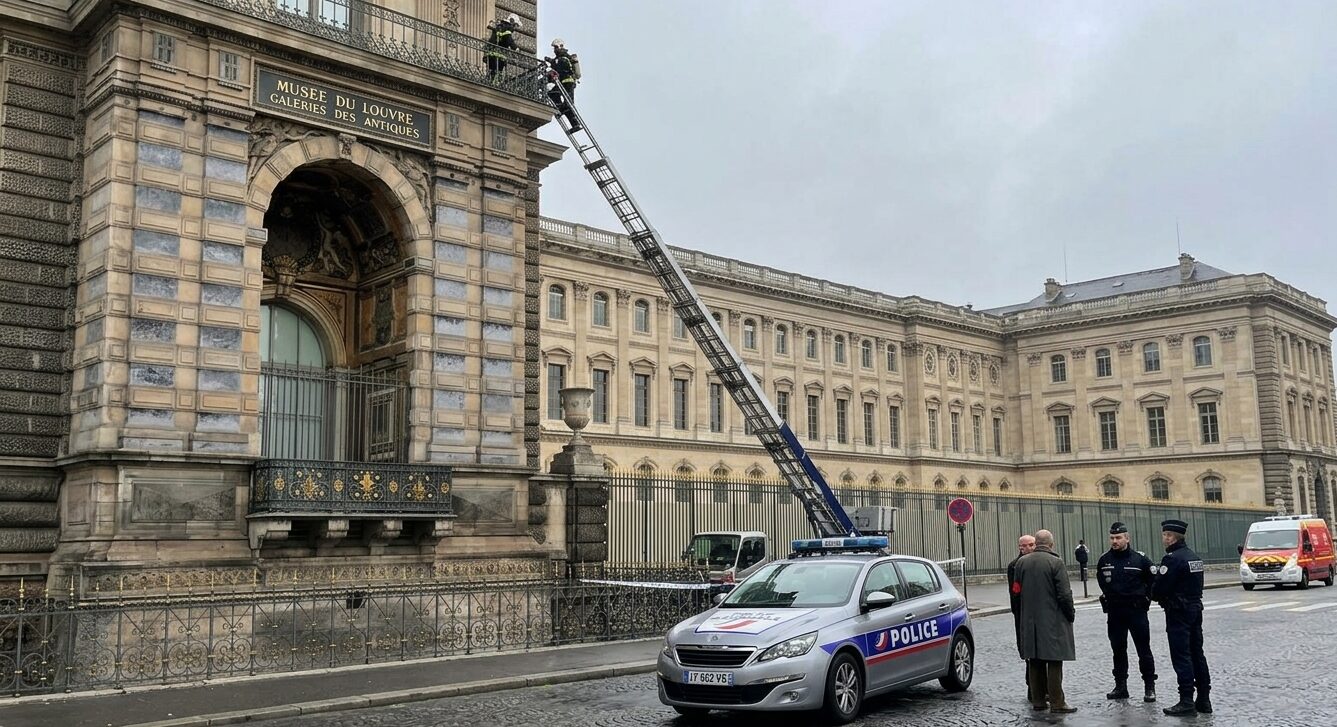
The 2025 Louvre Heist refers to one of the most brazen and shocking art crimes of the 21st century. On October 19, 2025, a highly organized group of thieves successfully breached the world’s most heavily guarded museum in broad daylight. Bypassing state-of-the-art security, they infiltrated the Galerie d’Apollon and made off with a fortune in French Crown Jewels, leaving the global art world stunned and exposing critical vulnerabilities in modern museum security.
A Crime Straight Out of a Movie
It’s almost surreal to imagine a daylight robbery taking place at the Louvre in our modern era. The museum is one of the most heavily visited and protected cultural institutions in the world, so the idea of criminals pulling off such a brazen act feels straight out of a Hollywood action thriller. You’d expect this kind of plot in a blockbuster film, not in real life, where priceless works of art are supposed to be safeguarded under layers of security and surveillance.
Beyond the cinematic shock factor, the loss of historic artifacts to the criminal underworld is devastating. These treasures aren’t just objects; they carry centuries of human history, creativity, and identity. When they vanish into private collections or black markets, the world loses access to pieces of its shared heritage. It’s a reminder that even in the 21st century, cultural preservation is fragile, and the fight to protect humanity’s masterpieces is ongoing.
| The 2025 Louvre Heist | |
|---|---|
| Date | October 19, 2025 |
| Location | Galerie d’Apollon, Louvre Museum |
| Target | The French Crown Jewels |
| Estimated Value | ~€88 Million ($95 Million USD) |
| Items Stolen | 8 pieces (7 currently missing) |
| Perpetrators | Unknown professional syndicate |
| Status | Active global Interpol investigation |
1. The Infiltration: Hiding in Plain Sight
The success of the heist relied entirely on the thieves’ ability to blend in. The Louvre is in a perpetual state of renovation, meaning the presence of contractors is a daily norm. At approximately 10:15 AM on a bustling Tuesday, a team of four individuals dressed in authentic construction uniforms drove a commercial utility truck onto the museum grounds.
Instead of attempting to navigate the labyrinth of internal security checkpoints and armed guards, the crew targeted the exterior. They quickly deployed a heavy-duty, truck-mounted furniture lift—the kind commonly used for moving apartments in Paris—and extended it directly up to the second-story windows of the Galerie d’Apollon.
2. The Target: The Galerie d’Apollon
The Galerie d’Apollon is one of the most spectacular rooms in the Louvre, featuring heavily gilded vaulted ceilings and housing the remaining French Crown Jewels. Because the room is located on an upper floor overlooking the Seine river, exterior window security was primarily focused on sensors rather than physical barricades.
The thieves bypassed the window alarms using a localized electronic jammer. Once inside, they used specialized, high-powered rotary saws to cut through the supposedly “impenetrable” reinforced glass of the central display pavilions. The entire interior breach took less than three minutes.
3. The Three-Minute Escape
Museum interior guards were alerted to the vibration of the saws, but the Galerie d’Apollon is physically massive, and lockdown protocols take precious seconds to engage. Before the guards could secure the gallery doors, the thieves had loaded their bags and scrambled back down the exterior furniture lift.
Abandoning the truck, the crew jumped onto high-powered electric scooters waiting at street level. They vanished into the dense Parisian traffic along the Rue de Rivoli, utilizing the narrow alleys and pedestrian zones where police cruisers could not follow.
4. The Missing Treasures
The thieves specifically targeted items with high concentrations of diamonds and easily detachable precious stones. A total of eight priceless historical pieces were stolen, valued collectively at over €88 million. The most significant losses included:
- The Sword of Charles X: A highly ornate ceremonial weapon encrusted with hundreds of diamonds.
- The Duchess of Angoulême’s Tiara: A staggering piece of 19th-century craftsmanship featuring over 1,000 emeralds and diamonds.
- Several royal brooches and diamond-encrusted stomachers dating back to the reign of Louis XV.
5. The Aftermath and Global Manhunt
The fallout from the heist was immediate. The Director of Security for the Louvre resigned, and a massive overhaul of the museum’s exterior surveillance protocols was initiated. Interpol immediately issued “Red Notices” for the stolen artifacts.
The greatest fear among art historians and law enforcement is that the thieves will not try to sell the historic pieces intact on the black market. Instead, the standard procedure for jewelry heists is to pry the precious stones from their historical gold and silver settings, cut the gems into smaller, untraceable pieces, and melt down the metal. If this happens, the history of these artifacts will be lost forever.