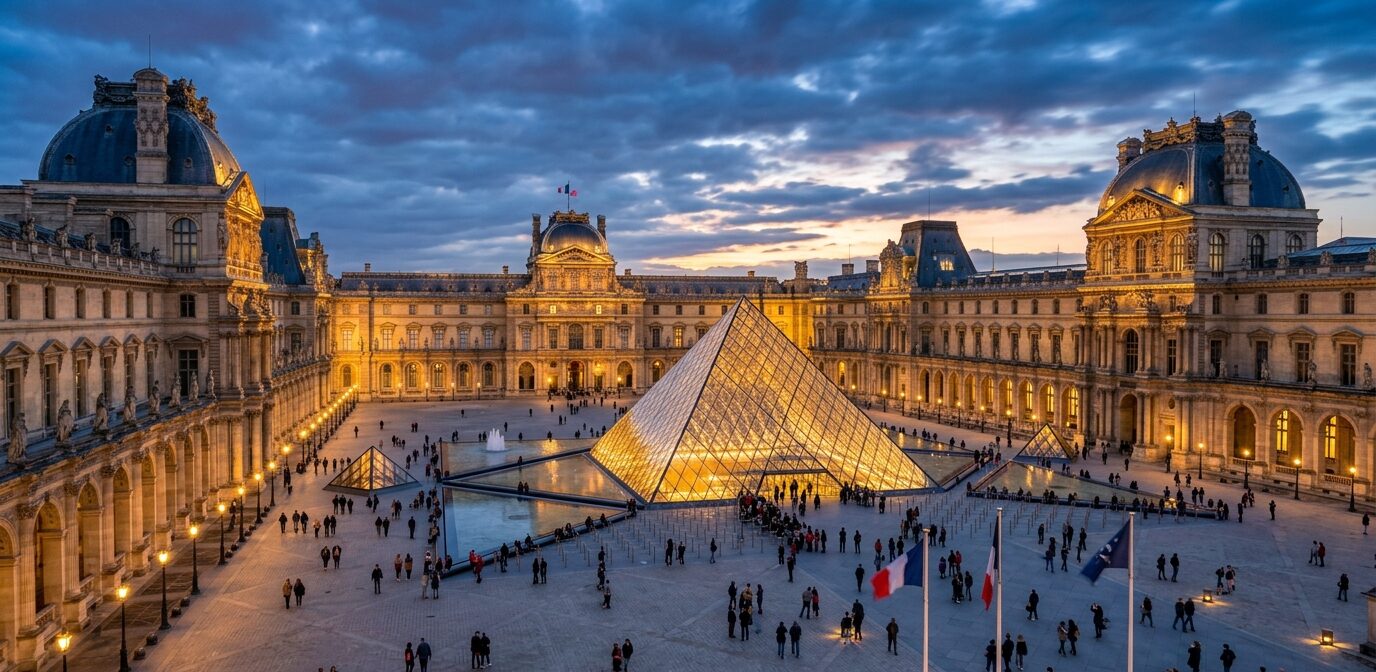
The Louvre Museum (Musée du Louvre) is the world’s largest art museum and a historic monument in Paris, France. Located on the Right Bank of the Seine River, it is the undisputed crown jewel of global art and culture. Housing over 35,000 priceless masterpieces ranging from ancient Egyptian antiquities to the Italian Renaissance, the Louvre is not just a building that holds art; the building itself is a masterpiece of human history.
The Palace of Human Brilliance
The Louvre is overwhelming in the best way possible. Standing in front of paintings that are hundreds of years old fills you with awe, as if you are sharing a moment with the artists themselves. Every gallery feels like stepping into a different chapter of history, where creativity and culture have been preserved for generations to admire.
What makes the Louvre truly incredible is how one building acts as a timeline for all of human creativity. From ancient sculptures to modern masterpieces, it shows the endless ways people have expressed ideas, emotions, and beauty. Walking through its halls is not just about seeing art it is about experiencing the story of humanity itself.
| The Louvre Museum | |
|---|---|
| Location | Paris, France |
| Established | 1793 (As a public museum) |
| Collection Size | ~35,000 works on display |
| Most Valuable Art | Mona Lisa (~$1 Billion valuation) |
| Original Purpose | 12th-Century Military Fortress |
| Global Branches | Louvre Abu Dhabi (UAE) |
| Annual Visitors | ~9 Million |
| Website | |
1. From Fortress to Museum
The Louvre was not originally built to showcase art. In the late 12th century, King Philip II built it as a massive, heavily fortified military fortress to protect Paris from invasions. You can still see the dark, medieval stone ruins of this original fortress in the basement of the museum today.
In the 1500s, the fortress was rebuilt as a lavish royal palace for the French kings. It served as the primary royal residence until 1682, when Louis XIV famously moved the royal court to Versailles. During the French Revolution in 1793, the government officially declared that the Louvre should be a public museum to display the nation’s masterpieces to all citizens, not just the elite.
2. The Pyramids: Glass and Inverted
When you visit the Louvre today, you enter through a massive, futuristic glass and metal pyramid sitting right in the classical courtyard. Designed by architect I.M. Pei and completed in 1989, it was initially met with outrage from traditionalists. Today, it is celebrated as an architectural triumph that bridges ancient history with the modern world.
However, there is a second, equally fascinating structure beneath the surface: The Inverted Pyramid (La Pyramide Inversée). Located in the underground shopping mall beneath the museum, this upside-down glass pyramid functions as a massive skylight. Its tip points downward, stopping just inches above a smaller, upright stone pyramid on the floor a design made globally famous by pop culture and thriller novels.
3. Masterpieces and The Billion-Dollar Smile
The Louvre’s collection spans 9,000 years of history. Unmissable pieces include the Venus de Milo, the Winged Victory of Samothrace, and the ancient Code of Hammurabi. But the undisputed star of the museum is Leonardo da Vinci’s Mona Lisa.
What is the most valuable piece of art in the world actually worth? While the Mona Lisa is culturally priceless, it holds the Guinness World Record for the highest insurance valuation in history. Insured for $100 million in 1962 before a temporary tour, that value equates to roughly $1 billion today.
4. Can the Louvre Sell Its Art?
With a collection worth hundreds of billions of dollars, people often wonder if the Louvre could simply sell a painting to raise money. The short answer is no. Under strict French law, artworks held in public national museums are deemed inalienable. This means they belong to the public trust and cannot be sold, auctioned, or given away under any circumstances. They are protected permanently as national heritage.
5. The Great WWII Rescue
One of the most heroic chapters in the Louvre’s history occurred just before World War II. Knowing the Nazis were notorious for looting European art, the museum’s director, Jacques Jaujard, orchestrated a massive secret evacuation in 1939.
He organized hundreds of trucks to quietly pack up thousands of priceless artworks including the Mona Lisa, transported in a custom red velvet-lined case. The art was scattered and hidden in various remote castles across the French countryside. When the Nazis eventually seized Paris and entered the Louvre, they found the frames completely empty.
6. The 2025 Crown Jewels Heist
Despite heavy modern security, the museum is not invincible. On October 19, 2025, the Louvre heist 2025 became one of the most audacious art crimes of the century. In broad daylight, thieves disguised as construction workers used a truck-mounted furniture lift to scale the museum’s exterior.
They broke into the second-floor Galerie d’Apollon, shattered display cases with power tools, and stole eight priceless pieces of the French Crown Jewels valued at approximately €88 million. The thieves fled on scooters in a matter of minutes, leaving the art world stunned and exposing severe vulnerabilities in institutional security.
7. The Louvre Goes Global: Abu Dhabi
In 2017, the Louvre expanded its legacy beyond France by opening the Louvre Abu Dhabi in the United Arab Emirates. Established through a historic 30-year agreement between the French and UAE governments, this stunning architectural marvel allows the UAE to use the prestigious Louvre name and borrow artifacts from Paris. It was designed to act as a bridge between Eastern and Western art.