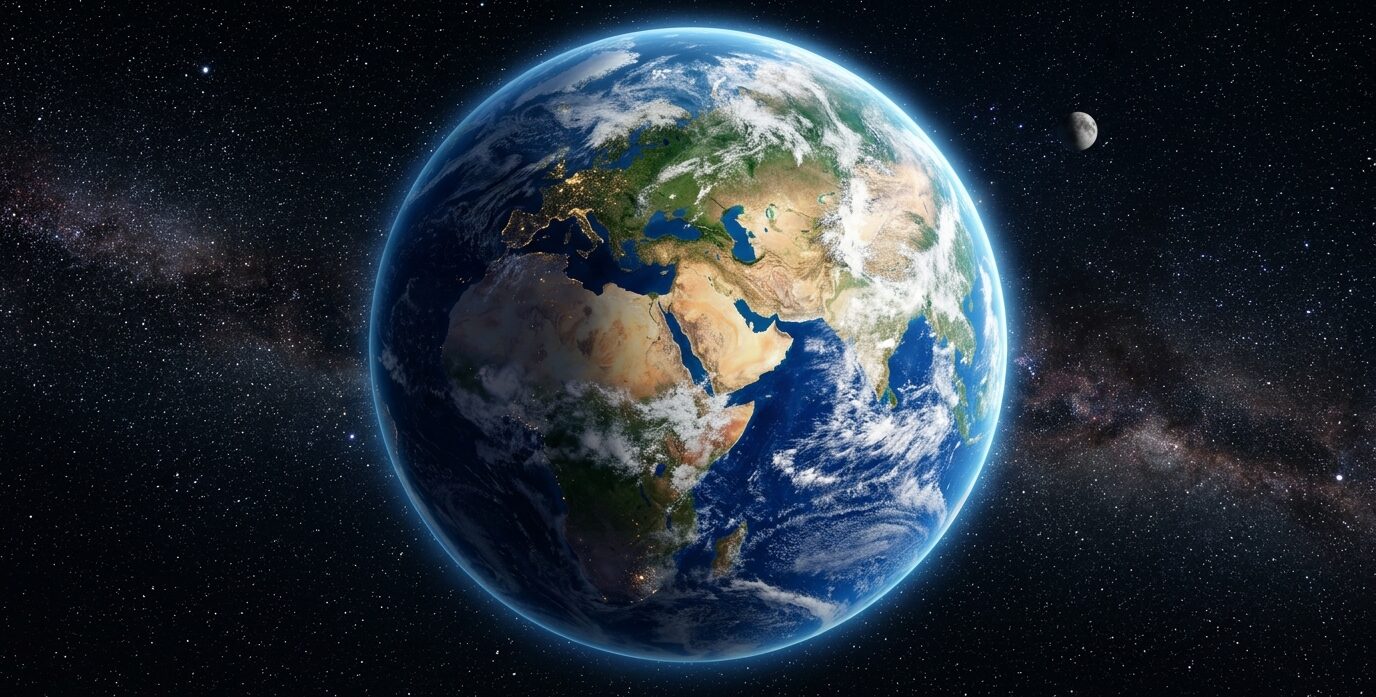
Earth is the third planet from the Sun, the largest of the terrestrial planets, and the fifth-largest planet overall in our Solar System. Characterized by its massive oceans of liquid water, a protective, oxygen-rich atmosphere, and a highly active geological surface, Earth is a perfectly balanced, deeply interconnected system. Most importantly, it is the only astronomical object in the known universe confirmed to harbor life.
Our Place in the Cosmos
Earth is nothing short of miraculous. Out of all the freezing, toxic, and barren planets we have discovered in the universe, our world alone has the perfect balance of conditions to support forests, oceans, and human civilization. The air we breathe, the water we drink, and the soil that grows our food all exist in harmony, making life possible in ways that feel almost magical.
What makes this miracle even more important is its fragility. Earth’s systems its climate, ecosystems, and natural cycles are delicate and can be disrupted if not cared for properly. Understanding how these systems work is the first step toward protecting our only home. By valuing and safeguarding this planet, we ensure that future generations can continue to thrive in the rare gift of life that Earth provides.
| Planet Earth At A Glance | |
|---|---|
| Age | ~4.54 Billion Years |
| Diameter | 12,756 km (7,926 miles) |
| Distance from Sun | ~149.6 Million km (1 AU) |
| Length of Day | 23.9 hours |
| Length of Year | 365.25 days |
| Surface Make-up | 71% Water, 29% Land |
| Axial Tilt | 23.4° (Creates seasons) |
| Atmosphere | 78% Nitrogen, 21% Oxygen, 1% Others |
| Time for Sunlight to Reach Earth | ~8 minutes 20 seconds |
| Time for Moonlight to Reach Earth | ~1.3 seconds |
1. Earth’s Position in the Solar System
Earth occupies a uniquely important place in the Solar System. It is the third planet from the Sun, sitting between the scorching orbit of Venus and the colder, drier world of Mars. This position is not just a simple astronomical fact it is one of the main reasons Earth can sustain long-term liquid water, moderate temperatures, and stable seasonal cycles.
Among all the major planets, Earth stands out as the largest rocky world and the only one known to combine oceans, breathable air, active geology, and life. Its location allows it to receive enough solar energy to power weather, climate, and ecosystems without pushing the planet into the runaway extremes seen elsewhere in the Solar System.
2. Size, Distance, and Motion
Earth holds a very privileged position in space. It orbits the Sun at an average distance of roughly 149.6 million km (93 million miles), a measurement scientists refer to as 1 Astronomical Unit (AU). This precise location places Earth squarely in the “Goldilocks Zone” not so hot that our oceans boil away, and not so cold that they freeze solid.
The mechanics of Earth’s motion govern the passage of time as we experience it:
- Rotation (The Day): Earth spins on its axis once every 23.9 hours, creating the cycle of day and night.
- Revolution (The Year): The planet travels around the Sun at a blistering speed of 107,000 km/h (67,000 mph), completing one full orbit every 365.25 days. That extra quarter of a day is why we add a Leap Year to our calendars every four years.
- Axial Tilt (The Seasons): Earth does not spin perfectly upright. It leans at an angle of 23.4 degrees. Because of this tilt, different hemispheres receive more direct sunlight at different times during our orbit, which is the sole reason we experience the changing seasons.
Earth is also not a perfect sphere. Because it rotates, the planet bulges slightly at the equator and is a little flattened at the poles an overall shape known as an oblate spheroid. This small detail adds to the realism and scientific accuracy of any well-written Earth blog.
3. Inside the Earth: Crust, Mantle, and Core
If you could slice the planet in half, you would see that Earth is built in distinct, dynamic layers. Because of its massive metallic core, it is the most dense planet in the Solar System.
- The Crust: The incredibly thin, brittle outer shell we live on. If Earth were an apple, the crust would be thinner than the apple’s skin.
- The Mantle: Making up a staggering 84% of Earth’s volume, the mantle is about 2,900 km (1,800 miles) thick. It consists of dense, super-heated rock that slowly flows and churns over millions of years like thick caramel.
- The Outer Core: A roaring, churning ocean of superheated liquid iron and nickel, situated about 2,890 km (1,800 miles) beneath our feet.
- The Inner Core: A solid, glowing ball of iron and nickel at the very center of the planet. While temperatures here reach 6,000°C (10,800°F) as hot as the surface of the Sun the crushing pressure of the entire planet above prevents the metal from melting into a liquid.
4. Earth’s Surface: Continents and Tectonics
Earth’s surface (the lithosphere) is a masterpiece of geological activity. It is not a single, solid piece of rock; it is shattered into gigantic, interlocking puzzle pieces called tectonic plates that constantly glide over the flowing mantle below.
When these plates crash into each other, they push land upward to form mountains and volcanoes. When they pull apart or grind past each other, they cause deep ocean trenches and earthquakes. This constant recycling of the Earth’s crust shapes our global map, which is divided into:
- 7 Continents: Asia, Africa, North America, South America, Antarctica, Europe, and Australia (Oceania).
- 5 Major Oceans: The Pacific, Atlantic, Indian, Southern, and Arctic Oceans.
This active surface is one of the reasons Earth never feels geologically “dead.” Its mountains, islands, volcanoes, faults, and ocean basins are constantly being reshaped across deep time.
5. The Hydrosphere: A Water World
Water is central to Earth’s identity. In fact, 71% of Earth’s surface is covered by water. The global oceans are massive, containing roughly 97% of all the water on the planet. The remaining 3% is fresh water, mostly locked up in glaciers and ice caps (the cryosphere) or hidden underground.
This massive hydrosphere acts as a global temperature regulator. Ocean currents absorb heat from the equator and distribute it toward the freezing poles, preventing extreme temperature swings and making the planet habitable.
Even with all our modern technology, the ocean remains one of the least understood parts of Earth. Much of it is still unmapped and unexplored, which means our own planet continues to hold enormous mysteries beneath its surface.
6. The Atmosphere: Our Breathable Shield
The atmosphere is the invisible shield of gases wrapping the planet. Near the surface, the air is composed of roughly 78% Nitrogen, 21% Oxygen, and 1% trace gases like argon (0.93%) and carbon dioxide(0.04%).
The atmosphere does much more than just provide oxygen. It helps maintain usable temperatures through the greenhouse effect, physically burns up thousands of dangerous meteoroids before they can hit the ground, and utilizes the ozone layer to block harmful ultraviolet (UV) radiation from the Sun.
Scientists divide Earth’s atmosphere into five main layers: the troposphere, stratosphere, mesosphere, thermosphere, and exosphere. Each layer has its own role, from shaping daily weather in the lower atmosphere to interacting with solar radiation much higher above the surface.
7. The Magnetic Field and Auroras
Without its magnetic field, Earth would be a lifeless, irradiated wasteland similar to modern-day Mars. The swirling liquid metals in Earth’s Outer Core act as a giant dynamo, generating a massive magnetic field around the planet known as the magnetosphere.
The Sun constantly blasts out lethal solar radiation and a high-speed stream of charged particles known as the solar wind. Earth’s magnetosphere deflects these deadly particles safely away into space. When a small fraction of these solar particles gets trapped and pulled toward the North and South magnetic poles, they collide with atmospheric gases to create breathtaking light shows known as Auroras.
8. The Biosphere: Why Earth Supports Life
Earth’s habitability is not due to just one factor; it is the combination of all its systems working together perfectly. NASA notes that Earth’s vast oceans likely provided a stable place for single-celled life to begin roughly 3.8 billion years ago.
Today, the biosphere encompasses the global sum of all ecosystems. From deep-sea bacteria to complex human civilizations, life on Earth survives because of the delicate balance of liquid water, suitable temperatures, a protective atmosphere, magnetic shielding, and active geological chemical cycling.
9. Earth as an Interconnected System
One of the most important ideas in modern Earth science is that our planet should not be understood in isolated parts. Earth functions as a connected system made up of the atmosphere, hydrosphere, biosphere, geosphere, and cryosphere. None of these components works alone.
Rain falls from the atmosphere into the hydrosphere, rivers shape the geosphere, living organisms influence the biosphere, and ice sheets in the cryosphere reflect sunlight and affect sea level and climate. This systems-based view makes an Earth blog feel much more complete because it shows how every part of the planet influences the others.
10. The Moon and Artificial Satellites
Earth has one natural satellite, the Moon. Sitting at an average distance of 384,400 km (238,855 miles), the Moon does far more than just create ocean tides. Its gravitational pull acts as an anchor, stabilizing Earth’s axial “wobble.” Without the Moon, our climate would be wildly unpredictable over long periods.
Today, the Moon shares the sky with thousands of artificial satellites. For example, GPS satellites operate in Medium Earth Orbit at about 20,200 km (12,500 miles) above the surface, while weather and communication satellites sit in Geostationary orbit much higher at 35,786 km (22,236 miles).
11. Humans, Climate, and Exploration
Earth is the home of human civilization, and we are entirely dependent on its land, water, air, and natural systems. However, humanity is putting unprecedented pressure on these systems.
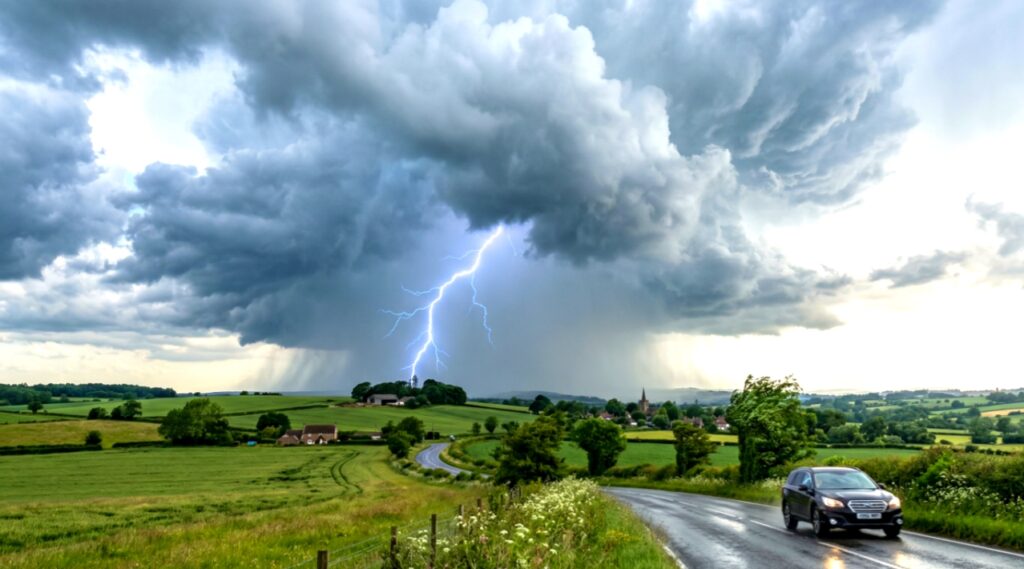
While weather dictates the day-to-day conditions of the atmosphere, climate is the long-term pattern. Because of greenhouse gas emissions, Earth’s climate is changing rapidly, which threatens the very features that make the planet hospitable.
To understand these changes, humanity studies Earth using ground science, ocean instruments, weather stations, aircraft, and fleets of Earth-observing satellites. These tools help scientists track storms, forests, glaciers, sea level, drought, pollution, and countless other signals that reveal the planet’s health.
12. Why Earth Matters More Than Ever
Earth is not just another planet in space. It is our only known home, the foundation of every ecosystem we depend on, and the single world where human history, nature, and life itself come together. Understanding Earth is not just an academic exercise it is a practical necessity.
The more we learn about the planet’s structure, climate, waters, atmosphere, and living systems, the better prepared we are to protect them. A truly strong Earth blog should leave readers with that feeling: wonder, respect, and a clearer sense that this world is both extraordinary and fragile.