
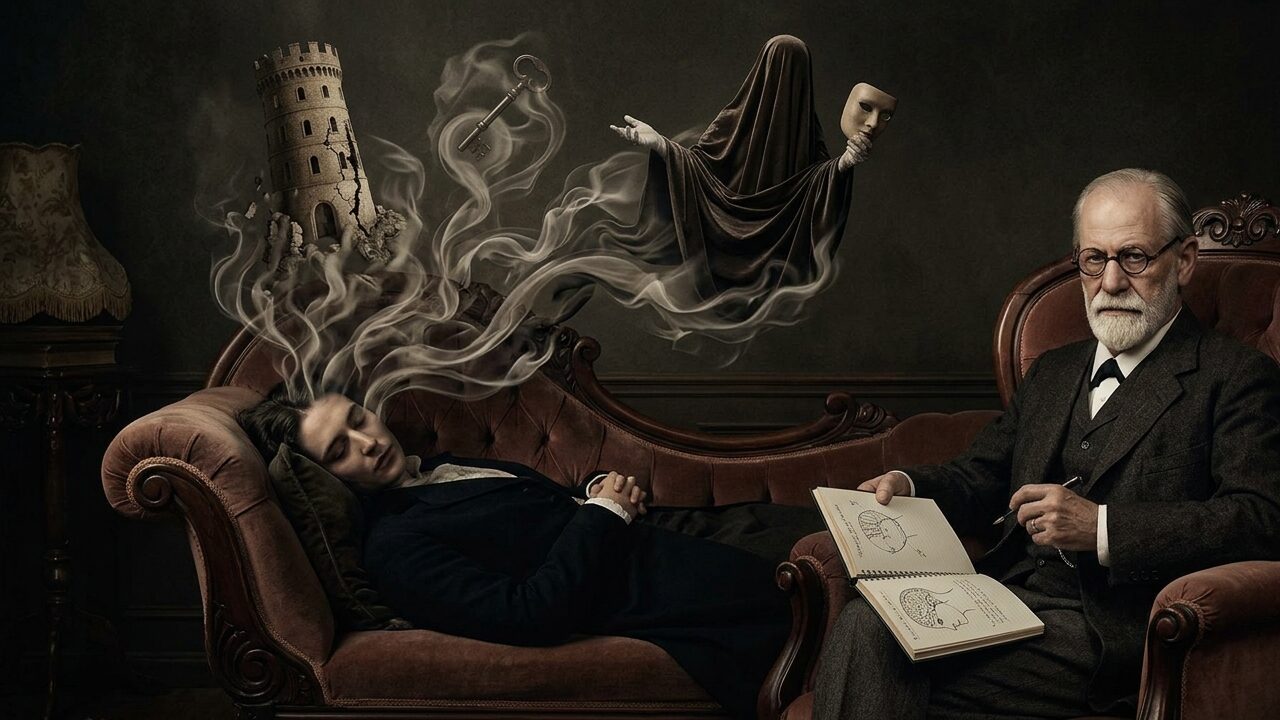
Every night, as we close our eyes and drift into sleep, our minds transport us to bizarre, vivid, and sometimes terrifying alternative realities. Dreams have fascinated humanity since the dawn of time. Ancient civilizations viewed them as messages from the gods or prophetic visions of the future. Today, neuroscientists and psychologists are using advanced brain-imaging technologies to uncover the true purpose of dreaming. While the exact reason remains one of the great mysteries of human biology, science has provided several compelling theories to explain why our brains put on this nightly cinematic show.
The Mystery of the Sleeping Mind
Dreams have always fascinated us because they can be so strange, funny, or even inspiring. Sometimes we wake up laughing at the odd stories our minds create, and other times a good dream leaves us in a happy mood all morning. Dreams feel like a secret world where anything is possible, and that makes them special.
They also remind us how powerful our imagination is. Even while we sleep, our minds are busy creating stories and pictures that can affect how we feel the next day. A good dream can give us energy, while a bad one can make us thoughtful. Either way, dreams show us that our inner world is just as colorful as the one we see when we are awake.
| The Psychology of Dreams | |
|---|---|
| Primary Sleep Stage | REM (Rapid Eye Movement) |
| Average Dreams Per Night | 3 to 6 dreams |
| Pioneering Theorists | Sigmund Freud, Carl Jung |
| Modern Theories | Activation-Synthesis, Memory Consolidation |
| Common Themes | Falling, being chased, flying |
| Latest Research (2026) | fMRI decoding of dream content; links to creativity & emotional health |
1. The Freudian View: The Window to the Unconscious
In the late 19th and early 20th centuries, the famous psychoanalyst Sigmund Freud revolutionized how we view dreams. In his landmark book, The Interpretation of Dreams (1899), Freud proposed that dreams are the “royal road to the unconscious.” According to Freud, our waking minds actively repress hidden desires, fears, and socially unacceptable thoughts. When we sleep, these defense mechanisms relax, allowing our repressed desires to surface in disguised forms. For example, dreaming of a locked door might not just be a door, but a symbol of a hidden emotional barrier.
2. Carl Jung and the Collective Unconscious
Freud’s protégé, Carl Jung, took a different approach. Jung believed that dreams were not just about repressed individual desires, but a way for the psyche to communicate and achieve balance. He introduced the concept of the Collective Unconscious—a shared, inherited reservoir of human memories and symbols called Archetypes. This is why people from completely different cultures and backgrounds often have identical dreams, such as encountering a wise old man, a frightening shadow figure, or experiencing a great flood.
3. The Modern Science: Activation-Synthesis Hypothesis
Moving away from psychoanalysis, modern neuroscience offers a more biological explanation. In 1977, Harvard psychiatrists J. Allan Hobson and Robert McCarley introduced the Activation-Synthesis Hypothesis. They discovered that during REM sleep, circuits in the brainstem are randomly activated, sending chaotic electrical signals to the cerebral cortex. The cortex, which is our brain’s logic and storytelling center, desperately tries to make sense of these random signals, “synthesizing” them into a cohesive (albeit often bizarre) narrative. In this view, dreams are simply the brain’s attempt to find meaning in random neural static.
4. Information Processing and Memory Consolidation
One of the most widely accepted scientific theories today is that dreaming is an essential part of organizing memory. Every day, our brains are bombarded with millions of pieces of sensory information. The Information-Processing Theory suggests that we dream in order to sort through this massive data dump. During sleep, the brain actively sifts through the day’s experiences, transferring important information from short-term to long-term memory while deleting useless “junk” data. Dreams may be a byproduct of this nocturnal filing system.
5. Modern Neuroscience: Dreams, Creativity & Emotional Processing
Recent brain-imaging studies (including fMRI research from the 2020s) show that dreams do far more than just replay the day. They actively help process emotions, reduce the intensity of painful memories, and boost creative problem-solving. People who remember their dreams often perform better on insight-based tasks the next morning. Many famous breakthroughs — from Paul McCartney hearing the melody for “Yesterday” in a dream to chemist Dmitri Mendeleev visualizing the periodic table — happened during sleep. In short, your brain uses dreams as an overnight workshop for creativity and emotional healing.
6. The Evolutionary View: Threat Simulation Theory
Why are so many of our dreams anxious or frightening? The Threat Simulation Theory proposes an evolutionary answer. Finnish cognitive neuroscientist Antti Revonsuo argues that dreaming acts as an ancient biological defense mechanism. By simulating threatening events—like being chased by a predator, falling from a height, or facing a hostile enemy—our brains allow us to practice our “fight or flight” responses in a safe environment. This mental rehearsal gave our early human ancestors a better chance of surviving real-world dangers.
7. Lucid Dreaming: Taking Control of the Narrative
Perhaps the most fascinating phenomenon within dream psychology is Lucid Dreaming. This occurs when a person becomes consciously aware that they are dreaming while the dream is still happening. Once lucidity is achieved, the dreamer can often consciously control the environment, the characters, and the narrative—such as deciding to fly or changing the scenery. Scientists have confirmed lucid dreaming exists using brain scans, showing that during a lucid dream, the prefrontal cortex (the area responsible for self-awareness and logic) “wakes up” while the rest of the brain remains in REM sleep.