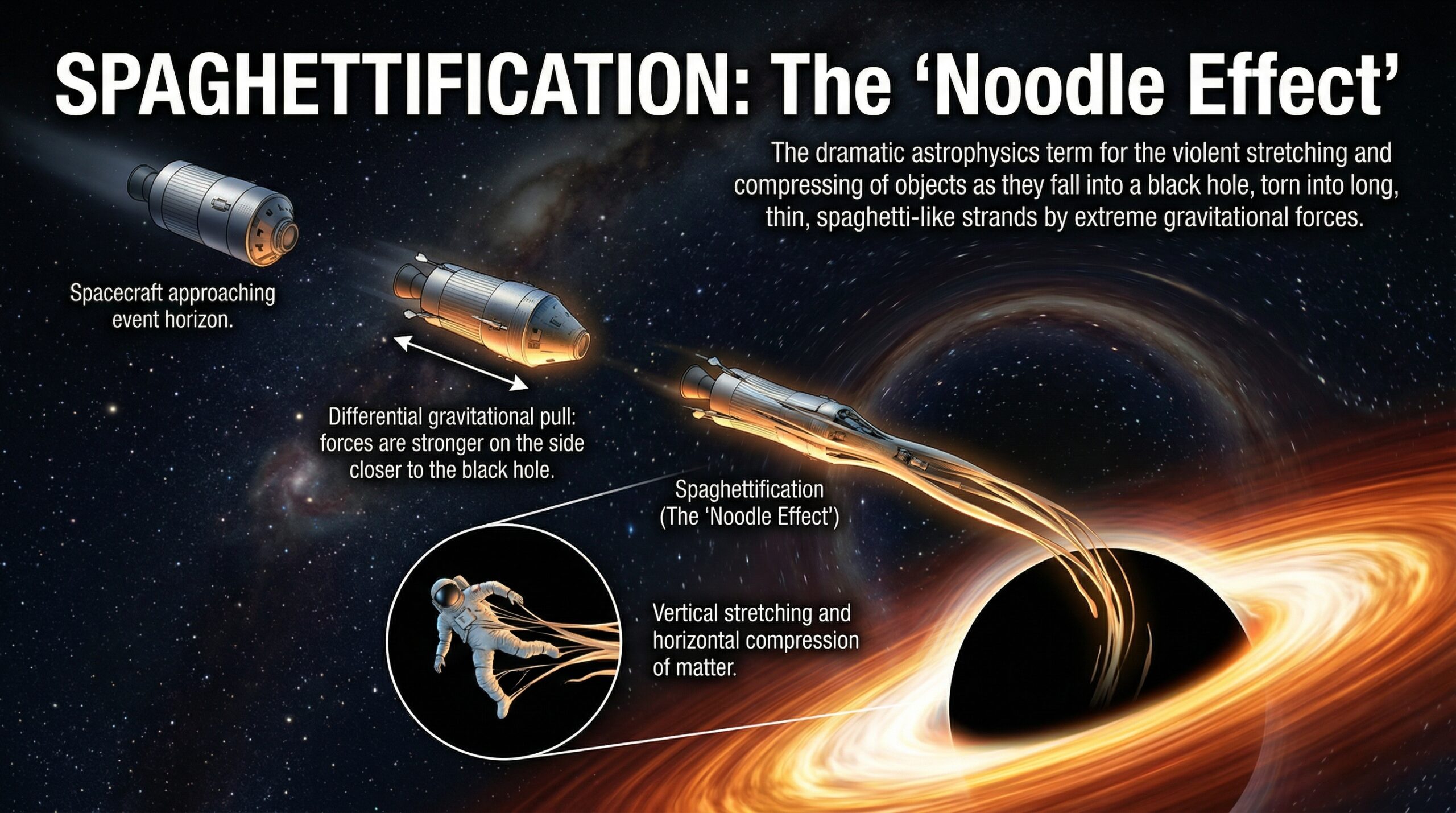
Spaghettification, sometimes referred to as the “noodle effect,” is a dramatic astrophysics term used to describe the violent stretching and compressing of objects as they fall into a black hole. Driven by extreme gravitational forces, this phenomenon literally tears matter apart into long, thin, spaghetti-like strands before it is swallowed entirely by the void.
The Ultimate Cosmic Shredder
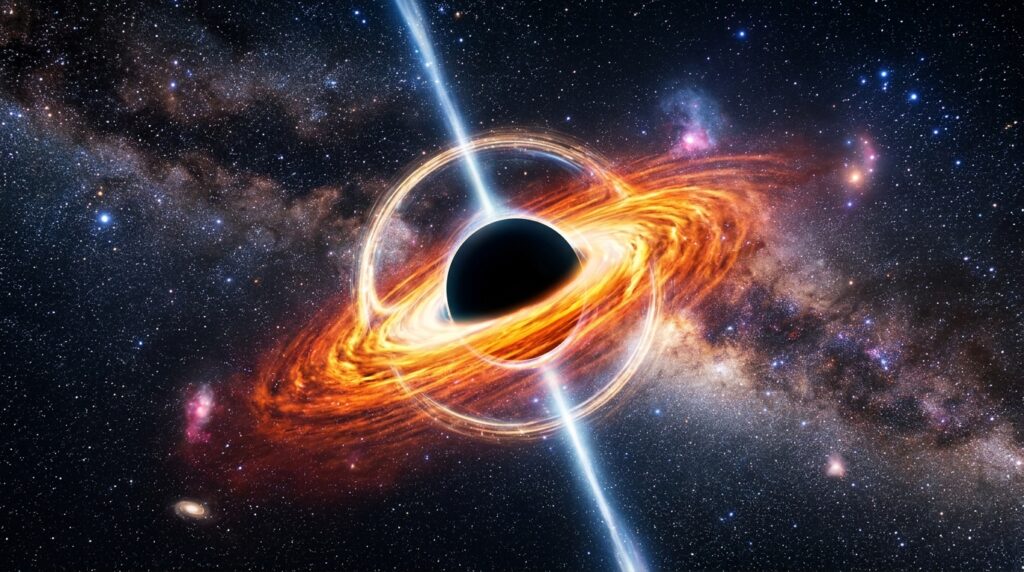
Black holes are both terrifying and fascinating. The idea that gravity can be so strong it pulls in everything around it even light itself is almost impossible to imagine. Scientists say that if a person or even a star gets too close, the force can stretch and change its shape completely. It shows the raw, unstoppable power hidden in the universe.
At the same time, black holes spark wonder because they remind us how much we still don’t know. They are mysteries waiting to be solved, places where the laws of physics bend in ways we can barely understand. Thinking about them makes us realize how small we are compared to the vast, powerful forces shaping the cosmos.
| Spaghettification | |
|---|---|
| Alternative Name | The Noodle Effect |
| Primary Cause | Extreme Tidal Forces |
| Location | Near a Black Hole’s Event Horizon |
| Popularized By | Stephen Hawking (1988) |
| Physical Effect | Vertical stretch, horizontal squeeze |
| Astronomical Term | Tidal Disruption Event (TDE) |
1. The Physics of the “Noodle Effect”
To understand spaghettification, you first need to understand the concept of a gravitational gradient. Gravity gets stronger the closer you are to a massive object. On Earth, the gravity pulling on your feet is technically slightly stronger than the gravity pulling on your head, but the difference is so incredibly tiny that you don’t feel it.
However, near a black hole, the gravitational field is so intensely compressed that the gradient becomes deadly. If you fell feet-first toward a black hole, the gravity pulling on your feet would be millions of times stronger than the gravity pulling on your head. This difference in force, known as a tidal force, is what causes the stretching.
2. Vertical Stretch and Horizontal Squeeze
Spaghettification doesn’t just pull you like a piece of taffy; it also crushes you from the sides. Because all matter is being pulled toward the exact center of the black hole (the singularity), the left and right sides of your body are pulled slightly inward toward each other.
The combination of being forcefully pulled downward at your feet, held back at your head, and crushed inward from your sides results in any object whether it’s a spaceship, a human, or an entire planet being extruded into a long, incredibly thin stream of subatomic particles.
3. Small vs. Supermassive Black Holes
Counterintuitively, your chances of avoiding spaghettification depend heavily on the size of the black hole. You are actually in more immediate danger near a small one.
- Stellar-Mass Black Holes: These are relatively small (about 10 times the mass of our sun) and have a very tight, extreme gravitational gradient. If you approach one, the tidal forces are so severe that you would be spaghettified thousands of miles before you even reach the Event Horizon (the point of no return).
- Supermassive Black Holes: These monsters sit at the center of galaxies and are millions or billions of times heavier than our sun. Because they are so massive, their Event Horizon is huge, making the gravitational gradient at the edge much gentler. You could theoretically cross the Event Horizon of a supermassive black hole without feeling a thing though you would eventually be spaghettified as you drifted closer to the center.
4. Have We Ever Seen It Happen?
Yes! While scientists obviously cannot throw objects into a black hole to test it, astronomers frequently observe this phenomenon happening to unlucky stars. When a star wanders too close to a supermassive black hole, it is ripped apart in a brilliant flash of light.
In astrophysics, this is known as a Tidal Disruption Event (TDE). Telescopes have captured the glowing, spaghetti-like streams of stellar gas swirling around a black hole right before being consumed, providing undeniable visual proof of the phenomenon.