
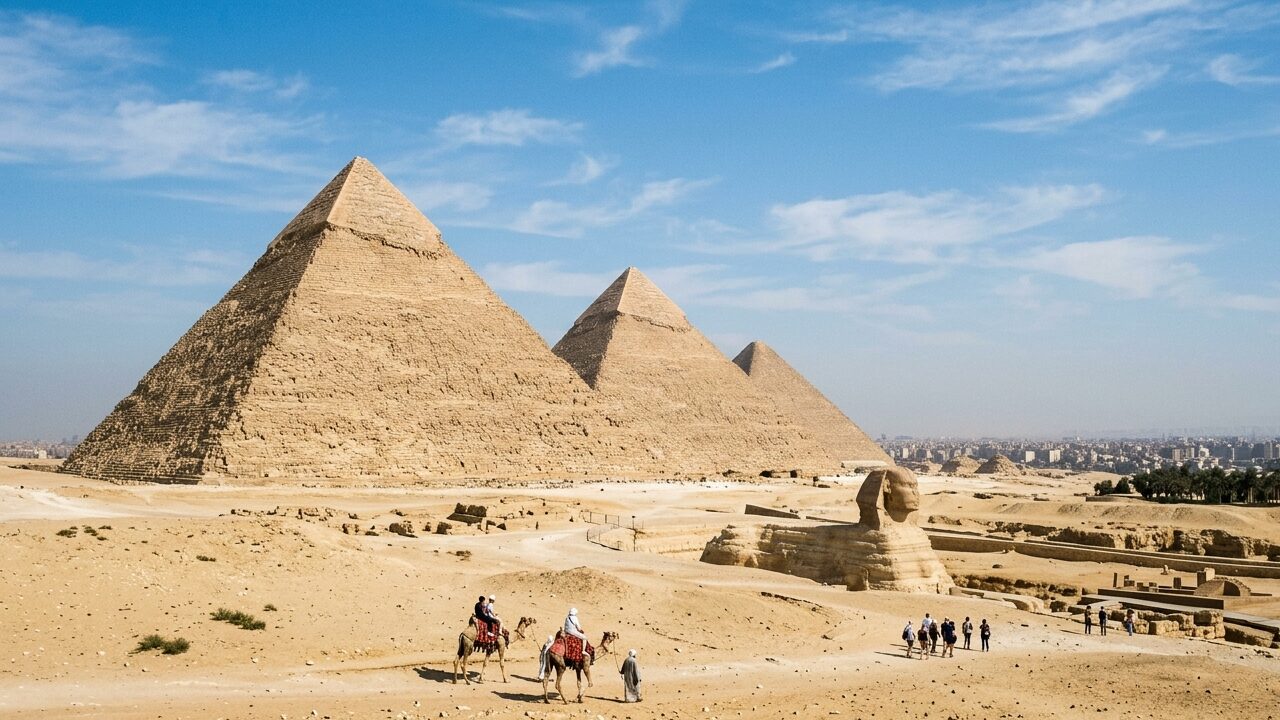
For over 4,500 years, the Great Pyramids of Giza have stood as a testament to human ingenuity, resilience, and ambition. As the last surviving structure of the original Seven Wonders of the Ancient World, the Great Pyramid of Khufu continues to baffle scientists, historians, and engineers. How did an ancient civilization, lacking iron tools, wheels, or modern machinery, quarry, transport, and perfectly align over two million massive stone blocks? Let’s explore the scientific facts, the brilliant engineering, and the enduring myths surrounding Egypt’s greatest marvel.
The Mystery of Ancient Marvels
Ancient history has always amazed us because it feels like stepping into another world. Standing in front of something built thousands of years ago makes us realize how much effort and creativity people had even without modern machines. It gives a sense of connection to the past, showing that human imagination and skill have always been powerful.
What excites us most are the mysteries that still surround ancient times. From pyramids to lost cities, these stories capture our imagination and remind us that there is so much we still don’t fully understand. Ancient history is not just about old stones—it is about human dreams, struggles, and achievements that continue to inspire us today.
| The Great Pyramid of Giza | |
|---|---|
| Pharaoh | Khufu (Cheops) |
| Completion Year | c. 2560 BC |
| Original Height | 146.6 meters (481 feet) |
| Total Blocks | Estimated 2.3 Million |
| Base Accuracy | Aligned to True North |
| Latest Discoveries | North Face Corridor (2023) & ongoing Big Void exploration |
1. The Engineering Mystery: How Were They Built?
The construction of the Great Pyramid required moving an estimated 2.3 million limestone and granite blocks, some weighing up to 80 tons. Modern archaeologists believe the Egyptians used a massive system of ramps to haul the stones upward. While the exact shape of the ramps (straight, zigzag, or spiraling inside the pyramid) is still heavily debated, recent discoveries have shed light on how they moved the stones across the desert. Workers placed the massive blocks on wooden sledges. To reduce friction, they poured water on the sand directly in front of the sledge. This simple but brilliant physics trick halved the pulling force required to move the stones.
Modern Technology Reveals New Secrets: The ScanPyramids Breakthroughs
Thanks to cutting-edge non-invasive scanning techniques, we are still discovering hidden features inside the 4,500-year-old structure. The international ScanPyramids project has used muon radiography (cosmic-ray imaging), ground-penetrating radar, ultrasound, and electrical resistivity tomography to peer through solid stone without drilling a single hole. In 2023, researchers confirmed a previously unknown 9-meter-long “North Face Corridor” hidden behind the original entrance. In 2025, multi-modal imaging further verified this corridor, proving the pyramid still conceals carefully engineered internal spaces. A new mission is now underway to explore the massive “Big Void” discovered in 2017 — the largest hidden chamber found in the pyramid in modern times.
2. Debunking the Myth: Slaves Did Not Build the Pyramids
One of the most persistent myths—fueled by Hollywood movies and early Greek historians—is that the pyramids were built by thousands of brutalized slaves. Archaeological excavations at the Giza worker’s village have completely debunked this. The builders were actually highly skilled artisans, architects, and paid laborers. During the annual flooding of the Nile River, when farming was impossible, thousands of farmers were conscripted by the state to work on the pyramid. They were well-fed with premium meat and beer, received advanced medical care for broken bones, and were given honorable burials near the pharaoh’s tomb. Modern estimates place the average workforce at 20,000–30,000 people, with a smaller core of permanent skilled workers.
3. Aliens and Atlantis: The Conspiracy Theories
Because the engineering is so precise, many conspiracy theorists argue that humans could not have built the pyramids alone. Popular myths suggest the involvement of extraterrestrial beings or the lost advanced civilization of Atlantis. However, these theories ignore the clear, documented evolution of Egyptian pyramid building. Before the perfect, smooth-sided Great Pyramid, the Egyptians built stepped structures like the Pyramid of Djoser, and experienced engineering failures like the collapsed “Bent Pyramid.” The Great Pyramid is the result of centuries of human trial, error, and architectural evolution, not alien intervention.
4. The Precision of the Heavens: Alignment and Astronomy
The Great Pyramid is not just a monumental tomb; it is a massive astronomical instrument. Its four sides are almost perfectly aligned to the four cardinal points of the compass (True North, South, East, and West) with an incredibly small margin of error. Egyptologists believe the ancient builders achieved this astonishing accuracy by tracking the path of the sun and observing the circumpolar stars using simple vertical measuring rods. Furthermore, the descending passages inside the pyramid were aligned to point directly toward the pole star of that era, Thuban.
5. What Lies Inside? New Discoveries
For centuries, explorers believed they had found all the main rooms inside the Great Pyramid: the King’s Chamber, the Queen’s Chamber, and the Grand Gallery. However, modern technology is proving us wrong. The ScanPyramids project has already revealed a hidden corridor and a massive “Big Void” above the Grand Gallery. Ongoing research and new missions in 2025 continue to scan the structure, confirming that the pyramid still holds profound secrets waiting to be uncovered.