While humanity has mapped the surface of the Moon and sent rovers to Mars, our own planet’s oceans remain largely unexplored. At the very edge of this unknown frontier lies the Mariana Trench, a crescent-shaped scar in the Earth’s crust located in the western Pacific Ocean. It is the deepest oceanic trench on the planet, a place of total darkness, freezing temperatures, and crushing pressure. Yet, against all odds, this alien environment is not a barren wasteland, but a thriving ecosystem full of bizarre creatures and geological wonders.
The Mysteries of the Deep Ocean
The deep ocean has always fascinated us because it feels like another world hidden beneath our feet. It is strange to think that we know more about outer space than we do about the bottom of our own oceans. The idea that so much of the sea remains unexplored makes it one of the greatest mysteries of nature.
Ocean exploration is exciting because it reminds us how much is still unknown. From strange creatures to hidden landscapes, the deep sea holds secrets that could change the way we understand life on Earth. The mystery of the ocean keeps our imagination alive and shows us that discovery is not limited to the stars—it is waiting right here in the waters around us.
| The Mariana Trench | |
|---|---|
| Location | Western Pacific Ocean, near the Mariana Islands |
| Deepest Point | Challenger Deep |
| Maximum Depth | Approx. 10,984 meters (36,037 feet) |
| Pressure at Bottom | Over 1,000 times standard atmospheric pressure (≈1,100 atm) |
| First Descent | 1960 (Jacques Piccard & Don Walsh in the Trieste) |
| Formation Type | Tectonic Subduction Zone |
| Length | ≈2,550 km (1,580 miles) |
1. How Deep is the Deepest Point?
To truly understand the sheer scale of the Mariana Trench, we have to look at its lowest point, known as the Challenger Deep. It plunges nearly 11 kilometers (about 7 miles) beneath the surface of the ocean. To put that into perspective, if you were to take Mount Everest — the tallest mountain on Earth at 8,848 meters — and drop it upside down into the Challenger Deep, its peak would still be completely submerged by more than two kilometers of water.
2. An Environment of Crushing Extremes
Descending into the trench is like traveling to another planet. Sunlight can only penetrate a few hundred meters into the ocean, so the Mariana Trench exists in absolute, perpetual darkness. The water temperature stays just above freezing, usually between 1°C and 4°C (34°F to 39°F). Yet the most extreme factor is the pressure — at the bottom it reaches more than 1,000 times the air pressure at sea level, or roughly 8 tons pressing on every square inch. That’s the same as having about 50 jumbo jets stacked on a single person.
3. Monsters of the Abyss: Bizarre Deep-Sea Life
For decades, scientists believed nothing could survive here. They were wrong. The trench teems with life specially adapted to the crushing darkness and pressure. The record holder is the translucent Mariana snailfish, the deepest-living fish ever observed. You’ll also find giant single-celled xenophyophores that can grow larger than a human hand, enormous amphipods, and species that produce their own light through bioluminescence to hunt, communicate, or find mates in the total blackness.
4. How Was the Trench Formed?
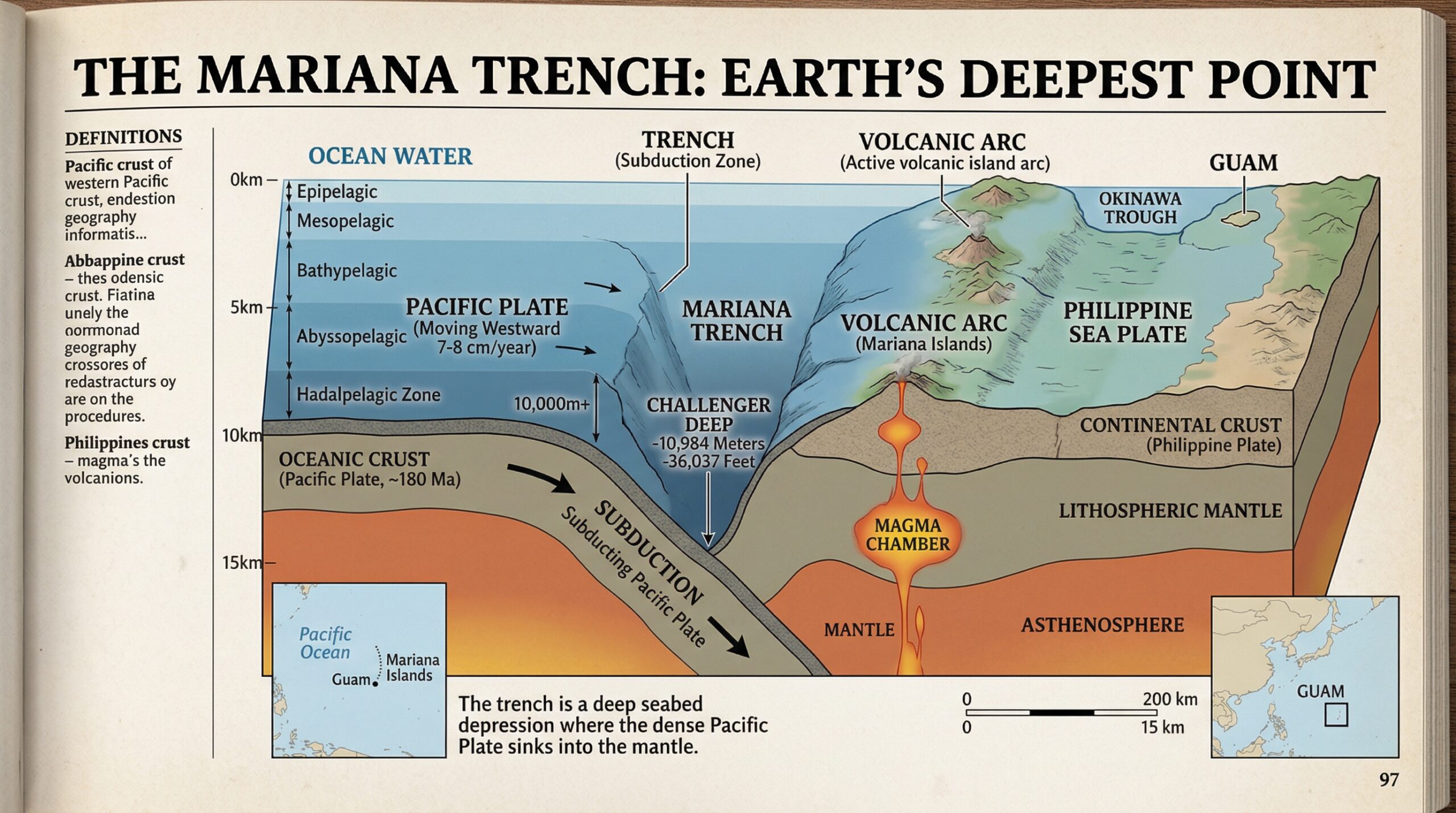
The Mariana Trench is a geological marvel created by the violent dance of Earth’s tectonic plates. It lies at a classic subduction zone, where the massive Pacific Plate is slowly forced beneath the smaller Mariana Plate. As the older, denser Pacific Plate sinks into the mantle, it drags the seafloor down with it, forming this immense V-shaped canyon. This same movement fuels frequent powerful earthquakes and volcanic activity along the nearby Mariana Arc.
5. A Sad Discovery: Plastic in the Deep
Even the most remote place on Earth is not untouched by humans. During the record-breaking 2019 dive by explorer Victor Vescovo, scientists found a plastic shopping bag and candy wrappers lying on the seafloor of the Challenger Deep. Later studies showed that tiny crustaceans living there had already ingested microplastics. This discovery proves that human pollution has reached every corner of the planet — even 11 kilometers underwater.