
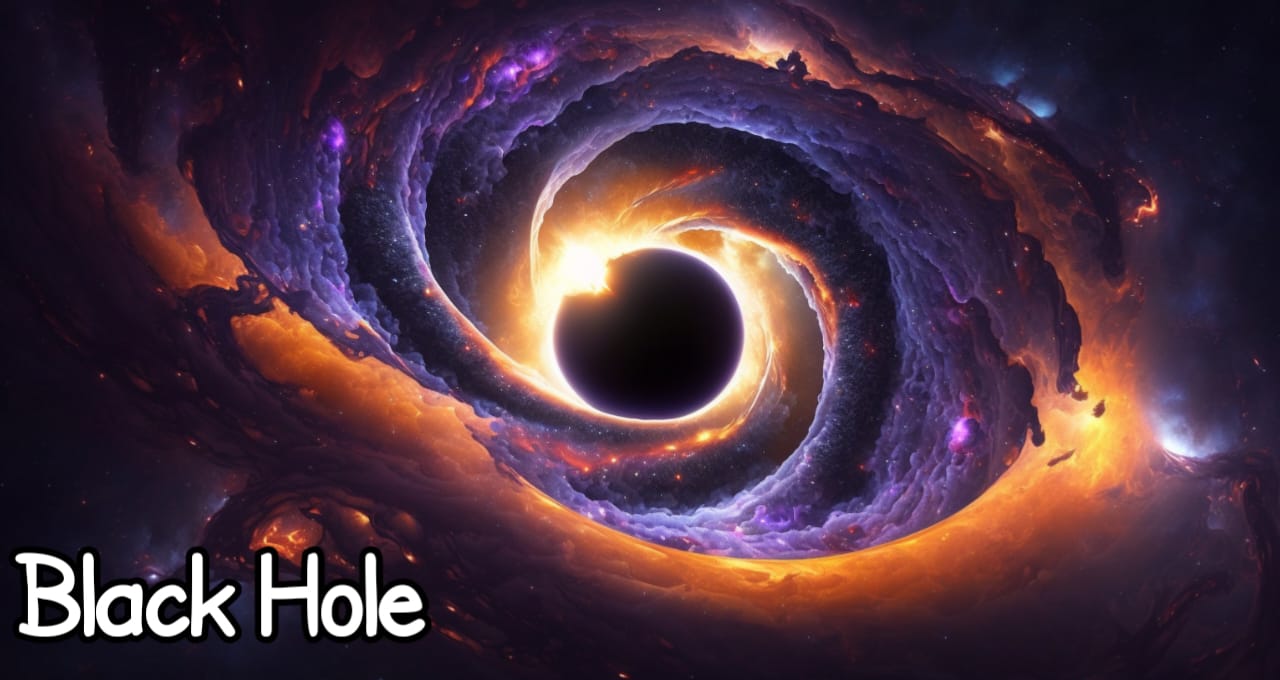
Of all the mysteries in the universe, nothing captures human imagination quite like a Black Hole. These cosmic titans are regions in space where the pulling force of gravity is so intense that absolutely nothing—not even light, the fastest thing in the universe—can escape their grasp. Invisible, infinitely dense, and capable of bending the very fabric of space and time, black holes challenge our deepest understanding of physics and the laws of nature.
The Wonders of the Cosmos
Looking up at the stars has always filled us with wonder. The vastness of the universe makes our everyday problems feel small, reminding us that there is so much more beyond our little world. Each star feels like a mystery waiting to be understood, and thinking about galaxies far away gives us a sense of endless possibility.
Learning about space is exciting because it shows how much we still have to discover. From planets that may hold life to black holes that challenge our imagination, space teaches us curiosity and patience. For us, exploring the universe is not just about science—it is about dreaming bigger and realizing how connected we are to something greater.
| Anatomy of a Black Hole | |
|---|---|
| Core Concept | Region of spacetime with extreme gravity |
| Boundary | The Event Horizon (Point of no return) |
| Center | The Singularity (Infinite density) |
| Key Theorists | Albert Einstein, Karl Schwarzschild, Stephen Hawking |
| First Image Captured | 2019 (Event Horizon Telescope) |
1. How is a Black Hole Born?
Most common black holes are born from the violent death of massive stars. When a star at least three to ten times the mass of our Sun runs out of nuclear fuel, it can no longer support its own heavy weight. The core collapses inward in a fraction of a second, causing a massive explosion known as a Supernova. If the remaining core is heavy enough, it continues to collapse until it shrinks into a single point of infinite density. A stellar-mass black hole is born, pulling in surrounding gas and dust to grow even larger over time.
2. The Anatomy: Event Horizon and Singularity
A black hole primarily consists of two main parts. The first is the Event Horizon, which is the invisible boundary surrounding the black hole. It represents the “point of no return.” Once anything crosses this line, the escape velocity exceeds the speed of light, making return impossible. At the very center lies the Singularity, a mysterious point where all the mass is crushed into zero volume. Here, the standard laws of physics completely break down, and scientists still do not fully understand what happens inside.
3. What Happens If You Fall In? (Spaghettification)
If a person were to fall toward a black hole, they would experience a terrifying phenomenon that scientists playfully call Spaghettification. Because gravity gets stronger the closer you get, the pull on your feet would be vastly stronger than the pull on your head. This would stretch your body out into a long, thin noodle shape. Additionally, due to extreme gravity, time would slow down for you relative to an outside observer—a concept known as time dilation. To someone watching from far away, you would appear to freeze at the edge of the event horizon forever.
4. Supermassive Monsters in the Dark
While stellar-mass black holes are relatively small, there are much larger beasts lurking in the universe: Supermassive Black Holes. These giants are millions to billions of times more massive than our Sun. Scientists believe that one of these supermassive black holes exists at the center of almost every large galaxy, including our own Milky Way, where a giant named Sagittarius A* resides. How they grow so large remains one of the greatest unsolved mysteries in astronomy, though some theories suggest they are formed by the merging of thousands of smaller black holes over billions of years.
5. Primordial Black Holes: Relics of the Big Bang
Not all black holes come from dead stars. Theoretical physicists suggest that shortly after the Big Bang, the universe was incredibly dense and chaotic. Pockets of this extremely dense matter may have collapsed on themselves, forming Primordial Black Holes. These ancient black holes could be as tiny as a single atom but weigh as much as an entire mountain. While none have been officially discovered yet, many scientists believe they could make up a portion of the mysterious “Dark Matter” that holds our universe together.
6. Do Black Holes Die? (Hawking Radiation)
For a long time, scientists thought nothing could ever leave a black hole. However, in 1974, the brilliant physicist Stephen Hawking proposed a groundbreaking theory. He suggested that black holes slowly leak tiny particles of energy back into space. This phenomenon is now known as Hawking Radiation. Because they are losing energy, black holes are actually shrinking. Given enough time—trillions of years—a black hole will eventually evaporate completely in a massive flash of energy.
7. Wormholes and White Holes: Portals to Other Dimensions?
In the realm of theoretical physics and science fiction, black holes are often linked to Wormholes. According to Einstein’s equations of general relativity, the intense gravity of a black hole might punch a hole through spacetime, creating a tunnel to another part of the universe. The exit of this tunnel is theorized to be a White Hole—a cosmic object that pushes matter and light out and allows nothing to enter. While mathematically possible, white holes and wormholes remain purely theoretical and have never been observed.
8. How Do We “See” the Invisible?
If black holes trap all light, how do we know they are there? Astronomers detect them by observing their effect on nearby objects. If a black hole passes through a cloud of interstellar matter or is close to a star, it pulls matter inward. This matter forms an “accretion disk” around the black hole, spinning incredibly fast, heating up to millions of degrees, and emitting powerful X-rays that telescopes can detect. In 2019, the Event Horizon Telescope collaboration made history by capturing the first-ever actual image of a black hole’s silhouette in the galaxy M87.