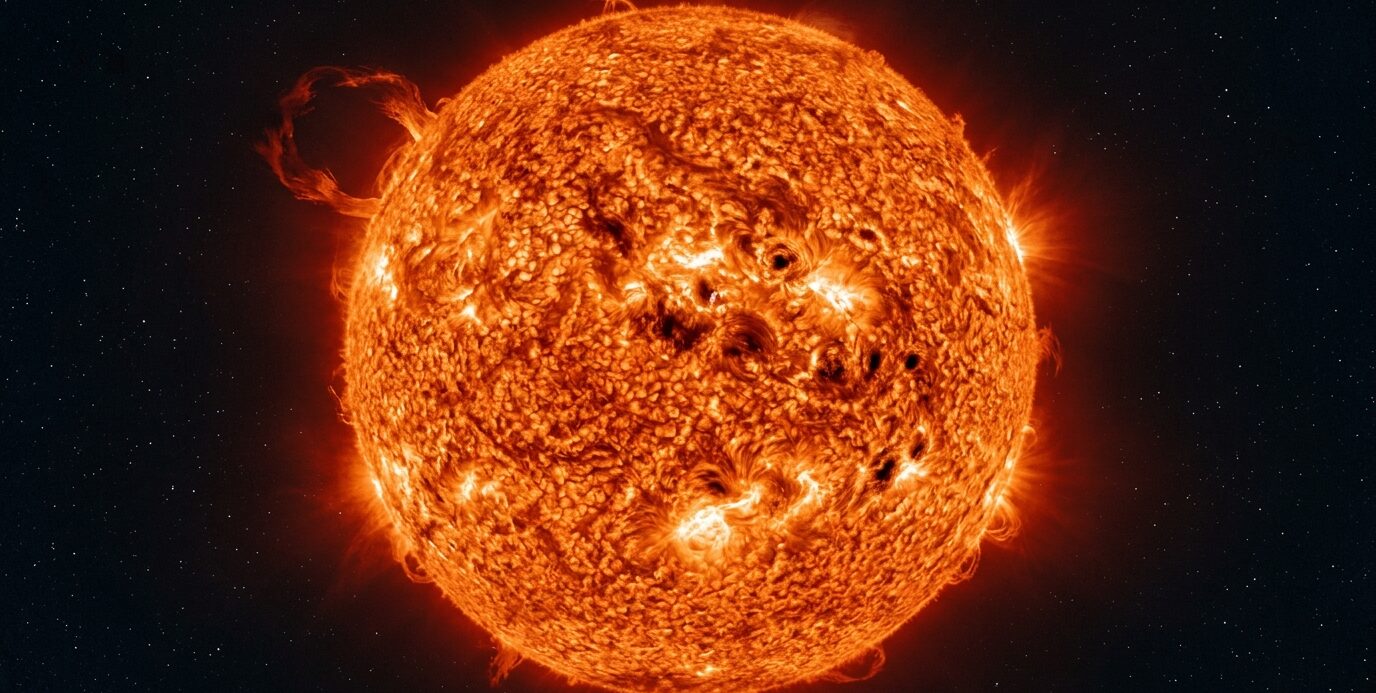
The Sun is the star at the absolute center of our Solar System. It is a nearly perfect sphere of incredibly hot plasma, generating an unfathomable amount of energy through nuclear fusion. By providing the light, heat, and gravitational anchor necessary to keep the planets in orbit, the Sun is the ultimate source of energy driving the climate, weather, and the existence of all life on Earth.
The Heart of Our Solar System
The Sun is one of the most powerful and awe‑inspiring forces in our lives. This single glowing sphere silently dictates everything that happens on Earth from growing our food to powering our weather systems. Its light and warmth make life possible, and without it, our planet would be nothing more than a frozen rock drifting in space.
It is humbling to realize that our entire world revolves around this one massive star. Every sunrise reminds us of the Sun’s quiet strength, and every sunset shows its beauty. Thinking about its scale and influence makes us appreciate how fragile and precious life on Earth truly is, and how deeply connected we are to the rhythms of the universe.
| The Sun At A Glance | |
|---|---|
| Age | ~4.6 Billion Years |
| Star Type | Yellow Dwarf (G-Type) |
| Diameter | 1.39 million km (864,000 miles) |
| Distance from Earth | ~149.6 Million km (1 AU) |
| Core Temperature | 15 million °C (27 million °F) |
| Surface Temperature | ~5,500 °C (10,000 °F) |
| Observation Hub | Lagrange Point 1 (L1) |
1. Size, Distance, and Unimaginable Mass
The scale of the Sun is notoriously difficult for the human brain to process. It sits at an average distance of 149.6 million km (93 million miles) from Earth. Even traveling at the absolute speed of light (300,000 km per second), it still takes sunlight roughly 8 minutes and 20 seconds to cross that vast emptiness and reach our eyes.
In terms of size, the Sun is a true behemoth. It accounts for a staggering 99.8% of all the mass in the entire Solar System. To put its volume into perspective: you could line up 109 Earths side-by-side just to stretch across the face of the Sun, and it would take 1.3 million Earths to completely fill the volume inside it.
2. What is the Sun Made Of? The Nuclear Engine
Unlike Earth, the Sun does not have a solid surface. It is composed entirely of electrically charged, super-heated gas known as plasma. The chemical makeup of the Sun is relatively simple: it is roughly 73% Hydrogen, 25% Helium, and trace amounts of heavier elements like oxygen, carbon, neon and iron.
The secret to the Sun’s power lies in its core. The crushing gravity of all that plasma pushes inward, raising the core temperature to an astonishing 15 million °C (27 million °F). Under this extreme pressure and heat, a process called nuclear fusion occurs. Hydrogen atoms are violently smashed together to form heavier helium atoms. This reaction releases a huge amount of energy the equivalent of billions of nuclear bombs detonating every single second. This energy radiates outward, eventually shining into space as light and heat.
3. Anatomy of the Sun: Layers of Plasma
Even though it is a ball of gas, the Sun has distinct, highly structured layers:
- The Core: The innermost 20% of the Sun where nuclear fusion takes place.
- The Radiative Zone: The dense layer surrounding the core. Energy from the core travels incredibly slowly through this zone; it can take a photon of light up to 100,000 years just to bounce its way through this dense layer of plasma.
- The Convective Zone: Here, hot plasma rises to the surface, cools, and sinks back down again, operating exactly like a pot of boiling water.
- The Photosphere: This is the visible “surface” of the Sun that emits the light we see on Earth. It is surprisingly cool compared to the core, sitting at about 5,500 °C (10,000 °F).
- The Corona: The Sun’s faint, wispy outer atmosphere. In one of astrophysics’ greatest mysteries, the Corona is actually much hotter than the surface below it, reaching temperatures over 1 million °C. It is only visible to the naked eye during a total solar eclipse.
4. Lagrange Points: Cosmic Parking Spots
Studying the Sun from Earth is difficult because our planet rotates, meaning we can only see the Sun during the day. To solve this, scientists park solar observatories in Lagrange Points.
Lagrange points are specific locations in space where the gravitational pull of the Earth and the gravitational pull of the Sun perfectly balance out the centripetal force required for a small object to move with them. The most important of these is Lagrange Point 1 (L1). Located about 1.5 million km (1 million miles) directly between the Earth and the Sun, a satellite parked at L1 is never blocked by the Earth’s shadow, giving it an uninterrupted, 24/7 view of our star.
5. Modern Solar Missions: Touching the Star
In the modern era of space exploration, multiple international space agencies have launched cutting-edge robotic missions to unlock the Sun’s final mysteries:
- Parker Solar Probe (NASA – USA): This historic spacecraft is the first human-made object to “touch” the Sun. Using a revolutionary carbon-composite heat shield, it actively dives directly into the Sun’s blistering Corona to sample plasma and measure the magnetic field.
- Solar Orbiter (ESA – Europe): A joint mission between the European Space Agency and NASA, this satellite is taking the closest-ever high-resolution images of the Sun. Crucially, its orbit allows it to fly over and photograph the Sun’s completely unmapped North and South poles.
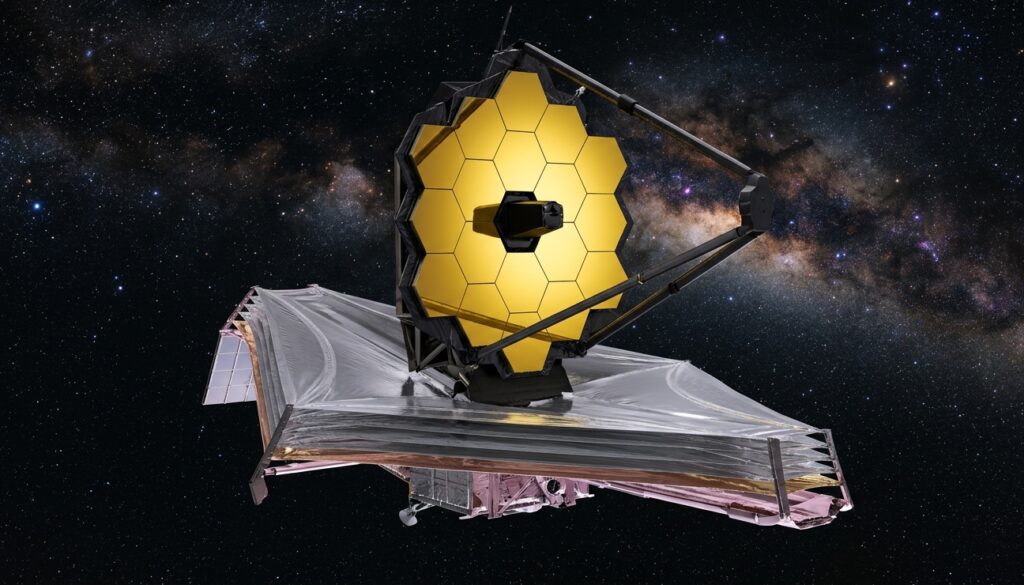
- Aditya-L1 (ISRO – India): India’s first dedicated solar mission. Parked securely at the L1 Lagrange point, this advanced observatory carries seven scientific payloads to study the photosphere, the corona, and the devastating mechanics of solar space weather in real-time.
6. Sunspots, Flares, and Space Weather
The Sun is incredibly dynamic and violent. Because it is made of plasma, it doesn’t spin at a uniform speed. The equator rotates much faster (every 25 days) than the poles (every 35 days). This differential rotation twists and tangles the Sun’s massive magnetic field lines.
When these magnetic lines poke through the surface, they create sunspots dark patches that are slightly cooler than the surrounding plasma. When these tangled magnetic lines snap and reconnect, they cause massive explosions known as Solar Flares and Coronal Mass Ejections (CMEs). These events hurl billions of tons of highly charged particles toward Earth. If a CME hits us, our magnetic field largely protects us, resulting in beautiful auroras, but a severe direct hit could fry electrical grids and destroy modern satellites.
7. The Lifecycle: How Will the Sun Die?
The Sun is a G-Type Main-Sequence star (often called a Yellow Dwarf). It was born about 4.6 billion years ago and is currently in the stable middle-age of its life. It has enough hydrogen fuel to keep burning peacefully for another 5 billion years.
Eventually, the core will run out of hydrogen. When this happens, gravity will temporarily win the battle, crushing the core until it is hot enough to start burning helium. This will cause the outer layers of the Sun to swell immensely, turning it into a Red Giant. As it expands, it will completely swallow Mercury, Venus, and likely Earth. Finally, the outer layers will drift away to form a beautiful planetary nebula, leaving behind only the glowing, dead, ultra-dense core a White Dwarf that will slowly cool into darkness over trillions of years.
8. The Science of Sunlight: Sunrises, Sunsets, and Twilight
While sunlight looks perfectly white to the human eye, it actually contains the entire continuous spectrum of visible light. When this light passes through a prism or raindrops, it spreads out into the familiar rainbow sequence: red, orange, yellow, green, blue, indigo, and violet. Violet has the shortest wavelength, while red has the longest.
This spectrum is exactly why our sunrises and sunsets are so spectacularly colorful. During the day, the Sun is high in the sky. As its light hits Earth’s atmosphere, the shorter blue and violet wavelengths are scattered strongly in all directions, making the sky look blue. However, when the Sun is low on the horizon at dawn and dusk, its light must travel a much longer path through a thicker layer of atmosphere. This long journey scatters away almost all the blue light, allowing only the longer, warmer wavelengths red, orange, and golden yellow to reach our eyes. Dust, smoke, and water droplets can make these twilight colors even richer.
Furthermore, daylight does not vanish the second the Sun sinks below the horizon. The atmosphere continues to scatter sunlight from below the curvature of the Earth, creating a fading-light period known as twilight. Depending on how far the Sun is below the horizon, meteorologists divide this gap into civil, nautical, and astronomical twilight. This is why the sky changes so beautifully from bright orange to deep purple before finally reaching full darkness.