Stretching across nine nations in South America and covering a staggering 6.7 million square kilometers, the Amazon Rainforest is the largest and most biodiverse tract of tropical rainforest in the world. Often romantically referred to as the “Lungs of the Earth,” this sprawling green ocean holds mysteries that scientists are only just beginning to unravel. From uncontacted indigenous tribes and bizarre, deadly wildlife to ancient, hidden cities swallowed by the jungle, the Amazon is a place of unparalleled beauty and critical ecological importance.
The Wonders of the Natural World
Nature and wildlife are treasures that keep our world alive. Trees give us clean air to breathe, shade to rest under, and food to survive. They are like silent protectors, working every day to keep us healthy. Without them, life would not be possible, and that makes us realize how important it is to care for the environment.
Wildlife is equally fascinating because it shows us the beauty of diversity. From tiny insects to giant animals, each creature plays a role in keeping the balance of nature. What excites us most is knowing that there are still unexplored places on Earth, full of secrets waiting to be discovered. Nature reminds us that the world is bigger than we imagine, and protecting it is our shared responsibility.
| The Amazon Rainforest | |
|---|---|
| Location | South America (Mostly Brazil & Peru) |
| Total Area | 6.7 Million sq km (2.6 Million sq miles) |
| Key River | The Amazon River |
| Biodiversity | Estimated 3 Million+ Species |
| Indigenous Tribes | Over 400 distinct groups |
| Ecological Role | Massive Global Carbon Sink |
1. The “Lungs of the Earth” Myth and Reality
For decades, the Amazon has been famously dubbed the “Lungs of the Earth,” with widespread claims that it produces 20% of the world’s oxygen. However, scientists have clarified that this is largely a myth. While the vast canopy does produce a massive amount of oxygen through photosynthesis, the incredibly active ecosystem—including decomposing plants, microbes, and animals—consumes almost all of that oxygen right back. The true ecological superpower of the Amazon is not oxygen production, but carbon storage. It acts as a gigantic Carbon Sink, absorbing billions of tons of carbon dioxide from the atmosphere and helping to stabilize the global climate.
2. A Biodiversity Superpower
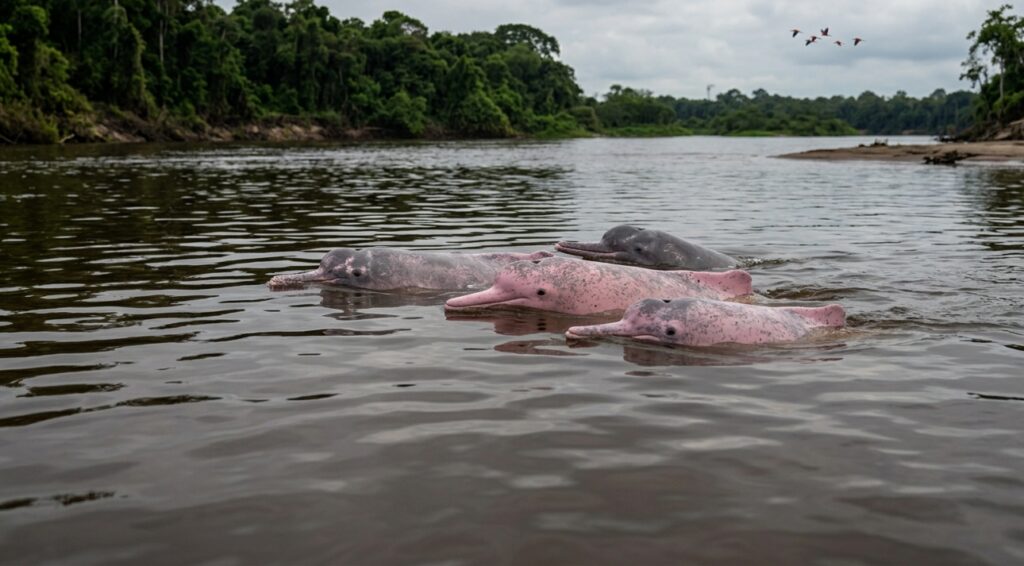
The sheer scale of life within the Amazon is staggering. It contains one in ten known species on Earth. The forest floor, understory, and dense canopy are home to jaguars, harpy eagles, pink river dolphins, and the deadly poison dart frogs. Furthermore, the Amazon is a living pharmacy. Indigenous peoples have used the jungle’s plants for medicinal purposes for millennia. To this day, less than 1% of the Amazon’s flowering plants have been scientifically tested for their medicinal potential, yet many of our current treatments for leukemia, glaucoma, and muscle spasms are derived from its flora.
3. The Mighty Amazon River: The Forest’s Lifeblood
Winding through the heart of the jungle is the Amazon River. By volume of water, it is the largest river in the world, discharging more water into the Atlantic Ocean than the next seven largest independent rivers combined. During the wet season, the river can expand to over 30 miles (48 kilometers) wide. It creates unique, flooded “varzea” forests where fish swim through the branches of submerged trees to eat falling fruits, acting as crucial seed dispersers for the ecosystem.
4. Indigenous Guardians and Uncontacted Peoples
The Amazon is not just a haven for wildlife; it is home to over 30 million people, including approximately 400 distinct indigenous groups. Remarkably, deep within the Brazilian and Peruvian Amazon, there are an estimated 100 “uncontacted tribes.” These are groups of people who have chosen to remain completely isolated from the modern, globalized world. They survive using ancient hunting and gathering techniques, holding profound knowledge of the forest’s ecology. Protecting their land rights is currently one of the most pressing human rights issues in South America.
5. Hidden Secrets: Geoglyphs and Lost Cities
For centuries, European explorers searched the Amazon in vain for “El Dorado,” the legendary city of gold, assuming the harsh jungle could never support a large, advanced civilization. Modern technology has proven them wrong. Using LiDAR (Light Detection and Ranging) lasers mounted on airplanes, scientists have recently stripped away the digital canopy to reveal massive, ancient, man-made earthworks, agricultural terraces, and connected urban settlements. These findings prove that before the arrival of European diseases, the Amazon was heavily populated by millions of people living in highly organized societies.
6. The Looming Threat: Deforestation and the Tipping Point
Despite its vast size, the Amazon is highly vulnerable. Rampant deforestation, driven primarily by cattle ranching, soy farming, and illegal logging, has destroyed nearly 20% of the rainforest over the last 50 years. Climate scientists warn that the Amazon is rapidly approaching a dangerous “tipping point.” If deforestation reaches 20-25%, the forest will lose its ability to generate its own rainfall, triggering a catastrophic dieback process that would turn much of the lush rainforest into a dry, degraded savanna, releasing billions of tons of stored carbon into the atmosphere.