
The trajectory of the Indian Space Research Organisation (ISRO) represents an extraordinary paradigm in the history of global science and technology. Evolving from a nascent, resource-constrained post-colonial scientific framework into a premier, self-reliant space agency, ISRO’s operational portfolio now encompasses interplanetary exploration, heavy-lift orbital deployments, autonomous navigation networks, and a rapidly expanding private commercial ecosystem.
Unlike the space programs of the Cold War superpowers, which were fundamentally driven by geopolitical competition and military posturing, India’s space endeavors were conceptualized with an explicit socio-economic mandate. The overarching directive was to harness advanced orbital technologies to address the terrestrial challenges of a developing nation, utilizing satellite data for tele-education, telemedicine, agricultural monitoring, and disaster management.
The Architects of India’s Cosmic Ambitions
It is truly fascinating to trace ISRO’s journey from transporting experimental rocket parts on the backs of bicycles in the 1960s to successfully landing advanced robotic rovers on the unexplored southern pole of the Moon. This incredible ascent showcases the power of “frugal engineering”, an approach where maximum scientific yield is achieved through optimized, cost-effective innovation rather than unlimited budgets.
Today, as India prepares to launch its own astronauts into orbit and build a sovereign space station, ISRO is no longer just a regional agency. It has become a central pillar of the modern global space economy, actively nurturing a massive domestic ecosystem of private aerospace startups and partnering equally with international giants.
| Indian Space Research Organisation (ISRO) | |
|---|---|
| Agency Name | Indian Space Research Organisation |
| Formation Date | August 15, 1969 (Superseded INCOSPAR) |
| Founding Father | Dr. Vikram Sarabhai |
| Current Chairman | Dr. V. Narayanan (Since Jan 2025) |
| Headquarters | Bengaluru, Karnataka, India |
| Parent Department | Department of Space (DOS) |
| Primary Spaceport | Satish Dhawan Space Centre (SDSC-SHAR) |
| Upcoming Spaceport | Kulasekarapattinam (Tamil Nadu) |
| Active Launchers | PSLV, GSLV Mk II, LVM3 |
| Future Launchers | SSLV, NGLV (Soorya) |
| Navigation System | NavIC (IRNSS Constellation) |
| Key Historic Missions | Chandrayaan-3, Mangalyaan (MOM), Aditya-L1 |
| Human Spaceflight | Gaganyaan Program |
| Future Mega-Projects | Bharatiya Antariksh Station (BAS-1), LUPEX |
| Private Regulator | IN-SPACe |
| Official Web Portal | www.isro.gov.in |
| Commercial Arm (NSIL) | www.nsilindia.co.in |
| IN-SPACe Portal | www.inspace.gov.in |
1. The Genesis of Indian Space
The intellectual and institutional foundations of space research in India were laid decades before the formal establishment of a dedicated national space agency. The earliest pioneering efforts occurred in the 1920s when scientist S. K. Mitra initiated ground-based radio experiments to sound the ionosphere from Kolkata, establishing a critical precedent for atmospheric physics in the subcontinent.
In the post-1945 era, a coordinated approach to high-level scientific research was spearheaded by Homi J. Bhabha, who established the Tata Institute of Fundamental Research (TIFR) in 1945, and Vikram Sarabhai, who founded the Physical Research Laboratory (PRL). The establishment of the Department of Atomic Energy (DAE) in 1950, with Bhabha serving as its secretary, provided the vital financial and administrative scaffolding required to fund nationwide space research initiatives, leading to the creation of the Aryabhatta Research Institute of Observational Sciences (ARIES) in 1954.
INCOSPAR and Thumba
The formal institutionalization of India’s space aspirations materialized in 1962 when Prime Minister Jawaharlal Nehru, acting upon the visionary recommendations of Dr. Vikram Sarabhai, established the Indian National Committee for Space Research (INCOSPAR) under the umbrella of the DAE. Dr. Sarabhai articulated that India must be “second to none” in the application of advanced technologies to resolve the real socio-economic problems of its population, rejecting the idea of pursuing space exploration solely for national prestige.
To translate this vision into operational reality, Sarabhai selected Thumba, a quiet fishing village near Thiruvananthapuram, Kerala. This site was strategically chosen due to its precise proximity to Earth’s geomagnetic equator. Here, the Thumba Equatorial Rocket Launching Station (TERLS) was established. Early operations were remarkably frugal; a local Catholic institution, St. Mary Magdalene’s Church, was repurposed as the primary administrative office, and a local cattle shed functioned as a laboratory. Delicate rocket components and nose cones were routinely transported to the launch pad on the back of bicycles, while larger payloads were transported using traditional bullock carts.
Despite these humble logistical arrangements, TERLS successfully developed and began launching the indigenous Rohini series of sounding rockets in 1967. On August 15, 1969, recognizing the expanding scope of orbital research, INCOSPAR was superseded and formalized into the Indian Space Research Organisation (ISRO).
2. Organizational Architecture
To optimize the expanding scope of its operations, the Government of India formalized the institutional architecture of its space endeavors in June 1972 by constituting the Space Commission and establishing the Department of Space (DOS). By September 1972, ISRO was brought firmly under the purview of the DOS. The organizational structure is meticulously hierarchical, delegating authority downward through specialized centers.
| Institutional Category | Entity / Center | Primary Functional Mandate and Location |
|---|---|---|
| Autonomous Bodies | PRL, NARL, NE-SAC, IIST | Research and academic institutions; IIST in Thiruvananthapuram functions as India’s premier space university. |
| Launch Vehicle Development | VSSC (Vikram Sarabhai Space Centre) | Headquartered in Thiruvananthapuram, responsible for the overarching design of all launch vehicles. |
| LPSC (Liquid Propulsion Systems Centre) | Located in Valiamala and Bengaluru, dedicated to liquid, semi-cryogenic, and cryogenic stages. | |
| IPRC (ISRO Propulsion Complex) | Located in Mahendragiri, handles testing and assembly of liquid engines and cryogenic stages. | |
| Spaceports & Integration | SDSC-SHAR (Satish Dhawan Space Centre) | Located in Sriharikota, serving as the primary spaceport containing integration facilities. |
| Satellite Design | URSC (U R Rao Satellite Centre) | Dedicated to the design, assembly, and testing of satellite payloads. |
| Human Spaceflight | HSFC (Human Space Flight Centre) | Tasked with the execution of the Gaganyaan program and crewed spaceflight infrastructure. |
| Commercial & Regulatory | NSIL / Antrix Corporation | Central Public Sector Enterprises responsible for marketing technologies and commercial launches. |
| IN-SPACe | Single-window regulatory agency for promoting private space activities. |
3. Leadership Trajectories
The technological ambition of ISRO has been profoundly shaped by its lineage of leadership. Following the untimely death of Vikram Sarabhai, Prof. Satish Dhawan assumed the role of ISRO’s third chairman (1972 to 1984). He transformed ISRO from an ad-hoc experimental group into an establishment of international standing by introducing vertical project management. Under his aegis, ISRO successfully launched its first satellite, Aryabhata, in 1975.
Udupi Ramachandra Rao, known as the “Satellite Man of India,” succeeded Dhawan (1984 to 1994). His tenure marked a pivotal transition to operational maturity, laying the critical groundwork for the Polar Satellite Launch Vehicle (PSLV).
As of early 2026, the leadership mantle rests with Dr. V. Narayanan, a distinguished rocket and spacecraft propulsion expert who assumed the charge of Secretary, DOS, and Chairman, ISRO, on January 13, 2025. Prior to this elevation, he served as the Director of the Liquid Propulsion Systems Centre (LPSC), where he played an instrumental role in the successful development of the indigenous cryogenic subsystems. His techno-managerial leadership is currently steering ISRO toward heavy-lift reusable rockets and human-rated spaceflight.
4. Early Launch Vehicles
The cornerstone of any nation’s strategic autonomy in space is the capability to independently access Earth’s orbit. ISRO’s launch vehicle program has undergone a dramatic evolution.
Following its mastery of sounding rockets, ISRO embarked on the development of its first orbital launch vehicle. The Satellite Launch Vehicle (SLV-3) was a four-stage, all-solid propellant rocket designed to place a modest 40 kg mass into Low Earth Orbit (LEO). While its maiden flight in 1979 ended in failure, rigorous failure analysis led to a successful launch in 1980, placing the Rohini Series-I (RS-1) satellite into orbit. This achievement elevated India to an elite tier, making it the seventh country globally to achieve independent orbital launch capability. The SLV-3 was formally retired in 1983.
The success of the SLV-3 led to the conceptualization of the Augmented Satellite Launch Vehicle (ASLV) in the late 1980s. Engineered to orbit 150 kg class satellites, the ASLV experienced multiple catastrophic launch failures and was discontinued in the 1990s as resources shifted toward more reliable platforms.
5. The PSLV and Recent Challenges
The Polar Satellite Launch Vehicle (PSLV) arrived in the 1990s and became the undisputed workhorse of the Indian space program. Achieving a streak of over 50 consecutive successful flights, it is highly versatile, operating in multiple configurations (Core Alone, two, four, or six strap-on motors). The PSLV gained global commercial prominence by launching historic interplanetary missions, such as Chandrayaan-1 and the Mars Orbiter Mission (Mangalyaan). On February 14, 2017, the PSLV-C37 mission etched ISRO into the international record books by launching 104 satellites in a single mission.
The PSLV Reliability Crisis (2025 to 2026): Despite its historical reliability, the PSLV architecture faced a severe crisis in the mid-2020s. Following an anomaly in the PSLV-C61 mission, ISRO constituted a Failure Analysis Committee. The subsequent PSLV-C62 mission was subjected to unprecedented scrutiny, undergoing seven Mission Readiness Reviews. Despite these rigorous interventions, the C62 mission also failed due to persistent anomalies in the rocket’s third stage, resulting in the tragic loss of 16 satellites. In response, ISRO formed a National Level Expert Committee in early 2026 to systematically rectify the flaws before resuming the PSLV launch cadence.
6. Heavy Lift and Cryogenics
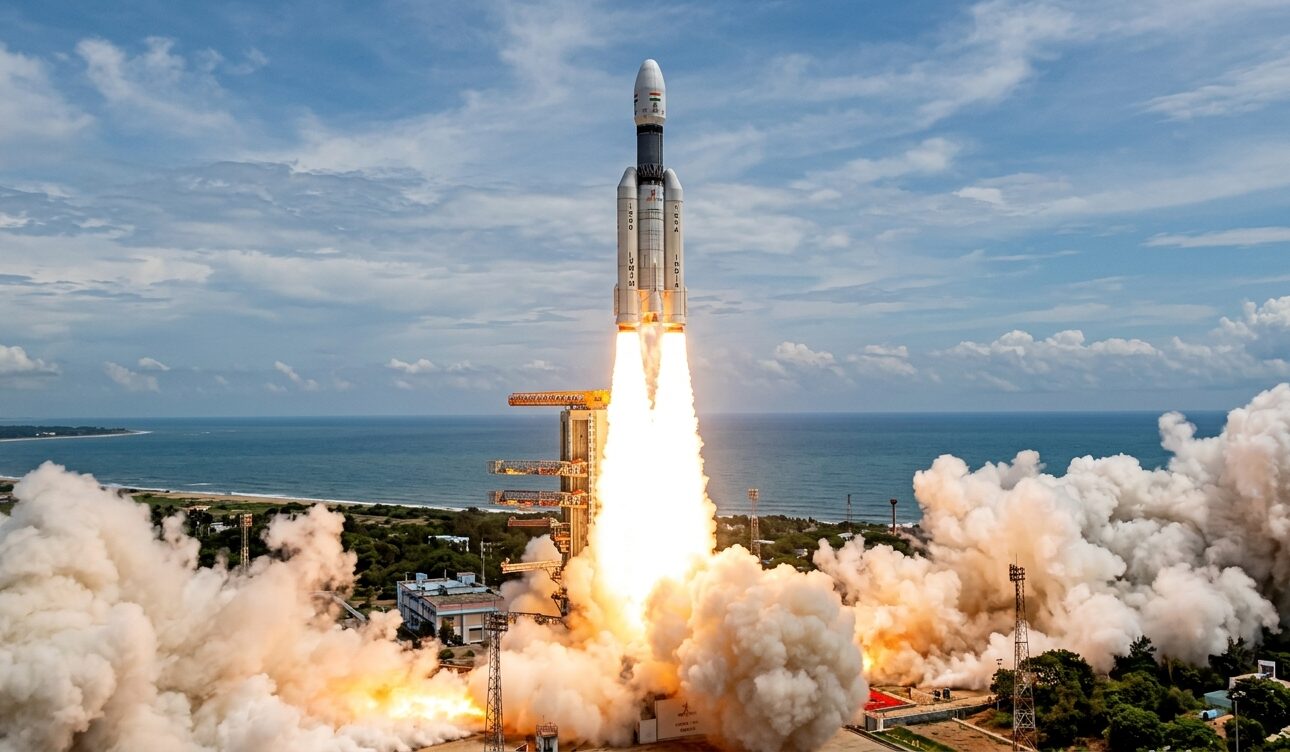
To place heavier communication satellites into Geostationary Transfer Orbits (GTO), ISRO required advanced cryogenic propulsion technology. In the early 1990s, India attempted to acquire this technology from Russia. However, between 1992 and 1994, the United States imposed severe sanctions on ISRO and successfully blocked the transfer under the Missile Technology Control Regime (MTCR).
This geopolitical blockade catalyzed a defining moment for Indian technological self-reliance. In 1994, ISRO initiated an arduous, two-decade-long project to develop indigenous cryogenic technology. This effort culminated in the operationalization of the Geosynchronous Satellite Launch Vehicle (GSLV Mk II), allowing India to join an elite group of only six government agencies globally with full indigenous cryogenic launch capabilities.
The current apex of India’s launch capability is the Launch Vehicle Mark-3 (LVM3), formerly designated as GSLV Mk III. This next-generation, three-stage vehicle represents a massive leap in payload capacity, capable of lifting 4-tonne class communication satellites to GTO and 10-tonne class payloads into LEO. Powered by the highly advanced, completely indigenized C25 cryogenic stage, the LVM3 has maintained a flawless operational record, successfully completing all of its orbital flights, yielding a cumulative success rate of 100%.
7. Next-Generation Rockets
Anticipating a highly segmented future launch market, ISRO is concurrently developing two new architectures designed for opposite ends of the payload spectrum.
The Small Satellite Launch Vehicle (SSLV): Developed with entirely indigenous technologies, the SSLV is designed to cater to the burgeoning global demand for the rapid deployment of micro and nano satellites, capable of lifting 500 kg to a 500 km LEO. To maximize the SSLV’s efficiency, ISRO has initiated the construction of a dedicated spaceport, the SSLV Launch Complex (SLC), located at Kulasekarapattinam in Tamil Nadu. Launching from this new facility avoids the fuel-intensive “dogleg” maneuver required from Sriharikota to bypass Sri Lanka, retaining a full 300 kg payload capacity to Sun-Synchronous Polar Orbits. With an allocated budget of ₹985.96 crore, the spaceport is targeted for full commissioning in the fiscal year 2026-27.
The Next Generation Launch Vehicle (NGLV) ‘Soorya’: To facilitate deep space crewed missions and the construction of a domestic space station, ISRO requires a super-heavy lift architecture. The NGLV is designed to carry 30 tonnes to LEO. This rocket introduces a paradigm shift by incorporating reusability through Vertical Take-off and Vertical Landing (VTVL) capabilities in its first stage. Embracing green propulsion, it utilizes a cluster of nine LOX-Methane engines (LME1100). Standing 105 meters tall with a liftoff mass of approximately 1,000 tonnes, the NGLV project has been allocated an outlay of ₹8,240 crore (approximately $915 million).
8. Communication and Society
ISRO’s orbital infrastructure is deeply integrated into India’s national administrative and economic framework. The Indian National Satellite (INSAT) and GSAT series have been pivotal in revolutionizing the subcontinent’s telecommunication infrastructure, utilizing C-band, Ku-band, and S-band transponders.
Beyond commercial applications, ISRO has aggressively pursued societal development programs. The launch of the dedicated EDUSAT satellite in 2004 enabled remote learning paradigms across underdeveloped rural geographies. Concurrently, ISRO established over 473 Village Resource Centres (VRCs). Through these centers, ISRO leveraged satellite communication to provide telemedicine services, linking state medical colleges to remote clinics. This enabled real-time tele-follow-ups, pre-referral counseling, and specialty healthcare delivery directly to grassroots communities.
9. Earth Observation
ISRO’s Earth Observation (EO) fleet comprises thematic series such as Cartosat, RESOURCESAT, and the more recent EOS series (EOS-01 through EOS-07). These satellites provide highly granular data on soil moisture, crop health, and potential fishing zones, fundamentally modernizing Indian agriculture and fisheries.
The life-saving efficacy of this EO infrastructure was globally validated during the Very Severe Cyclonic Storm (VSCS) Phailin in 2013. Utilizing real-time meteorological data and inundation maps provided by ISRO, disaster management authorities generated highly accurate numerical models predicting the cyclone’s movement and storm surge. This precise orbital intelligence enabled the proactive, massive evacuation of approximately one million individuals across Odisha and Andhra Pradesh, transitioning the state’s posture from post-disaster mitigation to intelligence-driven, preemptive casualty prevention.
10. Strategic Autonomy: NavIC
Dependence on foreign navigational data poses a severe vulnerability to national security. During the 1999 Kargil War, the United States denied the Indian military access to precise Global Positioning System (GPS) data, severely hampering combat operations. Recognizing the critical necessity for navigational autonomy, ISRO developed the Indian Regional Navigation Satellite System (IRNSS), operationally designated as NavIC (Navigation with Indian Constellation).
Constructed at a cost of ₹2,246 crore (approximately $266 million), the constellation consists of seven nominal satellites situated in geostationary and inclined geosynchronous orbits. NavIC provides highly accurate real-time positioning with a dual-tier service model: a Standard Positioning Service (SPS) for civilian use offering 3-meter accuracy, and an encrypted Restricted Service (RS) designed exclusively for authorized military users with 2-meter precision.
11. Lunar and Martian Exploration
Over the past two decades, ISRO has dramatically expanded its scientific purview beyond Earth orbit, maintaining an ethos of extreme cost-efficiency.
The Chandrayaan Lunar Program: Chandrayaan-1 (2008) generated the first definitive evidence of water molecules on the lunar surface. Following the lander crash of Chandrayaan-2 (2019), ISRO demonstrated exceptional institutional resilience by launching Chandrayaan-3 in 2023. On August 23, 2023, the Vikram lander executed a flawless soft landing near the lunar south pole. This monumental triumph made India the fourth nation globally to achieve a soft lunar landing, and the absolute first to land in the rugged southern polar region.
The Mars Orbiter Mission (Mangalyaan): Launched in 2013, MOM established India as the first Asian nation to reach Martian orbit, and the only nation globally to do so on its maiden attempt. With a total budget of roughly $74 million, MOM was famously cited as costing less than the Hollywood space thriller Gravity. ISRO achieved this through “frugal engineering”, maximizing the use of legacy hardware (like the PSLV), employing modular architectures, and conducting fewer but more intensive ground tests.
Aditya-L1: Launched on September 2, 2023, India’s first space-based solar observatory was positioned in a halo orbit around the Sun-Earth Lagrange Point 1 (L1). From this stable vantage point, it analyzes coronal mass ejections and maps solar magnetic storms.
12. The Gaganyaan Program
The strategic imperative to achieve independent human access to space culminated in the approval of the Gaganyaan program in 2018, endowed with a budget of ₹20,193 crore (approximately $2.4 billion). The primary objective is to launch a crew module carrying Indian astronauts, designated as Gaganyatris, into a 400 km Low Earth Orbit for a duration of three to seven days.
Prior to crewed flights, ISRO will launch uncrewed preliminary missions starting in the first quarter of 2026. These flights will carry “Vyommitra,” a highly advanced half-humanoid robot designed to mimic human biological parameters and execute life-support micro-experiments. In 2024, the four prime astronaut-designates were revealed: Group Captains Prasanth Balakrishnan Nair, Ajit Krishnan, Angad Pratap, and Shubhanshu Shukla.
In a strategic alignment resulting from an ISRO-NASA agreement, Group Captain Shubhanshu Shukla participated in the Axiom-4 mission, becoming the first Indian astronaut to board the International Space Station (ISS). This provided ISRO with invaluable insights into space station docking and crew-ground coordination. The first indigenous crewed flight (Gaganyaan-4) is anticipated no earlier than the second quarter of 2027.
13. The 2028 to 2040 Roadmap
The successful execution of Gaganyaan will serve as the technological bedrock for a vastly more ambitious, multi-decade interplanetary roadmap:
- Venus Orbiter Mission (Shukrayaan): Approved with a budget of approximately $147 million, it is slated for launch in March 2028 to study Venusian surface geology.
- Chandrayaan-4: Scheduled for 2028, this mission involves multiple modules designed to land on the Moon, collect samples, and execute a complex return trajectory back to Earth.
- Bharatiya Antariksh Station (BAS): ISRO plans to deploy the first module of its indigenous space station, BAS-1, by 2028. Orbiting at an altitude of 400 to 450 km, it will eventually comprise five distinct modules.
- Crewed Lunar Landing: The culmination of the NGLV heavy-lift capabilities and the sample-return technologies developed by Chandrayaan-4 is a targeted crewed lunar landing by Indian astronauts by the year 2040.
14. International Synergies
As ISRO’s capabilities have matured, the agency has evolved from a recipient of foreign assistance into an equal stakeholder in deeply integrated, high-value joint scientific missions.
NISAR (NASA-ISRO Synthetic Aperture Radar): Launched on July 30, 2025, NISAR is a landmark $1.5 billion Earth-observing mission. It utilizes a dual-frequency synthetic aperture radar to map global topography at unparalleled resolutions. By early 2026, the mission had already begun delivering crucial data, including high-resolution soil moisture maps of the Indo-Gangetic plains.
LUPEX (Chandrayaan-5): The Lunar Polar Exploration Mission is a high-profile collaborative effort between ISRO and the Japan Aerospace Exploration Agency (JAXA), targeted for 2028. JAXA will provide the H3 launch vehicle and an advanced lunar rover, while ISRO is responsible for the design and provision of the heavy 6.5-ton lunar lander to explore the permanently shadowed regions of the lunar south pole.
15. The Private Space Ecosystem
Recognizing that India accounted for merely 2% to 3% of the $360 billion global space economy, the federal government enacted sweeping structural reforms. The establishment of the Indian National Space Promotion and Authorization Centre (IN-SPACe) served as a transformative catalyst, acting as a single-window regulatory agency to seamlessly facilitate private sector participation.
This policy pivot yielded immediate dividends, fostering over 300 space tech startups. Skyroot Aerospace made international headlines in November 2022 by launching the Vikram-S suborbital vehicle. Agnikul Cosmos, operating from ALP-01 (India’s first private launchpad located within the SDSC complex), successfully launched the Agnibaan SOrTeD vehicle in May 2024. This rocket was powered by the ‘Agnilet’ engine, the world’s first single-piece, 3D-printed semi-cryogenic rocket engine. In February 2026, Agnikul successfully test-fired a clustered stack of three Agnilet engines simultaneously. ISRO is evolving into an anchor tenant and primary facilitator of a robust commercial space economy.
16. Future of the Space Economy
An objective analysis of ISRO’s trajectory, from transporting sounding rockets on bicycles through the coconut groves of Thumba to orchestrating autonomous lunar landings and preparing for human spaceflight, reveals an institution of extraordinary technological resilience. ISRO has mastered the highly complex art of frugal engineering, optimizing modular architectures to execute deep space missions at a fraction of the cost incurred by Western agencies, without compromising on operational efficacy.
Looking forward from the vantage point of 2026, the agency stands at a critical technological inflection point. While immediate challenges, such as the anomalies in the PSLV upper stages, necessitate rigorous quality assurance overhauls, the broader institutional foundation remains exceptionally robust. The flawless operational track record of the LVM3, the imminent rollout of the reusable NGLV architecture, and the successful maturation of private sector startups like Agnikul Cosmos indicate a highly resilient domestic aerospace ecosystem. As ISRO executes the Gaganyaan mission, deploys the Bharatiya Antariksh Station, and targets a crewed lunar landing by 2040, it is actively transitioning from a formidable regional space power into a central, indispensable architect of the 21st-century global space economy.