The Bureau of Indian Standards (BIS) is the National Standards Body of India, operating under the administrative oversight of the Department of Consumer Affairs within the Ministry of Consumer Affairs, Food and Public Distribution. Established to ensure the harmonious development of standardization, conformity assessment, and quality assurance, BIS functions as the critical infrastructural pillar underpinning consumer safety, environmental protection, and industrial competitiveness across the Indian subcontinent.
In a globalized economy, quality regulation transcends domestic consumer protection; it is a formidable strategic economic instrument. As India rapidly expands its economy and integrates into highly complex global supply chains with ambitions of becoming a premier global manufacturing hub, a robust and internationally harmonized quality ecosystem is imperative. By enforcing rigorous safety and quality benchmarks for products manufactured domestically or imported into India, BIS effectively mitigates the influx of substandard and potentially hazardous goods. Furthermore, as the designated World Trade Organization – Technical Barriers to Trade (WTO-TBT) enquiry point for India, BIS plays a central diplomatic role, ensuring that domestic industrial practices align with international trade agreements to facilitate commerce rather than arbitrarily restrict it.
The Pillar of India’s Economic Resurgence
The Bureau of Indian Standards carries an immense responsibility in modern life. It is incredible to think that a single organization regulates everything from the safety of the electronics we use every day to the purity of the gold we buy. Its work touches nearly every household, ensuring that trust and quality are built into the products people depend on.
In a world flooded with cheap and unsafe imports, strict quality standardization becomes the ultimate defense for consumers. At the same time, it is the driving force behind India’s global manufacturing ambitions, giving Indian products credibility and competitiveness on the world stage. The purple seal of BIS is not just a mark of compliance, it is a promise of safety, reliability, and national pride.
| Bureau of Indian Standards (BIS) Corporate Profile | |
|---|---|
| Organization Name | Bureau of Indian Standards (BIS) |
| Predecessor | Indian Standards Institution (ISI), Est. 1946 |
| Year Established | 1986 (Statutory Body status) |
| Governing Legislation | The BIS Act, 2016 |
| Parent Ministry | Ministry of Consumer Affairs, Food and Public Distribution |
| Headquarters | New Delhi, India |
| Director General | Shri Sanjay Garg, IAS (Appointed Nov 2025) |
| Regional Network | 5 Major Regional Offices (East, South, West, North, Central) |
| Technical Departments | 14 Dedicated Departments |
| Core Certification Schemes | ISI Mark (Scheme-I), CRS (Scheme-II), FMCS, Scheme-X |
| Hallmarking Tech | HUID (Hallmark Unique Identification) |
| Digital Platforms | Manakonline (e-BIS), LIMS, BIS Care App |
| Training Institute | National Institute of Training for Standardization (NITS) |
| Global Strategic Roadmap | SNAP 2022-2027 |
| Official Web Portal | www.bis.gov.in |
| Manakonline Portal | www.manakonline.in |
| Download App | BIS Care App (Google Play) |
1. History and The BIS Act of 2016
The institutional lineage of BIS traces back to the pre-independence era. It originated as the Indian Standards Institution (ISI), established in September 1946 through a resolution of the Department of Industries and Supplies, initially operating under the Societies Registration Act of 1860. As the industrial landscape of the newly independent nation evolved, requiring greater regulatory oversight, the Bureau of Indian Standards Act of 1986 elevated the institution into a formal statutory body, renaming it BIS.
However, the subsequent advent of hyper-globalization, the exponential rise of digital economies, the proliferation of e-commerce, and the growing complexities of cross-border trade demanded a highly agile and expansive regulatory framework. This imperative culminated in the passage of the BIS Act, 2016, which was formally notified in March 2016 and brought into force on October 12, 2017. By repealing the foundational 1986 Act, the 2016 legislation endowed the Bureau with sweeping powers and structural flexibility, fundamentally shifting the paradigm from purely voluntary standardization to a highly enforceable, sovereign quality mandate.
Expanded Scope and Enforcement: One of the most significant architectural changes introduced is the massive expansion of BIS’s jurisdictional scope. While the legacy framework focused almost exclusively on manufactured physical goods, the modern Act explicitly extends the regulatory mandate to encompass services, systems, and processes. This allows BIS to regulate complex, modern ecosystems such as IT security frameworks and environmental management systems. The Government of India retains the sovereign authority to notify any product for compulsory certification through Quality Control Orders (QCOs).
Furthermore, the Act drastically enhanced punitive mechanisms. BIS authorities can conduct search and seizure operations (executing over 500 enforcement raids in 2025 alone) and possess the statutory power of product recall. If a licensed manufacturer introduces non-conforming goods into the market, BIS has the unmitigated authority to halt supply, cease sales, and legally direct the recall of defective items. Manufacturers violating QCOs face escalating monetary fines that can exceed Rs. 5 lakh, alongside potential criminal imprisonment and financial liability for consumer compensation.
2. Organizational Structure and Leadership
The operational efficacy of BIS is underpinned by a highly structured, multi-tiered organizational hierarchy. At the absolute apex is the Governing Council, led by the Ex-officio President, who is the Minister in charge of the Ministry of Consumer Affairs, Food and Public Distribution. This ensures that standard formulation remains tightly coupled with broader governmental economic policies.
The day-to-day administrative, strategic, and operational command is vested in the Director General (DG). As of November 1, 2025, the office is held by Shri Sanjay Garg, a senior civil servant of the IAS-1994 batch from the Kerala cadre. DG Sanjay Garg brings decades of highly relevant administrative experience, having previously served as the Secretary of the Indian Council of Agricultural Research (ICAR) and Additional Secretary of DARE. His expertise in strategic planning, defense industry deregulation, and IT-driven administration is highly synergistic with BIS’s current trajectory toward digitization. He also concurrently serves as the President of India’s National Committee in the International Electrotechnical Commission (IEC).
Beneath the Director General operate Additional Director Generals (ADGs) and Deputy Directors General (DDGs) commanding critical divisions such as Administration, Finance, Standardization, Laboratories, Human Resources, Legal, Vigilance, and Policy & Planning (PP&C).
3. Regional Decentralization
To ensure vast national coverage, rapid regulatory responsiveness, and localized enforcement, BIS is geographically divided into five major Regional Offices: the Eastern Region (Kolkata), Southern Region (Chennai), Western Region (Mumbai), Northern Region (Chandigarh), and Central Region (Delhi).
Geographic decentralization is vital for conducting localized surveillance, managing factory audits, and executing search and seizures. Taking the Eastern Region as a representative model demonstrates the depth of BIS’s operational footprint.
| Facility / Office Name | Jurisdiction / Physical Location | Head / Scientific Designation |
|---|---|---|
| Eastern Regional Office (ERO) | Sector V, Salt Lake, Kolkata, West Bengal | Ms. Meenakshi Ganesan, Scientist-G & DDG |
| Kolkata Branch Office-I (KKBO-I) | Sector V, Salt Lake, Kolkata, West Bengal | Shri Sabyasachi Dhar, Scientist-E & Head |
| Kolkata Branch Office-II (KKBO-II) | Sector V, Salt Lake, Kolkata, West Bengal | Shri Sabyasachi Dhar, Scientist-E & Head |
| Durgapur Branch Office | Durgapur Steel Plant Area, West Bengal | Specialized in heavy industry and alloy steels |
| Guwahati Branch Office | Dispur, Guwahati, Assam | Shri Shouvik Chanda, Scientist-E & Head |
| Bhubaneswar Branch Office | Sachivalaya Marg, Bhubaneswar, Odisha | Operations mapping to eastern coastal industries |
| Patna Branch Office (PTBO) | Patliputra Industrial Estate, Bihar | Manages all 38 districts of Bihar |
These branch offices execute hyper-localized Annual Programs of Action (APA). For instance, the Patna Branch Office (PTBO) actively manages major sectors currently under certification, including 95 active licenses for Packaged Drinking Water, 80 for PVC and HDPE Pipes, 50 for Plywood Products, and 40 for Steels. The PTBO APA outlined aggressive enforcement strategies, forecasting a 24% growth in factory surveillance (targeting 950 visits) and a 20% growth in market surveillance (targeting 1000 visits) for 2025-26.
4. The Standard Formulation Process
Standard formulation represents the intellectual and scientific core of the Bureau of Indian Standards. It relies on the consolidated results of applied science, engineering technique, and empirical experience. The colossal task of standard development is distributed across 14 dedicated Technical Departments (TDs) within the BIS headquarters.
| Department Code | Full Name of Technical Department | Focus Area |
|---|---|---|
| CED | Civil Engineering | Infrastructure, concrete, building codes |
| CHD | Chemical | Fertilizers, industrial chemicals, polymers |
| ETD | Electrotechnical | Power generation, transmission, switchgears |
| FAD | Food and Agriculture | Agricultural implements, food safety systems |
| LITD | Electronics and Information Technology | IT hardware, cybersecurity, smart devices |
| MED | Mechanical Engineering | Heavy machinery, precision mechanics |
| MHD | Medical Equipment and Hospitals | Surgical tools, medical textiles, healthcare IT |
| MSD | Management & Systems | Quality, environmental, and AI management |
| MTD | Metallurgical Engineering | Ferrous and non-ferrous metals, alloys |
| PCD | Petroleum, Coal & Related Products | Petrochemicals, alternative fuels |
| PGD | Production and General Engineering | Hand tools, manufacturing equipment |
| TED | Transport Engineering | Automotive components, e-mobility, aerospace |
| TXD | Textile | Yarns, fabrics, geo-textiles |
| WRD | Water Resources | Irrigation systems, dams, hydrology |
5. The Five-Stage Formulation Process
The evolution of an Indian Standard (IS) navigates through a highly regulated, five-stage process designed to ensure absolute scientific consensus and democratic transparency. These points are meticulously followed:
- The Proposal Stage: Proposals for new standards or revisions can be initiated by government ministries, industry associations, professional academic bodies, or consumer organizations. The proposal must empirically demonstrate a national priority.
- The Preparatory Stage: Upon formal acceptance, a preliminary draft is authored by the relevant technical department internally, or by a specifically designated working group of domain experts.
- The Committee Stage: The draft is intensely reviewed by the Sectional Committee (comprising manufacturers, consumers, scientists, and regulators). This stage involves rigorous technical debate to forge a scientific consensus.
- The Approval Stage: Once cleared, it is designated as a ‘Wide Circulation Draft’ (WCD). It is placed in the public domain for a specified period, inviting comments from global stakeholders and the domestic public.
- The Publication Stage: Following the resolution of public comments, the standard is officially notified in the Gazette of India, published as a formalized Indian Standard (IS), and integrated into the national registry.
- Aggrieved consumers submit a petition within 90 days.
- The officer must acknowledge the grievance within 8 days.
- A final binding order (which can legally mandate the licensee to repair, replace, or compensate) must be passed within 40 days.
- If unresolved within 100 days, the issue can be escalated directly to the Ombudsman.
The evolution of an Indian Standard (IS) navigates through five distinct, highly regulated stages:
To democratize this standard formulation process, BIS operationalized the “Manak Manthan” initiative. This program mandates that every branch office hold monthly brainstorming sessions with local manufacturers and MSMEs. For instance, recent sessions in Chennai focused on draft standards for Industrial Safety Helmets, while Patna scheduled deep-dive sessions on Plastic Waste Management and Gold Alloys.
6. Conformity Assessment and Certification Schemes
The practical, commercial application of formulated Indian Standards is rigidly enforced through a highly calibrated matrix of Conformity Assessment Schemes, legally governed under Schedule II of the BIS (Conformity Assessment) Regulations, 2018.
| Certification Scheme | Primary Industrial Scope | Typical Validity | Processing Time | Applied Mark |
|---|---|---|---|---|
| Scheme-I (ISI Mark) | Heavy industrial goods, chemicals, steel, textiles, consumer appliances | 1-2 years | ~90 days | ISI Mark |
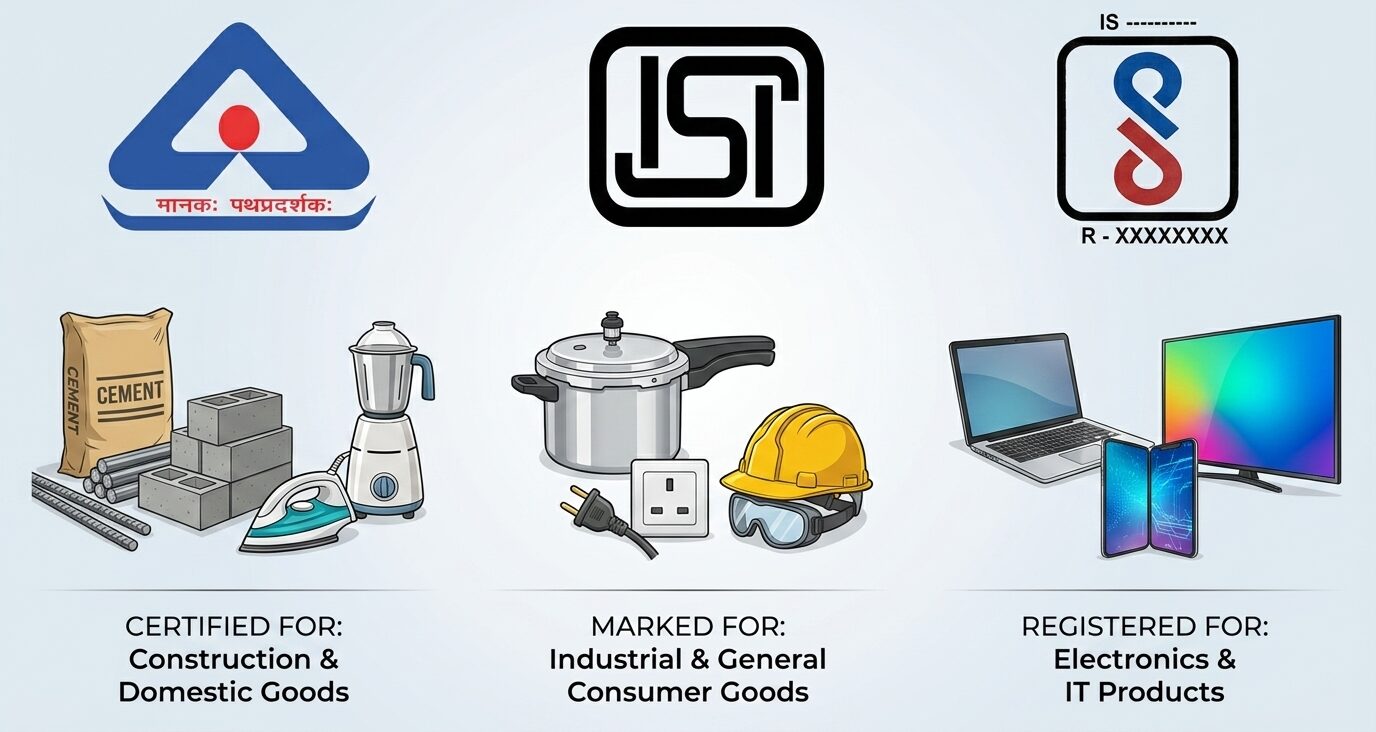
| Scheme-II (CRS) | Electronics, IT products, solar components, smart devices, LED lighting | 2 years | ~90 days | CRS Mark / R-Number |
| Scheme-IV (CoC) | Specific customized prototypes, localized batches (e.g., transformer stampings) | 1-2 years | ~180 days | CoC Number |
| Scheme-X | Low-voltage switchgear, complex machinery, high-tier electrical equipment | 3-6 years | ~60 days | Standard Mark |
Scheme-I: The Ubiquitous ISI Mark
The ISI Mark Scheme is the oldest, most comprehensive, and most widely recognized product certification program in India. It encompasses over 174 active Quality Control Orders mandating compliance for more than 688 distinct product categories. Obtaining a Scheme-I license requires the manufacturer to establish an adequate in-house testing facility and employ skilled quality control personnel. BIS scientific officers conduct comprehensive initial factory inspections before granting the license, followed by continuous market and factory surveillance.
Scheme-II: The Compulsory Registration Scheme (CRS)
Initiated in 2012 in strategic coordination with the Ministry of Electronics and Information Technology (MeitY), CRS serves as India’s primary regulatory vanguard against substandard electronic and IT imports. Covering over 78 mandatory product categories (including laptops, smart card readers, mobile phones, and power banks), CRS operates on a modernized model of self-declaration of conformity strongly corroborated by mandatory third-party testing at BIS-recognized laboratories. Upon successful testing, BIS issues a unique Registration Number (R-Number). Foreign manufacturers must explicitly appoint an Authorized Indian Representative (AIR) to bear legal liability.
Scheme-IV and Scheme-X
Scheme-IV involves the issuance of a Certificate of Conformity (CoC) for highly specific batches or prototypes where continuous production marking is impractical (e.g., transformer stampings). Scheme-X represents the absolute frontier of complex machinery regulation, introduced in March 2022 to cover advanced mechanical and low-voltage electrical ecosystems governed by the Omnibus Technical Regulations (OTR), such as AC/DC circuit breakers.
Foreign Manufacturers Certification Scheme (FMCS)
Running strategically parallel to domestic schemes, FMCS ensures that overseas manufacturers intending to export goods to India comply with the exact same Indian Standards mandated for domestic producers. BIS auditors conduct international factory inspections to verify capabilities abroad, creating a level playing field.
7. Precious Metals and HUID Hallmarking
To protect consumers from rampant metallurgical adulteration and elevate India’s standing as a world-class, trusted bullion market, BIS operates a massive, mandatory Hallmarking Scheme for precious metals. The gold hallmarking scheme commenced in 2000. However, in a historic policy shift aimed at eradicating market opacity, the central government mandated that from September 1, 2025, all domestically manufactured and imported silver jewelry and artifacts must undergo compulsory hallmarking.
Both gold and silver hallmarking are now rigidly governed by the Hallmark Unique Identification (HUID) system. Replacing the legacy four-mark format, the HUID system involves laser-engraving a distinct, six-digit alphanumeric code onto every individual piece of jewelry. This code acts as a cryptographic signature, permanently tying the specific artifact to the licensed manufacturer, the precise testing center, and its exact purity metric. Consumers can verify the artifact’s entire provenance instantly at the point of sale using the ‘Verify HUID’ feature on the BIS Care App.
| Silver Purity Grade | Implication / Added Features under IS 2112:2025 |
|---|---|
| 800, 835, 925 | Standard alloy mixes common in robust jewelry, artifacts, and sterling applications. |
| 958 | Newly added grade under the 2025 revision to capture ultra-high purity jewelry demands. |
| 970, 990 | High-end artifact, specialty craft, and premium utensil grades. |
| 999 | Newly added grade formally representing pure, investment-grade silver bullion. |
The operational success of this mandate relies on a vast network of Assaying and Hallmarking Centres (AHCs). The rollout of mandatory gold hallmarking resulted in registered jewelers growing from 34,647 in 2021 to 194,039 by the end of 2024. Presently, there are roughly 230 AHCs recognized for testing silver jewelry across 87 districts.
8. Digital Governance and IT Infrastructure
The modern operational effectiveness of BIS is heavily characterized by the deployment of comprehensive digital governance platforms designed to ensure absolute data transparency and expedite complex license grants.
Manakonline (e-BIS): The central nervous system for all regulatory interactions is the Manakonline portal. This robust platform consolidates all certification schemas, allowing manufacturers to file applications, upload technical files, pay fees, and track inspection tours online. A critical anti-corruption feature is its algorithmic, automatic selection of inspection officers, completely eliminating human bias. It also integrates directly with the National Single Window System (NSWS).
Laboratory Information Management System (LIMS): Conformity assessment is structurally dependent on robust empirical testing. BIS maintains an expansive network of internal laboratories (like the Central Laboratory in Sahibabad) augmented by NABL-accredited third-party labs. To manage over 1,000,000 test requests dynamically, BIS implemented LIMS. LIMS acts as the unalterable digital backbone, mapping lab competencies against standards, automating sample tracking, and integrating directly with laboratory instruments to prevent forged test reports.
9. Consumer Empowerment and Grievance Redressal
To shift standard enforcement to a consumer-driven model, BIS heavily invested in digital tools. The cornerstone is the BIS Care App (available on Android and iOS). The app allows citizens to instantly scan ISI marks, verify HUID codes on jewelry, and authenticate R-Numbers for electronics right at the retail counter.
If a product fails digital verification or possesses a quality defect, consumers can lodge a formal complaint directly through the app. The statutory Grievance Redressal Procedure dictates a strict timeline:
10. Capacity Building and Educational Outreach
Ensuring national adherence to dynamic technical standards requires continuous education. Located in Noida, Uttar Pradesh, the National Institute of Training for Standardization (NITS) serves as the premier capacity-building wing of BIS. NITS executes exhaustive training calendars catering to internal BIS scientific cadres and external industry participants.
| Training Program Focus | Specific Standard / Code Alignment | Target Audience & Scope |
|---|---|---|
| Laboratory Quality Management | IS/ISO/IEC 17025:2017 & ISO 15189 | Lab Technicians, Quality Managers, Medical Labs |
| Quality Management Systems (QMS) | IS/ISO 9001:2015 | Corporate Auditors, Government Officials |
| Environmental & Energy Mgt. | IS/ISO 14001:2015 & ISO 50001:2018 | Environmental Officers, Heavy Industries |
| Occupational Health & Safety | IS/ISO 45001:2018 | Manufacturing Safety Leads, Plant Managers |
| Information Security & AI | IS/ISO 27001:2022 & ISO/IEC 42001 | IT infrastructure operators, Data Centers |
| Anti-Bribery & Compliance | IS/ISO 37001:2016 | Corporate Governance Officers |
| Building and Electrical Codes | NBC, NEC, & NLC of India | Civil Engineers, Urban Planners, Architects |
Beyond professional training, BIS actively targets the foundational tiers of education to cultivate a generational culture of quality consciousness. A flagship initiative is “Learning Science via Standards” (LSVS), which develops specific lesson plans linking textbook science principles to manufacturing standards. This is complemented by the establishment of over 4,000 “Standards Clubs” in educational institutions across the nation. Furthermore, grassroots “Quality Connect” campaigns utilize hundreds of “Manak Mitras” (Standard Friends) to target rural areas.
11. Global Strategy and Future Outlook (SNAP 2022-2027)
As the global economy faces unprecedented technological disruptions and existential environmental threats, BIS is proactively re-engineering its regulatory philosophy. To facilitate global trade interoperability and assert Indian technological perspectives on the global stage, BIS aggressively pursues strategic international harmonization.
Standards National Action Plan (SNAP) 2022-2027: BIS launched SNAP as a highly detailed strategic roadmap designed to align India’s standardization system with emerging global macroeconomic drivers. The foundational priorities focus heavily on Sustainability, Climate Change, and regulating New/Emerging Technologies. By incorporating carbon accounting, Water Footprint Assessments, and circular economy principles into manufacturing standards, BIS ensures that Indian industries remain compliant with increasingly stringent global environmental regulations, such as the European Union’s Carbon Border Adjustment Mechanism (CBAM).
International MoUs and Academic Collaborations: To ensure mutual recognition of conformity assessments and reduce redundant testing for Indian exporters, BIS has executed numerous Memoranda of Understanding (MoUs) with global counterparts, including ANSI (USA), KazStandard (Kazakhstan), KATS (Korea), SASO (Saudi Arabia), and GSO (Gulf States). Domestically, a landmark achievement in 2024 was the MoU signed with the prestigious Indian Institute of Science (IISc), Bengaluru, establishing the ‘BIS Standardization Chair Professor’ to integrate standardization into elite academic curricula. Similar partnerships exist with IIT Kanpur focusing on blockchain applications in e-governance.