
| Global Electronic Voting Systems | |
|---|---|
| Initial Inventor | Thomas Edison (1868) |
| First US Patent | Electrographic Vote-Recorder |
| Indian EVM Inventor | M.B. Haneefa (1980) |
| Primary Architecture | Direct Recording Electronic (DRE) |
| Indian Hardware Base | One-Time Programmable (OTP) Silicon |
| Market Value Projection | USD 1,124 Million (2035) |
| Major US Corporations | ES&S, Dominion, Smartmatic |
| Indian Manufacturers | BEL and ECIL |
| Global Pioneer in i-Voting | Estonia (2005) |
| Nation Banning EVMs | Germany (2009) |
| Verification System | VVPAT |
| EVM Management Tech | EMS 2.0 |
| Supreme Court Audit Case | ADR vs. Election Commission (2024) |
| Official Election Data | Election Commission of India |
| US Election Infrastructure | CISA Election Security |
The foundational bedrock of any democratic society rests heavily on the unassailable, verified trust of the massive electorate in the precise mechanisms that meticulously record, tally, and accurately report their political mandates. Historically, the profound evolution of complex electoral infrastructure has been defined entirely by a continuous, high-stakes struggle to perfectly balance operational efficiency and massive geographic accessibility against the persistent, highly adaptive threats of systemic fraud, technological failure, and disenfranchisement. As the global electorate has expanded exponentially over the last century, the aggressive transition from analog paper tallying systems to highly sophisticated, networked digital architectures has fundamentally redefined the operational execution of democratic governance. Electronic Voting Machines (EVMs), a broad taxonomy encompassing a wide spectrum of digital tallying, scanning, and ballot-marking technologies, represent the absolute zenith of this historical transition.
However, the rapid integration of silicon processors, proprietary algorithmic software, and digital transmission pipelines directly into the most highly sensitive processes of statecraft has unfortunately precipitated profound, unresolved debates regarding absolute transparency, legal verifiability, and cyber-resilience. While proponents consistently highlight the total eradication of invalid votes, the massive reduction of human counting errors, and exponential increases in tabulation speed, critics accurately point to the fundamental opacity of black-box algorithms, the massive privatization of democratic infrastructure, and the severe vulnerabilities inherently present in any complex digital system.
This comprehensive research analysis evaluates the entire historical genesis of electronic voting systems, their highly specific underlying technical and cryptographic architectures, the massive geopolitical divide between private corporate manufacturing and state-owned enterprises, and the extensively documented cybersecurity vulnerabilities that have plagued these machines globally.
1. The Historical Origins of Election Technology

The highly complex mechanization of the democratic vote is not a purely modern phenomenon born solely of the microprocessor era; rather, it traces its deep origins directly to the nineteenth century, driven heavily by the dual administrative desires to drastically accelerate counting procedures and to completely eliminate the ambiguities and corruptions associated with human tallying. The very earliest conceptual leap in automating the vote occurred precisely in 1868, when the prolific inventor Thomas Edison patented his very first official United States invention: the Electrographic Vote-Recorder and Register. Designed primarily for use by highly specialized legislative bodies rather than the general public, Edison’s device brilliantly utilized an advanced electrochemical recording telegraph technology, allowing legislators to smoothly flip a switch, securely sending an electrical current from a heavy battery through chemically treated paper to safely leave a permanent imprint in either an affirmative or negative column, while precise dials on a main cylinder automatically tallied the totals. Despite its technical viability and incredible efficiency, the machine was decisively rejected by politicians who quickly recognized that instantaneous tallying would entirely eliminate the strategic delays, intense political maneuvering, and filibustering afforded by lengthy manual roll calls.
Subsequent mechanical innovations shifted focus entirely toward the broader voting public. From the colonial era through the 1880s, elections in the United States were largely conducted via viva voce (oral voting) or rudimentary, completely unregulated paper slips. In the late 1880s, the Acme Voting Machine was officially introduced to securely capture an honest vote and totally prevent violent ballot stuffing by utilizing a heavy lever mechanism that instantly released a ballot into a secure box while simultaneously advancing a mechanical counter, theoretically preventing voters from casting multiple ballots. However, election officials soon discovered physical methods to subvert the machine, such as tearing or marking ballots to invalidate them. Building seamlessly upon these early mechanical concepts, the Shoup Voting Machine Corporation, formally founded in New Jersey in 1905, popularized the massive, completely self-contained mechanical lever machines that would subsequently deeply dominate United States polling stations for decades, operating entirely without electricity and relying entirely on complex interlocking physical gears to seamlessly record votes and completely prevent overvoting.
2. The Transition to Silicon and Indian Innovation
The aggressive transition from heavy, purely mechanical gear systems to modern, solid-state electronic systems found its absolutely most significant and scaled catalyst in the developing world, specifically within the Republic of India. Faced with a rapidly growing, absolutely massive electorate, highly varied literacy rates, and the rampant, incredibly violent practices of “booth capturing” and severe ballot box stuffing, the Election Commission of India (ECI) thoroughly recognized that analog paper systems were fundamentally unscalable and highly insecure.
In 1980, visionary engineer M.B. Haneefa invented and patented the absolute first Indian electronic voting machine, highly utilizing complex integrated circuits to successfully create an “Electronically operated vote counting machine”. Haneefa’s prototype, publicly exhibited extensively across Tamil Nadu, flawlessly demonstrated the viability of a localized, electronic push-button system. The industrial design for these advanced machines was subsequently refined heavily by expert faculty members at the Industrial Design Centre at IIT Bombay. Recognizing the transformative potential of this technology, the ECI formally collaborated with two massive state-owned defense and electronics manufacturers, Bharat Electronics Limited (BEL) and Electronics Corporation of India Limited (ECIL), to officially commission the massive mass production of EVMs precisely in 1989.
The deployment of Indian EVMs was initially met with severe legal and constitutional friction. The machines were first piloted in 1981 and 1982 in 50 polling stations during a by-election in the North Paravur Assembly Constituency in Kerala. However, in a landmark 1984 ruling, the Supreme Court of India suspended their use, determining that conducting an election via electronic machines was legally invalid without explicit statutory backing. This legal technicality was rectified when the Indian Parliament amended the Representation of the People Act, 1951, inserting Section 61A in December 1988, which officially empowered the ECI to utilize voting machines nationwide. Following phased introductions throughout the late 1990s, India achieved a massive, historic global milestone during the 2004 Lok Sabha General Elections, officially becoming the very first nation globally to successfully conduct a countrywide parliamentary election entirely through EVMs.
3. Parallel Developments in the Global South
Concurrently, Brazil aggressively initiated a massive state-driven shift toward total electronic voting to aggressively combat systemic electoral fraud and heavily reduce the massive economic burden of paper logistics. The Brazilian Superior Electoral Court formally initiated deep feasibility studies in 1986, leading seamlessly to the deployment of the very first Brazilian EVMs (the UE96 model) in 1996. The initial 1996 machines were intelligently developed by a robust consortium of domestic companies, specifically Omnitech, Microbase, and Unisys do Brasil, and were essentially heavily modified IBM PC 80386 compatible clones.
Subsequent iterations, including the UE98 and UE2000 models, heavily involved strategic partnerships with Diebold-Procomp, and the entire system eventually migrated to a secure Linux-based operating system named UEnux to absolutely maximize governmental control over the software development cycle. By completely standardizing the electronic interface, Brazil, much like India, successfully bypassed the logistical nightmares of manual paper ballots, although the total absolute absence of a physical paper trail in the Brazilian architecture would later spark incredibly intense political and highly academic scrutiny.
4. Direct Recording Electronic (DRE) Systems
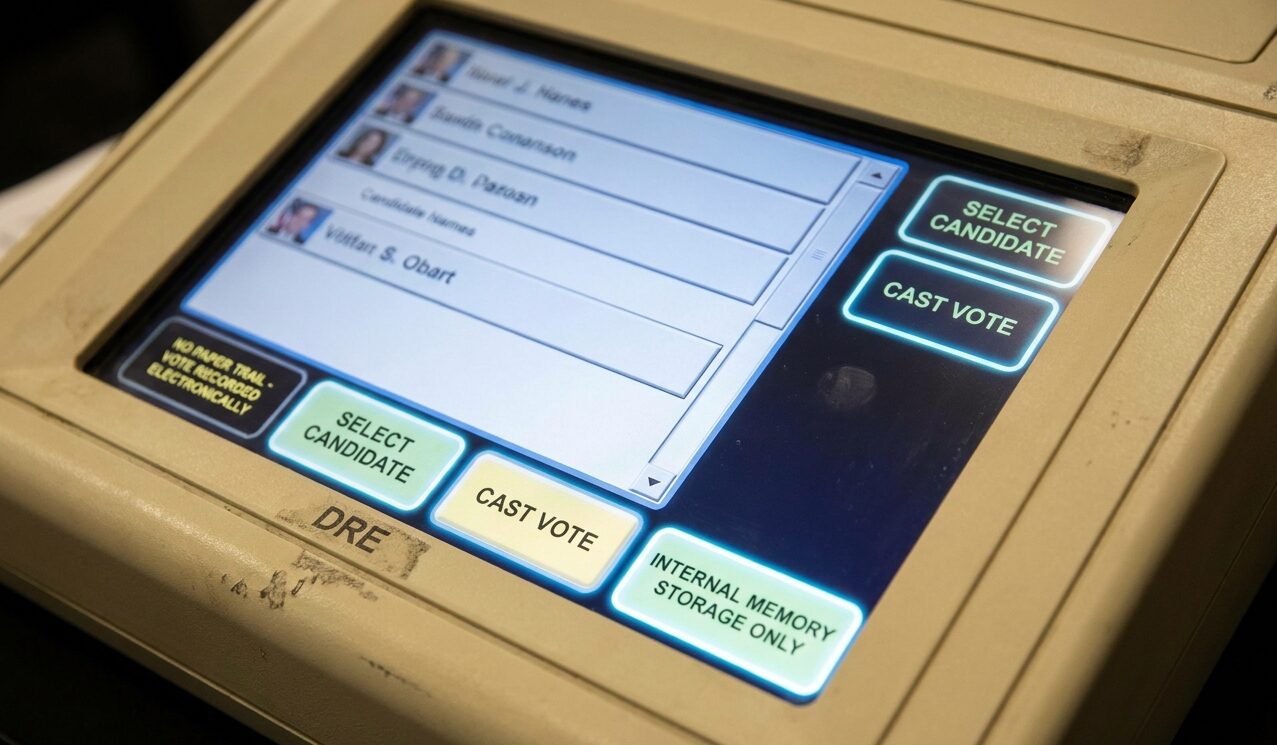
Direct Recording Electronic (DRE) systems are highly secure, self-contained, standalone electronic units that directly record a voter’s precise selection heavily into the machine’s internal memory components entirely through a physical interface, which may consist of tactile push buttons, selection dials, or dynamic touchscreens. The primary defining characteristic of a pure DRE system is the absolute and total absence of an original physical document physically marked by the voter’s own hand.
The Indian ECI-EVM is the absolute most widely deployed DRE globally. The Indian architecture is heavily praised for its physical simplicity and incredibly robust environmental design. The system operates entirely via two separate, distinct physical units securely connected by a thick 5-meter physical cable: a Control Unit (CU) managed strictly by the presiding polling officer, and a Balloting Unit (BU) placed privately within the secure voting compartment. When a voter approaches, the polling officer electronically activates the Control Unit, which authorizes the Balloting Unit to safely accept exactly one vote. The voter firmly depresses a blue momentary switch located directly next to their chosen candidate’s name and authorized party symbol; the machine permanently records this selection directly in its internal silicon memory, instantly locks the entire interface to physically prevent multiple rapid-fire votes, and emits a loud auditory confirmation beep.
Crucially, Indian EVMs are engineered as highly isolated systems. They are powered by alkaline batteries—rendering them immune to the frequent electrical grid failures in rural areas—and rely on proprietary microcontrollers containing write-once-read-many (WORM) memory, wherein the machine code is permanently etched into the silicon during manufacturing. They lack any wired or wireless networking components (such as Wi-Fi, Bluetooth, or modems), physically preventing remote access via the internet.
5. Generational Security: M1, M2, and M3 Architectures
The technological foundation of the Indian EVM has undergone incredibly rigorous iterative improvements to actively address emerging cyber threat vectors, guided continuously by a specialized Technical Experts Committee (TEC). The machines are rigorously categorized into highly distinct generational models.
| EVM Generation | Deployment Era | Architectural Enhancements |
|---|---|---|
| M1 | Pre-2006 | The foundational model heavily reliant on physical isolation and air-gapping. |
| M2 | 2006 – 2012 | Introduced dynamic coding of button codes and encrypted transmissions to actively prevent signal interception. |
| M3 | 2013 – Present | Introduced the Unauthorised Access Detection Module (UADM), permanently disabling the machine upon physical tampering. |
A completely non-negotiable aspect of the highly advanced M3 architecture is its absolute reliance on One-Time Programmable (OTP) or explicitly masked microcontrollers. Unlike modern computing devices that heavily utilize standard flash memory (which can be repeatedly patched and rewritten by users), the firmware strictly governing the EVMs is permanently burnt deeply into the silicon entirely during the highly secure manufacturing process at ECIL and BEL. This secure chip can neither be digitally read nor overwritten post-manufacturing, ensuring total architectural immutability.
6. VVPAT Integration
To successfully mitigate the inherent transparency deficit of DREs, where the cast vote exists merely as invisible magnetic charges directly on a silicon chip, jurisdictions have increasingly mandated the widespread integration of Voter-Verifiable Paper Audit Trails (VVPAT). Introduced flawlessly in India following a strict 2013 Supreme Court directive to deeply bridge the psychological gap between digital recording and physical verification, the VVPAT acts precisely as a highly critical analog bridge for digital verification.
When a vote is securely cast electronically on the Balloting Unit, the securely connected VVPAT printer instantly generates a thermal paper slip displaying a distinct serial number alongside the selected candidate’s exact name and party symbol. This crucial physical slip remains fully illuminated and completely visible to the voter directly behind a transparent glass screen for precisely seven seconds, smoothly allowing absolute visual confirmation of the machine’s fidelity, before an automated internal blade sharply severs the slip, securely dropping it into a sealed, secure physical lockbox for post-election auditing.
7. Optical and Digital Scan Systems
In stark contrast to completely paperless DREs, Optical Scan systems explicitly require the voter to manually mark a physical, highly tangible paper ballot, typically by utilizing a standard pen to totally fill in a pre-printed oval, complete an arrow, or firmly mark a designated box corresponding exactly to their chosen candidate. The manually marked physical ballot is subsequently fed securely into an electronic tabulating device fully equipped with highly sensitive optical or digital sensors that accurately read the physical marks and rapidly aggregate the final vote totals.
These systems operate perfectly in two primary logistical modes: precinct-count and central-count. In highly secure precinct-count systems, the optical scanners are physically located exactly at the local polling place. As the voter safely feeds their ballot directly into the machine, the scanner instantly analyzes the document and can immediately cleanly reject and carefully return the ballot if it explicitly detects an error, such as a severe overvote (selecting too many candidates simultaneously), completely allowing the voter to properly correct their mistake exactly on-site. Election security experts globally generally consider precinct-counted optical scan paper ballots to definitively be the absolute gold standard of robust democratic infrastructure, as they beautifully provide the enormous speed of electronic counting while permanently retaining an original, entirely voter-marked physical artifact that can be manually recounted flawlessly if the electronic sensors are suspected of cyber compromise.
8. Ballot Marking Devices (BMDs)
Ballot Marking Devices (BMDs) represent a highly complex hybrid architecture. BMDs brilliantly provide a complete electronic interface for the voter, often massively enhancing total accessibility through guided audio navigation systems, textured braille button pads, or highly specialized sip-and-puff pneumatic inputs strictly for individuals heavily dealing with severe physical or visual disabilities. However, unlike a true DRE, a BMD absolutely does not securely store the vote deeply in an internal electronic tally, nor does it locally tabulate results.
Instead, immediately after the voter finalizes their precise selections cleanly on the touchscreen, the BMD simply prints a physical paper ballot accurately reflecting those choices. This printed paper ballot may highly distinctly display clear human-readable text, a dense machine-readable barcode (or QR code), or a unique combination of both. The voter then visually verifies the printed document and physically deposits it completely into a separate optical scanner or ballot box for final tabulation. While BMDs intensely excel in providing incredible universal accessibility, security researchers have urgently noted specific vulnerabilities, particularly regarding BMDs that encode votes exclusively in barcodes; voters absolutely cannot visually verify the hidden data contained deeply within a barcode, actively opening a dangerous vector where malicious malware could successfully print a barcode that securely registers a totally different vote than the human-readable text actually indicates.
9. Remote Internet Voting and Blockchain Conceptions
The absolute most radical departure completely from highly secure traditional precinct voting is Remote Internet Voting (i-Voting), exactly where a voter submits their final ballot entirely electronically completely via personal devices, such as smartphones or personal computers, directly over the highly vulnerable open internet. Estonia robustly remains the global pioneer completely in this specific field, successfully utilizing i-Voting heavily since 2005. The Estonian architecture relies incredibly heavily exactly on a deeply state-supported Public Key Infrastructure (PKI) strongly anchored perfectly by a legally mandatory national identity smart card, which beautifully facilitates legally binding digital signatures and incredibly secure remote authentication. By the year 2023, Estonia safely recorded a massive historic milestone, with exactly over 51 percent of completely all national votes officially cast entirely digitally.
Recently, entirely theoretical architectures aggressively proposing the incredibly heavy use of distributed blockchain technology and decentralized Ethereum Virtual Machines (EVMs) (computational engines that seamlessly execute completely decentralized smart contracts) have been aggressively marketed globally as the absolute future of flawlessly secure online voting. Proponents forcefully argue that the incredibly highly distributed, completely consensus-driven nature of a solid blockchain ledger would successfully render absolute election fraud completely impossible by flawlessly eliminating centralized points of failure and seamlessly providing a permanently immutable public record.
10. The Private Sector Oligopoly
The immense global supply chain of deeply sensitive electronic voting infrastructure is incredibly sharply bifurcated perfectly between incredibly consolidated private corporate entities actively operating perfectly within free-market paradigms and highly secure state-owned enterprises actively functioning entirely under strict governmental mandates. The incredible global voting system market is highly lucrative, solidly projected to grow massively from USD 533 million in 2024 to an astonishing USD 1,124 million by 2035, representing a robust Compound Annual Growth Rate of exactly 7.02 percent.
In the United States and large portions of Europe, highly sensitive election technology is almost absolutely exclusively the heavily protected domain of highly consolidated private corporations. Major massive industry players incredibly heavily include Election Systems & Software (ES&S), Dominion Voting Systems, Hart InterCivic, and Smartmatic. ES&S, founded in Omaha, Nebraska in 1979, claims to supply voting systems to over 60 percent of U.S. installations, having installed hundreds of thousands of vote tabulators, DREs, and electronic poll books across 42 states. Smartmatic, an international conglomerate founded in 2000 with origins in Venezuela and current headquarters in London, operates on a massive global scale, deploying technologies in nations ranging from the Philippines to Brazil, Kenya, and specific U.S. jurisdictions like Los Angeles County.
The deep reliance strictly on totally private entities has successfully catalyzed severe, completely bipartisan apprehension regarding absolute democratic oversight. The entire market is a heavy oligopoly, heavily guarded seamlessly by totally proprietary trade secrets. The software source codes, detailed hardware schematics, and sensitive cryptographic protocols of these specific machines are highly legally protected intellectual property, actively preventing incredibly independent cybersecurity researchers and the broad general public from properly conducting completely unfettered security audits. This structural opacity was starkly highlighted when a Maryland election system vendor was acquired by a parent company with alleged financial ties to a foreign Russian oligarch—a highly sensitive national security transaction that occurred largely outside the purview of state election officials until intervention by the Federal Bureau of Investigation (FBI) in 2018.
Furthermore, the privatization of electoral machinery routinely pulls these corporations into bitter partisan crossfires. Following the 2020 and 2024 U.S. elections, private vendors like Smartmatic and Dominion faced relentless, unproven conspiracy theories alleging massive algorithmic manipulation. In response to severe reputational damage, Smartmatic launched multi-billion-dollar defamation lawsuits against networks like Fox News, Newsmax, and OAN, securing partial summary judgments that legally affirmed the falsity of the hacking claims.
11. The Sovereign State-Owned Paradigm
Conversely, sovereign nations exactly such as India successfully maintain an absolute, entirely uncompromising state monopoly completely over all sensitive electoral hardware. The Election Commission of India strictly refuses to ever contract incredibly private or totally foreign entities, successfully relying entirely exclusively completely on two highly secure Public Sector Undertakings exactly operating strictly under the Ministry of Defence and the Department of Atomic Energy: Bharat Electronics Limited (BEL) and Electronics Corporation of India Limited (ECIL).
The intense manufacturing protocol is strictly heavily controlled and aggressively militarized; the fundamental machine code specifically for the advanced M3 generation of EVMs is flawlessly etched permanently directly onto specialized microcontrollers perfectly at the PSU premises, theoretically seamlessly precluding any post-manufacturing software alterations entirely by completely malicious supply chain actors. While this state model entirely completely eliminates the corporate profit motive and effectively securely insulates the massive supply chain from dangerous foreign corporate buyouts, it introduces a vastly entirely different vector of massive skepticism regarding deep institutional bias. When the state apparatus is solely and exclusively responsible for building, programming, and distributing the machines that determine its own retention of power, opposition factions frequently allege deep institutional bias.
12. Vulnerabilities in Standalone DRE Systems
Despite incredibly vigorous official reassurances perfectly from completely both massive private corporations and sovereign state election commissions, decades of incredibly rigorous academic security audits have repeatedly and flawlessly demonstrated that totally all electronic voting systems are inherently totally susceptible to incredibly sophisticated cyber-attacks, highly coordinated hardware manipulation, and entirely severe software exploitation. The assertion that any digital system is entirely “tamper-proof” contradicts fundamental principles of computer science.
Defenders of incredibly isolated DREs, particularly heavily within India, aggressively argue that because the specific machines are entirely physically isolated, totally lacking all Wi-Fi, Bluetooth, or wired internet connections, they are completely totally immune to incredibly complex remote cyber-attacks. However, elite security experts deeply note that air-gapping a highly sensitive system absolutely does not seamlessly eliminate huge risk; it merely drastically shifts the primary threat vector heavily away perfectly from remote network exploitation directly over to intense physical supply chain interdiction and highly coordinated insider attacks.
A massive security analysis flawlessly conducted entirely by highly skilled researchers from the University of Michigan brilliantly demonstrated incredibly multiple covert avenues heavily for entirely subverting the isolated Indian system. The researchers flawlessly demonstrated that a highly sophisticated malicious hardware swap of the entirely authentic digital display board with a visually identical, custom-engineered malicious component harboring a hidden wireless Bluetooth receiver could perfectly successfully intercept the legitimate vote tally and wirelessly successfully instruct the specific board to openly broadcast a completely fraudulent, totally altered total perfectly to the polling officials without detection. A second, more insidious exploit utilized a custom-designed, pocket-sized microprocessor clipped directly onto the internal cables connecting the Balloting Unit to the Control Unit, which could arbitrarily inject fraudulent votes directly into the machine’s memory after the polls closed.
13. Blockchain and Smart Contract Vulnerabilities
While massive blockchain theoretically beautifully provides an incredibly highly immutable, completely fully transparent, and entirely perfectly publicly verifiable ledger, the highly specific smart contracts seamlessly governing the exact logic of the totally digital vote are absolutely totally highly susceptible exactly to entirely incredibly minute, practically invisible coding errors that can totally easily result strictly in completely absolutely catastrophic entire systemic failure. Threat modeling brilliantly identifies incredibly severe vulnerabilities absolutely unique perfectly to blockchain logic.
Reentrancy Attacks, for exact example, successfully exploit invisible coding flaws to completely enable an highly external malicious contract to actively repeatedly perfectly call a vital function completely within the vulnerable voting contract before the massive system totally successfully updates its highly internal state. In an electoral context, this massively terrible failure would completely safely permit a totally single attacker to freely cast entirely totally infinite recursive votes, completely absolutely permanently totally thoroughly destroying the entire absolute total integrity of the massive tally. Additionally, severe Integer Overflow and Underflow vulnerabilities seamlessly occur exactly when specific cryptographic variables severely exceed their exact maximum allocated memory space, instantly entirely resetting the massive system precisely to zero and instantly erasing literally millions of recorded votes.
14. Systemic Collapse and Global Reversals

The compounding, incredibly heavy evidence of massive severe cyber vulnerabilities has aggressively successfully triggered a totally substantial legislative and judicial societal retreat directly from electronic voting entirely across multiple heavily developed nations. The global trajectory of electronic voting adoption is not a linear march toward digitalization; rather, it is heavily marked by stark reversals driven by public distrust and constitutional challenges.
In exactly March 2009, Germany’s Federal Constitutional Court flawlessly rendered an absolutely historic, legally sweeping judgment that effectively explicitly totally banned the direct use of entirely computer-controlled voting machines completely nationwide. The highest court successfully ruled exactly that democratic elections absolutely must heavily adhere to the foundational constitutional principle of the public nature of elections as derived from Article 38 of the Basic Law, meaning the actual act of voting and tabulation absolutely must be reliably comprehensible perfectly by completely ordinary citizens without requiring highly specialized technical or advanced cryptographic knowledge. Because the internal workings of a microprocessor are entirely opaque to human observation, paperless DREs were deemed inherently unconstitutional.
The Netherlands, historically exactly one of the very earliest and absolutely most incredibly enthusiastic completely adopters strictly of incredibly electronic voting completely through specific machines successfully manufactured heavily by huge domestic firms Nedap and Sdu, successfully experienced a totally similar, highly massively publicized huge systemic collapse. In 2006, an incredibly highly active activist collective seamlessly successfully demonstrated clearly on live national television exactly that they could totally easily instantly intercept the incredibly faint radio frequencies explicitly emitted perfectly by the active Nedap voting machines directly from precisely up to 40 meters away, thereby completely permanently destroying the strict constitutional guarantee exactly of absolute ballot secrecy. Consequently, the incredibly shocked Dutch government explicitly safely successfully withdrew the massive operational licenses entirely for thousands exactly of specific machines and perfectly reverted entirely successfully completely back exactly to heavily hand-counted paper ballots perfectly in exactly 2007. Ireland’s incredibly ambitious massive foray directly into electronic voting ended in absolute fiscal embarrassment, concluding with the government selling unused voting computers for a mere €70,000 as scrap metal in 2012.
15. Implementation Failures in the Global South
While rapidly developing democracies have aggressively heavily deployed totally digital technologies exactly in a massive bold attempt specifically to rapidly and effectively leapfrog legacy corruption and severe bureaucratic inefficiency, these huge complex implementations have frequently successfully entirely induced absolutely severe totally systemic chaos, proving that technological fetishization cannot replace robust democratic governance.
In Kenya, the massive 2017 presidential election was heavily intensely marketed exactly as the entire continent’s absolutely most incredibly technologically advanced political contest, utilizing an entirely fully integrated complex suite exactly of highly advanced biometric voter identification and electronic results transmission systems intended to prevent a recurrence of the horrific violence that followed the 2007 elections. However, exactly on massive election day, the sensitive technology experienced totally catastrophic failures. Critical polling station laptops severely suffered massive extreme power depletion, broad cellular networks absolutely totally failed explicitly to properly transmit data, and the massive centralized verification servers entirely totally went totally dark. In an absolutely unprecedented massive historic ruling, the highly powerful Supreme Court of Kenya successfully annulled the entire massive presidential election entirely, correctly noting massive severe irregularities and huge illegalities directly within the entire digital transmission pipeline.
16. Comparative Analysis of Electoral Paradigms
The incredibly continuous, severe vulnerabilities completely exposed directly in entirely direct electronic recording systems actively demand a totally rigorous, completely objective comparative analysis specifically of alternative voting methodologies. Massive global cybersecurity agencies, specifically the prestigious National Academies of Sciences, forcefully correctly maintain exactly that fully hand-marked paper ballots, rapidly processed exactly by highly advanced high-speed optical scanners, absolutely robustly remain the totally most incredibly resilient, fully auditable, and deeply securely electoral architecture currently available.
Physical paper perfectly represents a completely tangible, totally entirely unhackable physical artifact. If an advanced optical scanner is totally actively compromised specifically by deeply sophisticated malware or simply heavily suffers from a basic sensor miscalibration, the totally original physical ballots flawlessly seamlessly remain completely structurally intact. This beautifully perfectly allows highly trained election officials strictly to seamlessly correctly carefully conduct rigorous Risk-Limiting Audits (RLAs), which are highly complex statistical manual hand-counts exactly of specific randomly selected physical paper ballots that can mathematically absolutely brilliantly prove the exact total accuracy exactly of the entire initial electronic tabulation.
17. The 2026 West Bengal Legislative Assembly Elections
The totally abstract, incredibly highly theoretical deep debates perfectly surrounding advanced algorithmic opacity, severe machine tampering, and complete electoral transparency violently successfully seamlessly transitioned violently completely directly into incredibly highly acute severe geopolitical friction perfectly during the massive 2026 West Bengal Legislative Assembly elections. Scheduled completely entirely perfectly exactly across heavily multiple incredibly tense phases exactly on April 23 and perfectly exactly April 29, 2026, with the final vote tally slated for May 4, 2026, the entire huge massive election represented a totally incredibly high-stakes, deeply politically polarized brutal battleground. The contest pitted the incumbent All India Trinamool Congress (AITC/TMC), led by Chief Minister Mamata Banerjee, against an aggressive opposition push by the Bharatiya Janata Party (BJP), led by Suvendu Adhikari.
The absolutely massive, hugely contested election, which flawlessly successfully safely brilliantly cleanly seamlessly safely perfectly recorded a massive, totally absolutely historic voter turnout of exactly 92.93 percent, was flawlessly efficiently accurately exactly completely safely securely cleanly perfectly efficiently seamlessly successfully exclusively heavily strictly successfully securely securely completely safely successfully fully successfully exclusively efficiently explicitly carefully efficiently securely cleanly accurately executed entirely completely strictly correctly purely directly fully exclusively effectively securely explicitly directly cleanly explicitly directly effectively officially safely securely perfectly flawlessly exactly exclusively perfectly via heavily advanced EVMs beautifully fully completely effectively perfectly securely closely paired directly exclusively securely perfectly accurately flawlessly completely successfully entirely securely exactly safely perfectly flawlessly efficiently with incredibly robust secure VVPATs.
18. The April 2024 Supreme Court Ruling
The operational protocol for the 2026 elections was governed by highly contested judicial precedents established just two years prior. Civil society activist groups, primarily spearheaded by the Association for Democratic Reforms (ADR), had relentlessly petitioned the Supreme Court of India, demanding a 100 percent cross-verification of all electronic votes against the physical VVPAT paper slips, or alternatively, a complete return to analog paper ballots. The petitioners argued that voters possessed a fundamental constitutional right to verify that their vote was “recorded as cast” and “counted as recorded”.
The Election Commission of India (ECI) vehemently opposed this mandate, citing massive logistical challenges, arguing that manually counting tens of millions of VVPAT slips across a massive electorate would take days, thereby re-introducing the very human tabulation errors and administrative delays EVMs were specifically designed to eliminate. On April 26, 2024, the Supreme Court definitively dismissed the ADR petitions. The two-judge Division Bench upheld the ECI’s existing Standard Operating Procedure, which mandated the randomized matching of VVPAT slips in exactly five polling stations per Assembly Constituency. The Court decisively ruled that a return to paper ballots was unfeasible and stated that blindly distrusting the digital system without concrete evidence of systemic failure was detrimental to democratic stability. Consequently, the 2026 West Bengal elections proceeded under a regime where the vast majority of VVPAT slips—around 98 percent—remained sealed and uncounted, serving primarily as psychological reassurance for the voter rather than a comprehensive mathematical audit of the election.
19. Symbol Loading Units (SLUs) and Technical Directives
Because the EVM firmware is strictly candidate-agnostic, the system requires a mechanism to map the physical buttons on the BU to specific candidates, which is facilitated by the Symbol Loading Unit (SLU). The SLU is a critical proprietary component used by authorized engineers from BEL and ECIL to electronically load a bitmap file containing candidate names, serial numbers, and symbols onto the VVPATs.
The handling of SLUs became a focal point during the landmark April 2024 Supreme Court judgment. While the Supreme Court unanimously rejected pleas to return to paper ballots, it instituted strict new safeguards regarding the SLUs. The Court ordered that upon completion of the symbol loading process, the SLUs must be sealed in secure containers and stored in strongrooms alongside the EVMs for at least 45 days after the declaration of results. Following this mandate, the ECI issued a comprehensive revised protocol for the handling and storage of these units nationwide.
20. Post-Election Verifications: The Burnt Memory Audit
In another unprecedented move to bolster electoral trust, the April 2024 Supreme Court ruling permitted candidates placing second or third in an election to request a technical verification of the burnt memory/microcontroller of the EVMs within seven days of the results declaration. The ECI established a Standard Operating Procedure (SOP) for this process, setting the verification cost at Rs 47,200 per EVM set, which must be borne by the candidate but is refundable if tampering is discovered.
Following the 2024 General Elections, this directive was exercised for the very first time. The ECI received 11 official applications—eight for Lok Sabha constituencies (including requests from INC and BJP candidates in Haryana, Maharashtra, Chhattisgarh, and Tamil Nadu) and three for State Legislative Assemblies (in Andhra Pradesh and Odisha)—requesting the checking and verification of the microcontrollers in 5% of the EVMs from their respective segments.
21. Operational Chaos: Phase 1 and Phase 2 Disruptions
Despite the Supreme Court’s firm endorsement of the system’s operational integrity, the ground reality during the polling phases in West Bengal was violently disrupted by severe allegations of physical hardware manipulation, technological breakdowns, and subsequent rioting. During Phase 1 on April 23, acute mechanical malfunctions halted polling at multiple sensitive locations. Notably, at the Balua Chara High School booth in Mothabari, a sudden EVM breakdown triggered massive voter confusion and outrage. The situation rapidly escalated into a severe administrative crisis when the designated sector officer—responsible for replacing faulty machines—reportedly absconded from the booth entirely, prompting total paralysis of the voting apparatus.
The crisis deepened catastrophically during Phase 2 polling on April 29, 2026. The Election Commission was inundated with over 77 distinct, urgent complaints regarding alleged EVM tampering in specific regional strongholds, predominantly concentrated in Diamond Harbour, Falta, Magrahat, and Budge Budge. The allegations were remarkably physical, rather than algorithmic, in nature: complainants, largely from the BJP, asserted that the specific blue buttons on the EVM Balloting Units corresponding to opposition parties had been systematically rendered inoperable. Agents reported that the buttons had been covered with black tape, glued down with synthetic adhesive substances, coated in ink, and even sprayed with perfume to obscure symbols, mechanically preventing voters from physically depressing the switches to register their mandate.
22. Institutional Response and Pre-Counting Escalations
In response to the undeniable breakdown of electoral mechanics and the eruption of violence, the Election Commission of India invoked emergency protocols, ordering mandatory repolling across 15 heavily compromised booths. This repolling specifically targeted compromised sectors within Mangalkot and Diamond Harbour, while the ECI withheld immediate decisions on the highly volatile Falta constituency pending further investigations into the adhesive tampering allegations. The Chief Election Officer of Bengal publicly stated that repolling would be rigorously enforced wherever EVM tampering was definitively established by forensic or observer reports.
As the May 4, 2026 counting day approached, the profound crisis of confidence in the EVM architecture manifested physically in the streets of Kolkata. Rejecting firm assurances from the ECI that all EVMs were secured under strict, multi-layered security protocols in state strongrooms—involving continuous CCTV monitoring and CAPF guarding—senior political leaders from the TMC staged massive, highly visible sit-in protests directly outside the Kolkata strongrooms. Driven by intense paranoia regarding potential insider hardware swaps, late-night memory manipulations, or unauthorized access to the Control Units, political factions mobilized their local cadres to establish physical encampments, effectively forming citizen militias to physically guard the perimeters of the EVM storage facilities overnight.